
Investing in the Future: Climate-Conscious Energy Infrastructure and the Rise of Sustainable Urbanization
 Aime Summary
Smart Grids: The Backbone of Resilient Energy Systems
Smart grid technologies are at the forefront of modernizing energy infrastructure. By integrating digital monitoring, automation, and distributed energy resources, smart grids optimize energy distribution and reduce waste. According to a report by the U.S. Department of Energy's Office of Energy Efficiency and Renewable Energy, smart grid investments are projected to grow from $72.8 billion in 2025 to $165.5 billion by 2035, reflecting their critical role in enabling renewable energy integration and grid resilience. Cities like Amsterdam and Singapore are already leveraging smart grids to balance supply and demand in real time, reducing reliance on fossil fuels while enhancing reliability during extreme weather events.
AI and Energy Efficiency: A Dual-Edged Revolution
Artificial intelligence (AI) is both a consumer and an enabler of energy efficiency. While AI-driven data centers demand significant power, they also optimize energy systems through predictive analytics and automation. For instance, AI-powered building management systems can reduce energy consumption by up to 30% by dynamically adjusting heating, cooling, and lighting based on occupancy patterns. Meanwhile, AI is streamlining industrial processes, such as in steel manufacturing, where machine learning algorithms minimize energy waste and emissions. However, the energy demands of AI itself are prompting innovations in localized renewable generation and advanced cooling solutions, ensuring that its environmental footprint remains manageable. 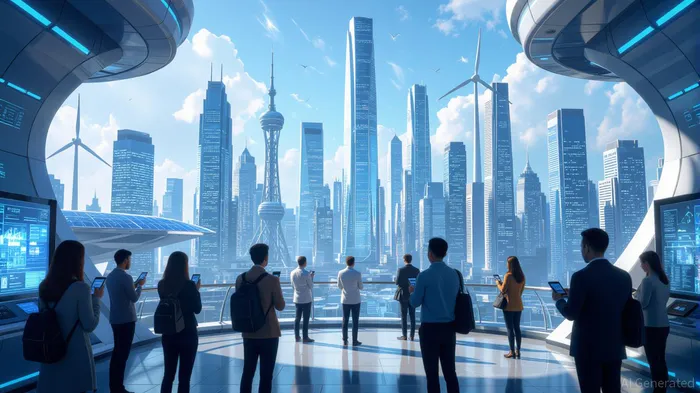
Renewable Energy and Storage: Scaling the Transition
Solar and wind energy are now the cheapest sources of electricity in most regions, with solar capacity expected to double by 2025. Coupled with advancements in energy storage-such as lithium-ion batteries and hydrogen fuel cells-these technologies are addressing intermittency challenges and enabling grid stability. The International Energy Agency reports that global investment in renewables, grids, and storage reached $2.2 trillion in 2025, with solar PV alone attracting $450 billion in funding. Emerging markets like India are leading the charge, with $101 billion in clean energy investments in 2025, though they still capture only 15% of global spending despite hosting 40% of the world's population.
Circular Economy and Sustainable Materials
Urbanization demands new construction, but traditional methods generate 30% of global CO₂ emissions. Circular economy practices are mitigating this by repurposing materials like reclaimed wood, recycled steel, and CO₂-infused concrete. Policies such as New York City's Local Law 97 and California's CALGreen standards are incentivizing these practices, mandating waste recycling and emissions reductions. Startups are also innovating in this space, developing carbon-negative building materials and modular designs that reduce construction waste.
Policy and Investment Trends: A Catalyst for Change
Government policies are accelerating the adoption of climate-conscious technologies. The U.S. Inflation Reduction Act and the EU Green Deal are creating regulatory frameworks that favor clean energyCETY--, offering tax credits and grants for renewable projects. Meanwhile, industrial policies are reshaping global supply chains, with countries prioritizing domestic manufacturing of solar panels and energy storage systems to secure energy independence. For investors, this means opportunities in both established markets (e.g., U.S. and EU) and emerging economies, where infrastructure gaps present high-growth potential.
Challenges and Opportunities
Despite progress, challenges persist. Grid expansion lags behind demand, requiring a 50% increase in advanced economies and over 150% in emerging markets by 2050. Supply chain bottlenecks and trade policies, such as U.S. FEOC rules, also complicate project financing. However, community-based projects like Denmark's Samsø Island-powered entirely by wind and solar-demonstrate the viability of decentralized, resilient systems. Investors who prioritize scalable, policy-aligned technologies and collaborate with local stakeholders are best positioned to navigate these complexities.
Conclusion
Climate-conscious energy infrastructure is no longer a niche sector but a cornerstone of sustainable urbanization. From AI-driven efficiency to circular economy innovations, the technologies reshaping cities today offer compelling returns for investors. As global spending on clean energy surpasses $3.3 trillion in 2025, the imperative to act is clear. For those who invest wisely, the future of energy is not just sustainable-it's profitable.

La combinación de la sabiduría tradicional en el comercio con las perspectivas más avanzadas sobre las criptomonedas.
Latest Articles
Stay ahead of the market.
Get curated U.S. market news, insights and key dates delivered to your inbox.
AInvest
PRO
AInvest
PRO



Comments
No comments yet