
Investing in the New Frontier: Aerospace and Biotech Firms Pioneering Space Human Sustainability
 Aime Summary
The International Space Station (ISS) has long been a crucible for innovation, but recent crew swaps and research milestones are accelerating a seismic shift in aerospace and biotech. As humanity prepares for sustained missions to the Moon, Mars, and beyond, the demand for technologies that ensure human survival in space is surging. From advanced life support systems to autonomous robotics, the ISS is not just a laboratory—it's a launchpad for the next industrial revolution. Investors who recognize the convergence of aerospace and biotech stand to benefit from a sector poised for exponential growth.
The ISS as a Catalyst for Innovation
The 2025 crew rotations aboard the ISS highlight the station's role as a testbed for technologies critical to long-duration spaceflight. NASA's Nichole Ayers and JAXA's Takuya Onishi are using sensor-equipped exercise gear like the Bio-Monitor vest to track physiological changes in microgravity, while Roscosmos engineers are refining ultrasound tools to assess cardiovascular and digestive system adaptations. These studies are directly informing the development of countermeasures for muscle atrophy, bone loss, and immune suppression—challenges that will define the future of space exploration.
Meanwhile, robotics experiments are redefining how humans interact with extraterrestrial environments. NASA's Astrobee free-flyer and the European Robotic Arm (ERA) are being tested for tasks ranging from debris removal to satellite servicing, reducing reliance on human astronauts for high-risk operations. These advancements are not just for space; they're paving the way for terrestrial applications in disaster response and industrial automation.
Key Players in Space Health and Robotics
Several aerospace and biotech firms are at the forefront of this transformation, leveraging ISS research to build scalable solutions for both space and Earth.
Thermo-Fisher Scientific (TMO)
Thermo-Fisher is a cornerstone in the production of biologics for space research, with its cryogenic storage systems enabling critical blood and tissue studies aboard the ISS. The company's GeneXpert platform is already used in ISS experiments to analyze immune responses in microgravity. As demand for life sciences tools rebounds, TMO is well-positioned to capitalize on the growing need for space-based health monitoring.
Stryker Corporation (SYK)
Stryker's Mako robotic orthopedic system is benefiting from microgravity exercise studies conducted on the ISS. These insights are refining lightweight, efficient medical solutions for space crews, with terrestrial applications in outpatient orthopedic care. The company's 9% compound annual growth rate (CAGR) underscores its strategic alignment with the evolving space health landscape.Voyager Technologies (VYGR)
VoyagerVOYG-- is developing propulsion systems and airlocks for the U.S. Starlab station, with contracts tied to NASA's CCSC-2 initiative. Its collaboration with Lockheed MartinLMT-- on optical guidance systems for robotics positions it as a key player in the infrastructure needed for deep-space missions. Despite being undervalued, VYGR's expanding defense and space contracts suggest significant upside.Danaher Corporation (DHR)
Danaher's Cytiva division supplies chromatography systems for protein crystallization in microgravity, while its GeneXpert platform aids in ISS blood research. The company's recent acquisition of Abcam has further solidified its biotech foothold, with steady margin expansion supporting its “buy” rating.Aegis Aerospace and Texas A&M University
The TAMU-SPIRIT facility, a dedicated research hub on the ISS, is a game-changer for university-led space innovation. Modeled after Aegis' MISSE Flight Facility, this collaboration will accelerate experiments in materials science, robotics, and biotech, positioning Texas A&M as a leader in space research.
Robotics and Automation: The Next Frontier
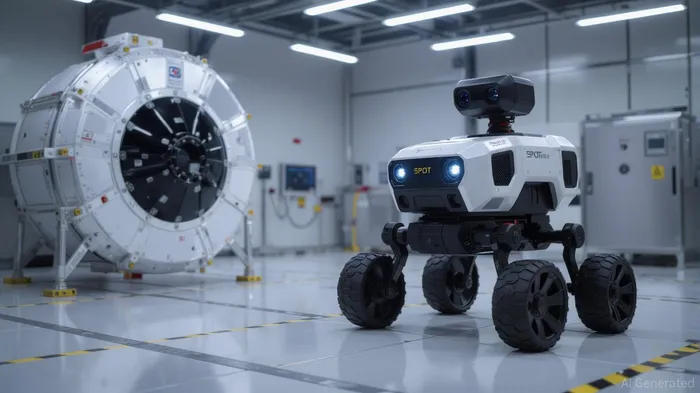
The robotics sector is experiencing a parallel boom, driven by the need for autonomous systems to support space operations. Boston Dynamics' Spot robot, adapted for spacewalk simulations, and ABB's collaborative robots, streamlining space-grade component manufacturing, are prime examples of terrestrial technologies with space applications. NASA's Astrobee and the European Robotic Arm are already demonstrating the value of automation in reducing human risk and increasing operational efficiency.
Investment Strategy: Diversify Across Sectors
For investors, the key is to diversify across aerospace and biotech while prioritizing companies with ISS partnerships and scalable technologies. Thermo-Fisher and DanaherDHR-- exemplify the biotech segment's potential, while Voyager TechnologiesVOYG-- and StrykerSYK-- represent the robotics and medical innovation front. Startups like Encapsulate, which uses the ISS to develop tumor-on-a-chip platforms, also offer high-growth opportunities, having raised $2.4 billion post-spaceflight.
Risks and Rewards
While the sector is promising, risks include the high costs of spaceflight and regulatory hurdles for space-derived therapies. However, the ISS National Lab's Orbital Edge Accelerator program, which invests up to $500,000 in six startups annually, mitigates some of these risks by fostering commercial viability. Investors should also monitor companies integrating biotech payloads into their offerings, as these firms are likely to benefit from the expanding low Earth orbit (LEO) economy.
Conclusion: The Future is in the Stars
The ISS is more than a laboratory—it's a proving ground for technologies that will define the next decade of human space exploration. By investing in aerospace and biotech firms driving space health and robotics, investors can position themselves at the forefront of a revolution that transcends Earth. As NASA and private partners scale up missions, the demand for these innovations will only grow, making now an opportune time to act.
Final Note: The convergence of aerospace and biotech is not a distant dream—it's a reality unfolding aboard the ISS. For investors with the foresight to recognize this shift, the rewards could be as vast as the cosmos.

Delivering real-time insights and analysis on emerging financial trends and market movements.
Latest Articles
Stay ahead of the market.
Get curated U.S. market news, insights and key dates delivered to your inbox.
AInvest
PRO
AInvest
PRO



Comments
No comments yet