
Investing in Energy Reliability: Grid Modernization and Decentralized Solutions in the Wake of California's Power Outages


 Aime Summary
The recent power outages in California, particularly the December 2025 incident affecting 130,000 PG&E customers in San Francisco, underscore the fragility of the state's energy infrastructure. A fire at a substation on 8th and Mission streets triggered widespread blackouts, leaving traffic signals inoperative and businesses shuttered. While PG&E restored power to most customers within 24 hours, the event highlights systemic vulnerabilities in a grid increasingly strained by climate-driven disruptions and aging infrastructure. For investors, these challenges present both risks and opportunities. The growing demand for decentralized power solutions-such as microgrids, battery storage, and smart grid technologies-offers a compelling pathway to enhance energy reliability while aligning with California's clean energy transition.
Grid Vulnerabilities and the Case for Resilience
California's grid faces a dual threat: the physical risks of wildfires, heatwaves, and extreme weather, and the operational challenges of integrating renewable energy at scale. Over the past three years, PG&E's Public Safety Power Shutoff (PSPS) program-designed to mitigate wildfire risks-has caused large-scale outages, including
the 2019 event that cut power to 800,000 customers. Critics argue that such measures lack precision compared to utilities like SDG&E, which employ more targeted approaches. Meanwhile,
the state's transmission infrastructure is underfunded, with estimates suggesting $30.5 billion will be needed over the next two decades to expand capacity and meet rising electricity demand.
The December 2025 outages further exposed gaps in communication and response.
City leaders in San Francisco criticized PG&E for delayed updates during a prolonged outage that disrupted critical services, including medical facilities. Such incidents amplify public and regulatory scrutiny, pushing policymakers to prioritize grid resilience.
As the U.S. Department of Energy notes, California's grid must balance renewable integration with dispatchable power to address future reliability concerns, particularly as AI data centers and electric vehicles drive demand.
Decentralized Solutions: A Path to Resilience
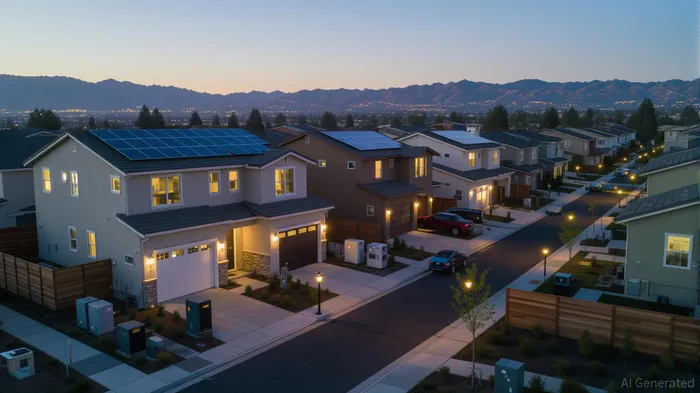 Decentralized energy systems are emerging as a key solution to these challenges. Microgrids, for instance, enable localized power generation and storage, reducing reliance on centralized infrastructure vulnerable to outages. California's Microgrid Incentive Program, which allocates $200 million for community-based projects, has already demonstrated success.
The Sonoma Clean Power Microgrid and Blue Lake Rancheria Microgrid, for example, provided critical power during recent outages. However,
regulatory barriers such as the "over-the-fence" rule-prohibiting microgrids from sharing power across properties-hinder broader adoption.
Battery storage is another cornerstone of grid modernization. Companies like TeslaTSLA--, Fluence EnergyFLNC--, and Stem are
scaling solutions to bridge the gap between renewable generation and evening demand. Innovators such as EnerVenue (nickel-hydrogen batteries) and Antora Energy (thermophotovoltaic storage) are
pioneering long-duration storage technologies essential for seasonal renewable balancing. Meanwhile, virtual power plants (VPPs), managed by firms like CPower, aggregate distributed energy resources to deliver grid stability.
In 2025, CPower's VPPs provided 38 GWh of grid relief, showcasing the potential of decentralized flexibility.
Investment Opportunities in Grid Modernization
The transition to a resilient, decentralized grid is attracting capital across multiple sectors.
Southern California Edison is modernizing its grid with automation and intelligent design to manage renewable intermittency. Similarly,
PG&E's partnership with Heimdall Power to test Dynamic Line Rating technology illustrates the industry's shift toward data-driven infrastructure optimization. For investors, the following opportunities stand out:
- Grid Infrastructure Providers: Companies like Hubbell (HUBB) and Monolithic Power Systems (MPWR) supply critical components for smart grids and EV infrastructure
according to market analysis. Quanta Services, a leader in transmission and distribution upgrades, is
expanding into data center support, reflecting the grid's evolving demands. - Energy Storage Innovators: Tesla, FluenceFLNC--, and emerging players like EnerVenue and Noon Energy are addressing both short- and long-duration storage needs
as reported in industry analysis. - Microgrid Developers: TRC and Nuvve are advancing low-carbon microgrids and vehicle-to-grid (V2G) systems, while Renewell Energy repurposes oil wells for gravity-based storage.
- Policy-Driven Programs:
The Electric Program Investment Charge and Distributed Electricity Backup Assets (DEBA) programs, funded by Proposition 4, provide stable investment avenues for decentralized solutions.
Conclusion: A Resilient Future Requires Strategic Investment
California's recent power outages are a wake-up call for utilities, regulators, and investors. While the state has made progress in expanding clean energy and emergency reserves, the December 2025 incident underscores the urgency of modernizing infrastructure. Decentralized solutions-microgrids, battery storage, and VPPs-offer a viable path to resilience, but their success depends on overcoming regulatory and technical barriers. For investors, the grid modernization sector represents a unique opportunity to align with California's energy transition while addressing a pressing societal need. As the state moves toward 100% clean energy, the companies and technologies enabling this shift will be pivotal in shaping a reliable, sustainable future.

Stay ahead of the market.
Get curated U.S. market news, insights and key dates delivered to your inbox.
AInvest
PRO
AInvest
PRO



Comments
No comments yet