
Investing in Education Tech and Workforce Development Sectors for Long-Term Growth
 Aime Summary
STEM Employment Growth and the Skills Gap
The U.S. STEM job market is projected to expand at a remarkable pace, with employment growing 1.9% annually from 2019 to 2024, outpacing non-STEM sectors by nearly double. By 2033, the Bureau of Labor Statistics forecasts a 10.4% increase in STEM jobs, compared to just 3.5% for non-STEM roles. This growth is fueled by industries such as software development (projected to grow 17% from 2023 to 2033) and construction, which added 2,000 jobs in July 2025 alone.
However, this expansion is shadowed by a looming skills gap. By 2025, the U.S. is expected to face a shortage of 2 million qualified workers for 3.5 million STEM-related jobs. This mismatch between demand and supply underscores the urgency for scalable solutions in education and training.
STEM Education and Workforce Alignment
The U.S. has made strides in producing STEM graduates, surpassing its national goal of 1 million additional STEM degrees between 2012 and 2022 by 16%, with 4.65 million degrees awarded. Notably, 52% of STEM workers lack a bachelor's degree, with 63% of this skilled technical workforce employed in middle-skill roles. This highlights the importance of vocational and associate-level programs in addressing immediate labor needs.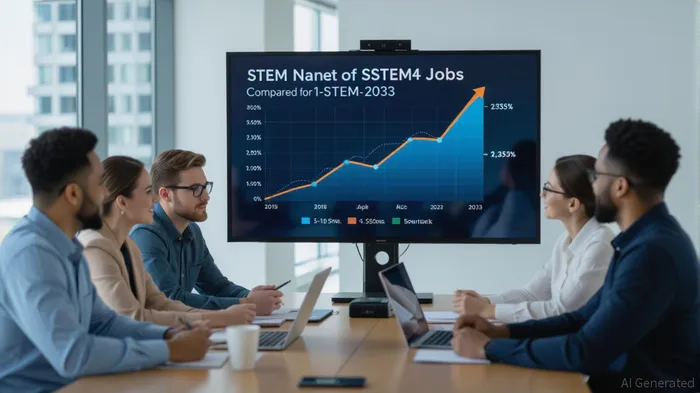
Despite these gains, challenges persist. Retention rates for STEM students have improved to 52%, but aligning curricula with evolving industry demands remains a priority. For instance, while women now earn 37% of STEM degrees (up from 32% in 2012), underrepresentation of Black and American Indian/Alaska Native students persists. Addressing these disparities is not only a social imperative but also a strategic opportunity for investors seeking to support inclusive growth.
The EdTech Revolution: Bridging Gaps with Innovation
Education technology is at the forefront of addressing these challenges. The global EdTech market, valued at $163.49 billion in 2024, is projected to grow at 13.3% annually, driven by AI-powered platforms and immersive technologies like VR/AR. These tools are particularly transformative in STEM fields, where they enable hands-on learning and simulate real-world problem-solving scenarios.
Government and institutional investments are accelerating this shift. The U.S. government has allocated $1.5 billion from 2023 to 2025 to support STEM EdTech initiatives, emphasizing partnerships between academia and industry. For example, South Carolina State University's new cybersecurity programs and North Carolina State University's $20 million bioengineering initiative exemplify how targeted funding can align education with labor market needs.
Workforce Development: Public-Private Synergies
Public-private partnerships are critical to scaling workforce development. The U.S. Economic Development Administration (EDA) has awarded $4.5 million in FY23 STEM Talent Challenge grants to 11 organizations, fostering regional talent pipelines. Similarly, the National Science Foundation's ITEST program supports K-12 STEM education through public-private collaborations, while initiatives like the YOU Belong in STEM program prioritize equity by allocating $185 million to the Education Innovation and Research Program.
Private sector players are also stepping up. Platforms like CourseraCOUR-- and Udacity offer flexible, skills-based learning tailored to STEM careers, while organizations like Global Services in Education (GSE) are establishing investment funds to scale technology-driven education solutions. These efforts reflect a growing recognition of STEM and EdTech as pillars of economic resilience.
Investment Opportunities and Strategic Considerations
For investors, the EdTech and workforce development sectors present a dual opportunity: addressing a $3.5 million job gap while capitalizing on a market growing at 13.3% annually. Key areas to consider include:
1. AI-Driven Learning Platforms: Tools that personalize education and upskill workers in high-demand fields like AI and cybersecurity.
- Middle-Skill STEM Training: Investments in community colleges and vocational programs to meet immediate labor needs.
- Equity-Focused Initiatives: Programs targeting underrepresented groups, which align with federal priorities and long-term demographic trends.
- Public-Private Partnerships: Collaborations that leverage government funding and industry expertise to scale solutions.
However, risks such as rapid technological obsolescence and regulatory shifts must be managed. Investors should prioritize adaptable platforms and programs with strong industry partnerships to mitigate these challenges.
Conclusion
The convergence of STEM demand, EdTech innovation, and workforce development represents a compelling investment thesis. As the U.S. races to fill 3.5 million STEM jobs by 2025, the need for scalable, equitable, and industry-aligned education solutions has never been greater. By targeting EdTech and workforce development, investors can not only generate financial returns but also contribute to a more resilient and inclusive economy.

Blending traditional trading wisdom with cutting-edge cryptocurrency insights.
Latest Articles
Stay ahead of the market.
Get curated U.S. market news, insights and key dates delivered to your inbox.




Comments
No comments yet