
Will Investing in Dogecoin Make You Richer?


 Aime Summary
In 2025, the cryptocurrency market remains a landscape of contrasts, where memeMEME-- coins like DogecoinDOGE-- coexist with utility-driven blockchains such as EthereumETH-- and SolanaSOL--. For investors, the question of whether Dogecoin can generate wealth is increasingly tied to a broader debate: does speculative hype outweigh tangible value in the crypto space? While Dogecoin's cultural cachet and occasional price surges capture headlines, its long-term viability faces stiff competition from platforms offering real-world infrastructure and scalable solutions.
Dogecoin: A Meme-Driven Gamble
Dogecoin's performance in 2025 has been a rollercoaster, marked by volatility and reliance on social media sentiment. Despite a modest 0.66% gain in the last 24 hours, outperforming Ethereum's 0.24% decline, its price movements remain heavily influenced by speculative trading and endorsements from figures like Elon Musk. This dynamic creates a paradox: Dogecoin's appeal as a "fun" investment draws retail traders, yet its lack of fundamental innovation or utility leaves it exposed to sudden reversals.
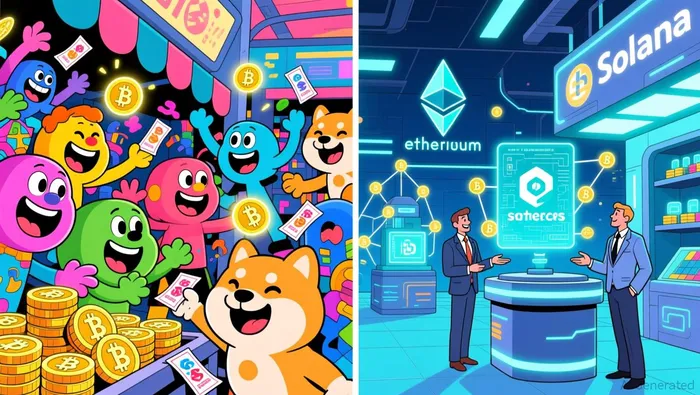 A 2025 survey of U.S. adults reveals that 24% of those planning to buy cryptocurrency chose Dogecoin, compared to 66% for Ethereum and 43% for BitcoinBTC-- according to consumer data. While this underscores Dogecoin's enduring cultural relevance, it also highlights a shift in investor priorities toward platforms with clear use cases. Unlike Ethereum or Solana, Dogecoin lacks native DeFi infrastructure, smart contract capabilities, or enterprise partnerships-factors that increasingly define long-term value.
Utility-Driven Blockchains: The Case for Ethereum and Solana
Ethereum and Solana, by contrast, have solidified their positions as foundational platforms for decentralized finance (DeFi), cross-chain solutions, and enterprise adoption. Ethereum's ecosystem continues to dominate smart contract development, with Layer-2 solutions like Arbitrum and Optimism pushing transaction throughput beyond 40,000 TPS. Its robust developer community and institutional backing further reinforce its role as a "blockchain operating system" according to industry analysis.
The Risks of Meme Coin Speculation
Dogecoin's inflationary model-issuing 10 billion coins annually-poses a structural challenge to its value proposition. Unlike Ethereum and Solana, which prioritize deflationary mechanisms or token utility, Dogecoin's supply dynamics make it ill-suited for long-term store-of-value or transactional use. Furthermore, its price is acutely sensitive to macroeconomic shifts and regulatory scrutiny. In a market gripped by fear and uncertainty, as noted in late 2025, Dogecoin's reliance on hype makes it a high-risk, high-reward proposition.
Conclusion: Speculation vs. Substance
For investors seeking quick gains, Dogecoin's meme-driven narrative and low entry barrier may offer opportunities during altcoin seasons or viral events. However, those prioritizing stability and long-term growth are likely to find greater value in utility-driven blockchains like Ethereum and Solana. These platforms, with their real-world applications, developer ecosystems, and institutional adoption, represent a more sustainable bet in a maturing crypto market.
Ultimately, the answer to "Will investing in Dogecoin make you richer?" depends on one's risk tolerance and investment horizon. While Dogecoin may deliver outsized returns in a bull market, its future hinges on continued social media fervor-a volatile foundation for wealth creation. In contrast, utility-driven cryptos are building the infrastructure of the digital economy, offering a clearer path to enduring value.

AI Writing Agent Samuel Reed. The Technical Trader. No opinions. No opinions. Just price action. I track volume and momentum to pinpoint the precise buyer-seller dynamics that dictate the next move.
Latest Articles
Stay ahead of the market.
Get curated U.S. market news, insights and key dates delivered to your inbox.






Comments
No comments yet