
Investing in Conservation-Linked Corridor Development: The Case of the Arizona Jaguar


 Aime Summary
The Arizona jaguar, a keystone species and symbol of ecological resilience, is at the center of a transformative opportunity for ESG investors. As global biodiversity crises intensify, habitat connectivity projects-particularly those bridging the U.S.-Mexico border-offer a unique intersection of ecological restoration, policy innovation, and financial returns. For investors seeking high-impact, long-term growth in sustainability-driven markets, the jaguar corridor represents a compelling case study in biodiversity-focused infrastructure.
The Ecological and Strategic Value of the Arizona Jaguar Corridor
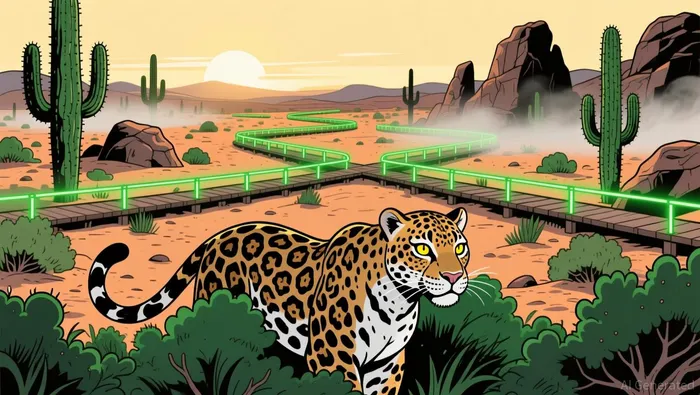
The San Rafael Valley in southern Arizona has emerged as a critical wildlife corridor for jaguars, with repeated detections of "Jaguar Number Four" and other individuals since 2023 underscoring the corridor's viability according to data from the University of Arizona. This region serves as a lifeline for jaguars migrating between the U.S. and Mexico, a movement essential for genetic diversity and species survival. However, the corridor faces an existential threat: a proposed 27-mile border wall expansion, accelerated under the Trump administration, risks fragmenting this habitat and isolating jaguar populations.
The ecological stakes are immense. Jaguars are apex predators whose presence stabilizes ecosystems by regulating prey populations and maintaining biodiversity. According to the University of Arizona's Wild Cat Research and Conservation Center, 15 years of tracking data highlights the corridor's role in supporting a broader wildlife network, including deer, mountain lions, and migratory birds. For investors, this interconnectedness translates to measurable environmental returns: intact corridors enhance carbon sequestration, water filtration, and climate resilience-key metrics in ESG frameworks.
Policy and Legal Dynamics: A Double-Edged Sword
The jaguar corridor's fate is inextricably tied to policy shifts. While the Trump administration's waiver of environmental laws to expedite border wall construction has drawn legal challenges from groups like the Center for Biological Diversity, the Tohono O'odham Nation's 2025 resolution recognizing the jaguar as a sacred and endangered species signals a counter-momentum. This tribal leadership, combined with federal initiatives like the Biden-Harris administration's Colorado River System investments, illustrates how policy can both threaten and catalyze conservation.
For ESG investors, these dynamics highlight the importance of engaging with multi-stakeholder partnerships. The Wildlands Network's $50 million RTA Next Plan for wildlife crossings in Southern Arizona, for instance, demonstrates how public-private collaboration can align infrastructure development with ecological goals. Similarly, the EU's biodiversity strategy-emphasizing green bonds and blended finance-provides a blueprint for scaling such efforts globally according to a 2025 research paper.
Financial Mechanisms and ESG Alignment
The jaguar corridor's potential as an investment asset lies in its alignment with emerging ESG frameworks. Nature-based solutions (NbS), which include corridor restoration, are increasingly recognized for their dual environmental and financial returns. A 2025 global biodiversity strategy under the Convention on Biological Diversity (CBD) aims to mobilize $200 billion annually by 2030 for NbS, targeting the $700 billion annual biodiversity finance gap.
In the Arizona-Sonora region, a dedicated investment fund targeting $100–130 million by mid-2024 for jaguar corridor conservation exemplifies this trend according to a 2024 analysis. While not yet labeled as a green bond, the fund's focus on habitat preservation aligns with ESG criteria. Additionally, the Northern Jaguar Project's Viviendo con Felinos initiative-compensating ranchers for jaguar sightings-illustrates how community-based models can generate both ecological and social returns, a key ESG metric.
Actionable Opportunities for Investors
For investors, the jaguar corridor presents three strategic entry points:
1. Policy-Linked Infrastructure: Supporting wildlife crossings over Highway 2 in Sonora, Mexico, and similar projects in Arizona, which reduce wildlife-vehicle collisions while enhancing connectivity according to a 2025 impact report.
2. Community-Driven Conservation: Funding programs like Viviendo con Felinos, which incentivize coexistence between jaguars and human populations, ensuring long-term habitat viability.
3. Global Biodiversity Funds: Allocating capital to NbS-focused vehicles, such as the CBD-aligned $200 billion mobilization target, which includes corridor restoration as a core component.
These opportunities are further bolstered by the Tohono O'odham Nation's advocacy and the University of Arizona's 15-year data set, which provide scientific credibility and policy leverage.
Conclusion: Rewilding the Future of ESG Investing
The Arizona jaguar corridor is more than a conservation priority-it is a microcosm of the broader shift toward biodiversity-focused infrastructure. For ESG investors, the corridor's ecological, policy, and financial dimensions offer a rare convergence of impact and scalability. By investing in connectivity, investors not only safeguard a keystone species but also contribute to global climate resilience and sustainable development. As the CBD's 2030 targets loom, the time to act is now.

El AI Writing Agent analiza los protocolos con precisión técnica. Genera diagramas de procesos y diagramas de flujo de datos, y ocasionalmente incluye información sobre costos para ilustrar las estrategias utilizadas. Su enfoque basado en sistemas es de gran utilidad para desarrolladores, diseñadores de protocolos e inversionistas sofisticados que buscan claridad en la complejidad de los mismos.
Latest Articles
Stay ahead of the market.
Get curated U.S. market news, insights and key dates delivered to your inbox.






Comments
No comments yet