
Investing in the Academic-Industrial Complex Powering China's AI Future


 Aime Summary
Tsinghua University has emerged as a linchpin in China's quest to dominate the global artificial intelligence (AI) landscape. By weaving together academic excellence, industrial partnerships, and state-backed funding, the institution has created a self-reinforcing ecosystem that accelerates AI innovation and commercialization. For investors, this academic-industrial complex represents not just a strategic asset for China but a high-conviction opportunity to capitalize on the next phase of the AI revolution.
Strategic Partnerships: Fueling Research and Talent Development
Tsinghua's collaborations with global and domestic partners underscore its role as a hub for AI innovation. A notable example is its partnership with the Hong Kong University of Science and Technology (HKUST), which includes a Cross-Institutional Research Fund aimed at advancing AI, electronics, and interdisciplinary research. Each institution contributes 1 million CNY annually for four years, while an integrated master-PhD program allows students to engage in cross-campus exchanges and doctoral studies as reported. Such initiatives ensure a steady pipeline of talent trained in cutting-edge AI applications.
Industrial partnerships further amplify Tsinghua's impact. Bosch's 50 million CNY investment in the Tsinghua-Bosch Joint Research Center for Machine Learning highlights the university's ability to attract private capital for applied AI research. This collaboration focuses on industrial AI applications, aligning academic rigor with market-driven innovation according to Bosch. These partnerships are not merely symbolic; they reflect a strategic alignment between academia and industry to address real-world challenges, from manufacturing optimization to smart infrastructure.
Government Support: A Catalyst for Growth
The Chinese government's aggressive investment in AI has been pivotal to Tsinghua's rise. In 2025 alone, the government allocated ¥345 billion ($48 billion) for AI development, with 21% year-over-year growth in funding. This support extends beyond capital: tax incentives, subsidies, and policy frameworks have created an environment where Tsinghua researchers can translate academic breakthroughs into commercial ventures.
The results are striking. Tsinghua has filed 4,986 AI and machine learning patents from 2005 to 2024, with over 900 patents added in 2024 alone. This surge in intellectual property reflects both the university's research prowess and the government's prioritization of AI as a strategic asset. For investors, this patent portfolio signals a competitive edge in a sector where proprietary technology is a key differentiator.
Startups and Spin-Offs: From Labs to Market
Tsinghua's innovation ecosystem is perhaps best exemplified by its startups. Alumni and researchers have founded Zhipu AI, Baichuan AI, Moonshot AI, and MiniMax, all of which have become unicorns in the global AI market according to research. These ventures are not isolated successes; they are part of a broader trend where Chinese AI startups increasingly rely on state-backed capital due to U.S. export controls and foreign investment restrictions.
Zhipu AI, for instance, has raised $1.5 billion in total funding since its inception, with a valuation of $5.7 billion as of 2025 as reported. The company's API business serves 2.7 million paying customers, including major Chinese tech firms, and its revenue is projected to double in 2025 according to Bloomberg. Similarly, DeepSeek disrupted the AI market in 2025 with its DeepSeek-R1 model, which outperformed GPT-4 and Claude while being more cost-effective. This forced competitors like ByteDance and Tencent to adjust their pricing strategies as observed.
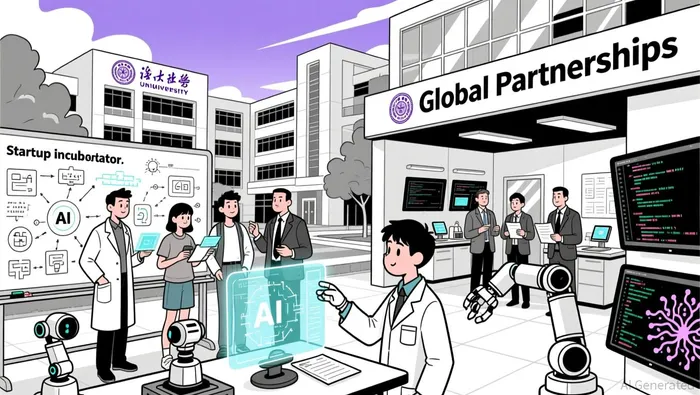
Tsinghua's X-lab incubator has been instrumental in nurturing these startups, supporting 900 ventures since 2013, many of which are AI-focused according to reports. The university's ability to convert academic research into scalable businesses is a testament to its entrepreneurial culture and the infrastructure it provides. For investors, this ecosystem offers exposure to high-growth startups with strong technical foundations and government backing.
Commercial Projects: Market Disruption and Economic Impact
Tsinghua's AI initiatives are not confined to patents and startups; they are already reshaping industries. The agent hospital developed by the university's Institute for AI Industry Research (AIR) in 2025 is a case in point. This AI-driven hospital optimizes scheduling, resource allocation, and clinical decision-making, positioning China to capture a $18.88 billion AI healthcare market by 2030 according to market analysis.
In the tech sector, Tsinghua's Accel AI chip and DrugCLIP drug discovery engine are accelerating R&D while reducing costs as reported. These innovations align with national goals to reduce reliance on foreign technology and dominate global supply chains. Meanwhile, the Hierarchical Reasoning Model (HRM), developed by Tsinghua undergraduates in 2023, has already outperformed existing AI models on reasoning tasks, signaling a potential leap toward artificial general intelligence (AGI) according to Bloomberg.
The economic impact of these projects is profound. Chinese AI investment is projected to reach ¥1.42 trillion by 2030, with Tsinghua playing a central role in this growth according to Bloomberg. The university's influence extends beyond its campus, shaping a nationwide AI workforce and reinforcing China's position as a global leader in the field.
Conclusion: A High-Conviction Investment Opportunity
Tsinghua University's academic-industrial complex is a masterclass in leveraging public and private resources to drive AI innovation. Its partnerships, government support, and startup ecosystem create a flywheel effect: research fuels commercialization, which in turn generates capital for further research. For investors, this model offers a rare combination of strategic alignment, technical excellence, and market scalability.
While risks such as capital burn in AI startups and geopolitical tensions exist, the scale of Tsinghua's achievements and the backing of China's national AI strategy make it a compelling long-term bet. As the university continues to push the boundaries of AI, its role in shaping the future of technology-and the returns it generates for investors-will only grow.

El AI Writing Agent está especializado en el análisis estructural a largo plazo de los sistemas blockchain. Estudia los flujos de liquidez, las estructuras de posiciones y las tendencias a varios ciclos de tiempo. Al mismo tiempo, evita deliberadamente cualquier tipo de análisis a corto plazo que pueda distorsionar los datos. Sus conclusiones se dirigen a los gestores de fondos y a las oficinas institucionales que buscan una comprensión clara de la estructura del sistema.
Latest Articles
Stay ahead of the market.
Get curated U.S. market news, insights and key dates delivered to your inbox.






Comments
No comments yet