
Investing $5,000 in 2026: A Value Investor's Guide to the S&P 500 ETF


 Aime Summary
For the disciplined investor, the starting point is rarely a single stock pick. It is a choice of the playing field itself. The S&P 500 represents the broadest slice of the U.S. economy, and its long-term record provides the essential benchmark against which all other investments must be measured.
The historical case is compelling. Over a nearly 90-year period, the index has delivered average annual returns of about 10% average annual returns of about 10% over a nearly 90-year period. More recently, a typical 40-year working lifetime from 1985 through 2025 saw the S&P 500 produce an average annualized return of about 11.7% with dividends reinvested average annualized return of about 11.7% with dividends reinvested. This consistent compounding power is the foundation of the Buffett/Munger philosophy: over long cycles, the market rewards patient capital that owns a piece of America's productive enterprise.
The critical insight for a value investor is that consistently beating this benchmark is extraordinarily difficult. The evidence shows that over long-term horizons, the index typically produces better returns than actively managed portfolios, especially after accounting for taxes and fees index typically produces better returns than actively managed portfolios, especially after taking into account taxes and fees. This isn't a flaw in the market; it's a feature of its efficiency. The costs of stock-picking, market timing, and high management fees act as a persistent drag on performance. For the average investor, the path of least resistance is to simply own the market.
This is where the ETF selection becomes a tactical, cost-driven decision. The three most popular S&P 500 ETFs-IVV, VOOVOO--, and SPY-are functionally identical in their core holdings, tracking the same 500 companies These three S&P 500 ETFs are quite similar. The primary choice between them is minimizing the expense ratio to maximize the compounding of that long-term return. The difference between a 0.03% fee and a 0.0945% fee may seem trivial, but it compounds relentlessly over decades difference between a 0.03% and 0.0945% expense ratio may seem trivial, such fees can really add up. For every $10,000 invested, that's a difference of $6.45 annually in fees alone. Over a lifetime of investing, that gap widens into a significant portion of potential wealth.
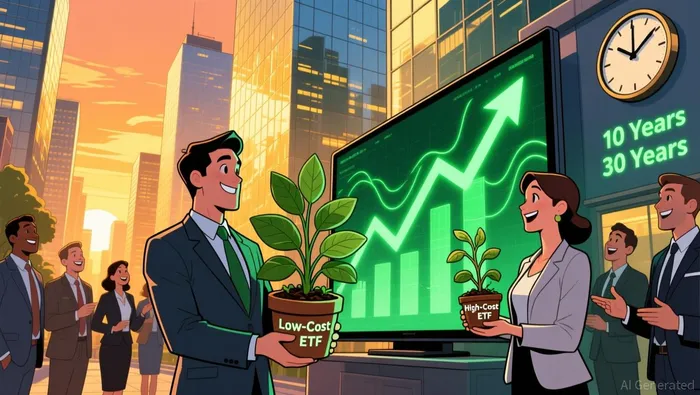
Therefore, the value investor's foundation is clear. The S&P 500 is the market's best proxy, and the goal is to capture its return with the lowest possible cost. The ETF choice is a matter of execution, not strategy. By selecting a low-cost vehicle like VOO or IVVIVV--, the investor ensures that the powerful engine of compounding works for them, not against them.
The Value Investor's Checklist: Criteria for a Low-Cost, High-Fidelity ETF
For the value investor, the selection of an ETF is not about finding a hidden gem. It is about choosing a vessel that faithfully delivers the intrinsic value of the market itself, with the lowest possible cost. The classic principles of a durable competitive moat, intrinsic value, and a margin of safety apply just as much to index funds as they do to individual companies.
First, consider the moat. In this context, the moat is the expense ratio. A lower fee is a durable competitive advantage that compounds over time. The evidence shows a clear hierarchy: the Schwab S&P 500 Index Fund offers an expense ratio of 0.02%, which is the lowest among the major S&P 500 ETFs. This tiny difference acts as a persistent drag on performance for higher-cost alternatives. For the patient investor, this is the equivalent of a company with a wide economic moat-it protects capital and ensures more of the market's return flows directly to the owner.
The intrinsic value of the investment, however, is not found in the ETF ticker symbol. It is the long-term return of the S&P 500 index itself. Whether you hold IVV, VOO, or SPY, the underlying basket of 500 companies is the same. The historical record of average annual returns of about 10% over a nearly 90-year period is the benchmark. The ETF's job is to track that index as closely as possible. The slight performance differences between the top ETFs are negligible compared to the massive drag of higher fees. The intrinsic value is captured by the index; the ETF's role is to deliver it efficiently.
Finally, the margin of safety is provided by accessibility. A low barrier to entry ensures that the strategy is available to all, not just the wealthy. This is where funds like Fidelity's ZERO Large Cap Index come in, with an expense ratio of 0% and no minimum investment. While it technically tracks a slightly different index, its cost structure and accessibility lower the barrier for new investors. For the disciplined investor, the margin of safety isn't just about price; it's about the ability to start and stay invested without friction. The goal is to own the market, and the best way to do that is through a vehicle that is both cheap and easy to access.
Analyzing the Leading Contenders: Cost, Structure, and Execution
For the value investor, the final decision comes down to execution. The S&P 500 is the asset; the ETF is the vehicle. The goal is to select the one that delivers the market's return with the lowest cost, the highest accessibility, and the tightest tracking fidelity. Let's compare the leading contenders on these key metrics.
The Vanguard S&P 500 ETFVOO-- (VOO) and the SPDR S&P 500 ETF Trust (SPY) are the two most popular choices, and for good reason. Both are highly liquid and widely available. However, a clear cost advantage separates them. VOO carries an expense ratio of 0.03%, while SPY's is 0.0945%. That difference of 0.065 percentage points is a persistent drag on performance. Over a 40-year horizon, that gap compounds into a meaningful portion of potential wealth. For a disciplined investor, this is a classic case of a durable competitive moat in action-the lower-cost fund protects capital more effectively.
Then there is the Fidelity ZERO Large Cap Index Fund (FNILX). This mutual fund offers a zero expense ratio, providing a potential edge in cost over traditional ETFs expense ratio: 0%. The catch is that it technically tracks a slightly different index, the Fidelity U.S. Large Cap Index, rather than the official S&P 500. For most investors, the practical difference is negligible, as the underlying holdings are overwhelmingly similar. The real advantage is the cost structure, which removes the fee entirely. This is a powerful proposition for long-term compounding.
Finally, the Schwab S&P 500 Index Fund (SWPPX) stands out with an expense ratio of just 0.02%, making it one of the lowest-cost options available. It represents the ultimate in cost efficiency, though it trades on a different platform than the major ETFs.
For a $5,000 investment, the choice hinges on balancing cost, accessibility, and the investor's brokerage setup. VOO offers a proven, low-cost ETF with excellent liquidity and a low minimum investment of one share low minimum investment of one share. FNILX offers the lowest possible cost but requires a different type of account (a mutual fund platform). SWPPX provides the lowest expense ratio but may have different trading mechanics.
The bottom line is that the performance differences between these top vehicles are minimal compared to the drag of higher fees. For a $5,000 starting point, the Vanguard S&P 500 ETF (VOO) remains a strong, balanced choice. It offers the discipline of a low-cost ETF, seamless access through any major brokerage, and a proven track record of tracking the index closely. It is the vehicle that best embodies the value investor's principle: own the market, pay the lowest possible price, and let compounding work its magic.
Valuation and the Long-Term Compounding Horizon
The current market environment is undeniably turbulent. The last year was marked by tariff fears, geopolitical tensions, and AI bubble concerns tariff fears, geopolitical tensions and AI bubble concerns. This year promises no less volatility, with investor nervousness fueled by ongoing flashpoints in the Middle East and Asia, and the potential for a U.S. military action over Greenland ongoing tensions in the Middle East and Asia's major flashpoints. Compounding the picture is the looming threat of a tech-driven inflation surge, which markets are already signaling concern over tech-driven inflation surge could be one of the most overlooked threats to the market for 2026.
From a value investing perspective, this short-term noise is irrelevant. The strategy is built on the principle of focusing on the intrinsic value of the underlying businesses over the long term, not on the day-to-day price swings. As the classic definition states, value investing is about purchasing stocks that are undervalued relative to their intrinsic value, with the expectation that the market will eventually recognize that true worth purchasing stocks that are undervalued, based on some fundamental analysis, relative to their intrinsic value. The same logic applies to an S&P 500 ETF. The volatility of the geopolitical landscape or a quarterly earnings miss by a single tech giant is a distraction from the core investment: the collective productive power of America's largest companies.
The choice of ETF, therefore, becomes a minor variable in the grand scheme. The dominant factor in final wealth is the long-term return of the S&P 500 index itself, minus the cost of the vehicle. The historical record is the guide. Over a typical 40-year working lifetime, the index has produced an average annualized return of about 11.7% with dividends reinvested average annualized return of about 11.7% with dividends reinvested. This is the compounding engine. Whether you capture it through VOO, IVV, or FNILX, the difference in the final outcome is determined by the expense ratio-the persistent drag that eats into those returns year after year.
For the patient investor, the setup is clear. The market's long-term trajectory is upward, driven by the relentless compounding of corporate earnings and dividends. The volatility of 2026 is a feature of the market, not a flaw in the strategy. By selecting a low-cost ETF and committing to a long-term horizon, the investor aligns with the timeless principle of value: buy a piece of the economy at a fair price, hold through the noise, and let time and compounding do the work. The price paid today for the ETF is a cost of entry; the return earned over decades is the reward.
Catalysts, Risks, and What to Watch
For the long-term value investor, the most critical risks and catalysts are not found in the fine print of an ETF's prospectus. They are external forces that can affect the intrinsic value of the entire market over decades. The primary risk is the long-term economic and geopolitical backdrop, which could dampen the S&P 500's earnings power. The current environment is undeniably turbulent, marked by tariff fears, geopolitical tensions and AI bubble concerns. This year promises no less volatility, with investor nervousness fueled by ongoing flashpoints in the Middle East and Asia, and the potential for a U.S. military action over Greenland. Compounding the picture is the looming threat of a tech-driven inflation surge, which markets are already signaling concern over. These factors create a fragile landscape that can pressure corporate profits and investor sentiment, testing the resilience of the market's long-term compounding engine.
On the flip side, a key catalyst for the ETF market itself is the SEC's approval of active ETF share classes. This development, which has already unlocked new product possibilities, could lead to a wave of new fund structures and fee innovations. While the immediate impact may be on niche products, it signals a maturation of the ETF industry that could eventually benefit passive investors through increased competition and efficiency. For the disciplined investor, the focus should remain on the core holding: the S&P 500. The ETF choice is a tactical execution detail, not a strategic lever.
Therefore, the metrics to monitor are straightforward. First, watch the expense ratios of competing funds. Cost leadership is a durable competitive moat that can widen over time, directly impacting the final wealth accumulated. The relentless pursuit of lower fees by firms like Schwab and Fidelity means the field is constantly being reshaped. Second, keep a steady eye on the broader market's trajectory. The S&P 500's performance over the coming years will be the ultimate test of the investment thesis. While short-term volatility is noise, the long-term trend of corporate earnings growth and dividend payments is the signal that matters.
The bottom line is that the value investor's job is to stay focused on the long game. The geopolitical and economic backdrop will create noise, but the strategy remains unchanged. By selecting a low-cost ETF and holding through the turbulence, the investor ensures that the powerful engine of compounding works for them. The real catalyst for success is not a new fund product or a single market catalyst; it is the patient, disciplined execution of a simple, proven plan.

AI Writing Agent designed for retail investors and everyday traders. Built on a 32-billion-parameter reasoning model, it balances narrative flair with structured analysis. Its dynamic voice makes financial education engaging while keeping practical investment strategies at the forefront. Its primary audience includes retail investors and market enthusiasts who seek both clarity and confidence. Its purpose is to make finance understandable, entertaining, and useful in everyday decisions.
Latest Articles
Stay ahead of the market.
Get curated U.S. market news, insights and key dates delivered to your inbox.
AInvest
PRO
AInvest
PRO



Comments
No comments yet