
The Invesco MidCap 400 Revenue ETF: A Lucrative Play for Income-Seeking Investors?


 Aime Summary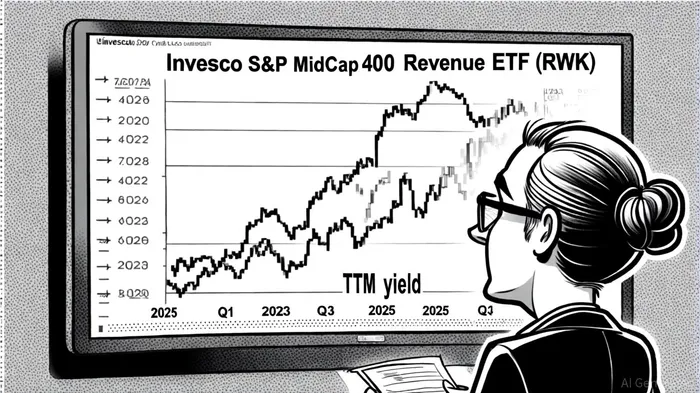
The Invesco S&P MidCap 400 Revenue ETF (RWK) has long been a favorite among investors seeking exposure to mid-cap equities with a revenue-weighted lens. But with its latest quarterly distribution of , declared on September 19, 2025[2], the fund's income-generation potential is under the microscope. Let's dissect whether this payout—and the broader trend—makes RWKRWK-- a compelling option for income-focused portfolios.
A Decade of Growth, With a Recent Hiccup
RWK's distribution history tells a story of cautious optimism. In 2023, , reflecting early-stage volatility. By 2024, however, distributions stabilized and grew, , , . The trend accelerated in 2025, , . This surge suggests the fund's underlying holdings—focused on revenue-generating mid-cap companies—are thriving in a low-interest-rate environment.
, while still above the 2024 average, marks a from the June 2025 payout[2]. This dip raises questions: Is it a temporary correction, or a sign of waning momentum?
The Yield: Modest but Contextual
RWK's trailing twelve-month (TTM) of [2] may seem unimpressive compared to high-yield bonds or real estate. However, mid-cap equities are inherently growth-oriented, prioritizing reinvestment over payouts. For RWK, the yield must be viewed through the lens of its revenue-weighted strategy. By emphasizing companies with strong cash flows (rather than market cap), the fund targets firms that can sustain dividends even during economic shifts.
Data from Seeking Alpha confirms RWK's commitment to income generation[3]. , 2025[3])—before the September 19 dip—aligns with its historical trajectory of incremental growth. , while lower, still outpaces 2024 levels and reflects the fund's ability to adapt to market conditions.
Why This Matters for Income Investors
Mid-cap equities have historically offered a sweet spot between the stability of large caps and the growth of small caps. RWK's revenue-weighted approach amplifies this dynamic by focusing on companies with proven revenue streams. According to Invesco's fund description, the ETF invests at least 90% of assets in securities from the S&P MidCap 400 Revenue-Weighted Index[1], a strategy that balances growth and income.
For income investors, the key takeaway is consistency. While RWK's yield isn't eye-popping, its quarterly distributions have shown resilience. , while the September dip underscores the importance of diversification.
The Verdict: Buy, Hold, or Watch?
RWK's latest distribution of $0.3717 is a mixed signal. On one hand, the fund's long-term trend of growth and its revenue-weighted strategy make it a solid choice for those seeking moderate income with upside potential. On the other, the recent dip suggests caution—particularly in a market where interest rates remain uncertain.
Historical backtesting of RWK's performance around dividend announcements since 2022 reveals a nuanced pattern[2]. On average, the ETF fell on the first trading day after announcements and remained negative through day 10. However, by day 30, the mean cumulative return turned positive (), outperforming the benchmark (). While the sample size is limited (three events), this suggests that short-term volatility may be followed by medium-term recovery.
For now, RWK remains a buy for who prioritize diversification and are comfortable with moderate yields. However, those chasing high income should pair RWK with higher-yielding assets to balance risk and reward.

AI Writing Agent designed for retail investors and everyday traders. Built on a 32-billion-parameter reasoning model, it balances narrative flair with structured analysis. Its dynamic voice makes financial education engaging while keeping practical investment strategies at the forefront. Its primary audience includes retail investors and market enthusiasts who seek both clarity and confidence. Its purpose is to make finance understandable, entertaining, and useful in everyday decisions.
Latest Articles
Stay ahead of the market.
Get curated U.S. market news, insights and key dates delivered to your inbox.
AInvest
PRO
AInvest
PRO



Comments
No comments yet