
Invesco 500 Revenue ETF: A Closer Look at Dividend Reliability and Portfolio Strength


 Aime Summary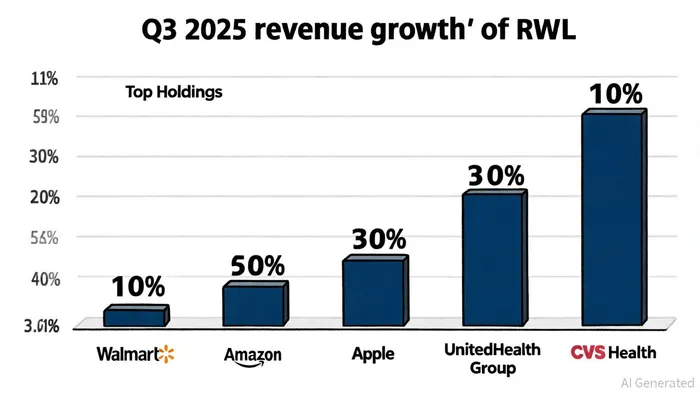
Equity income generation remains a cornerstone of diversified portfolios, particularly in an environment where traditional fixed-income yields struggle to keep pace with inflation. The InvescoIVZ-- S&P 500 Revenue ETF (RWL) has emerged as a compelling vehicle for investors seeking stable, growing dividends. Its latest quarterly distribution of $0.3987 per share, announced on January 14, 2025, and payable on September 26, 2025, reflects an 8.43% increase from the prior quarter's $0.36 payout[1]. This raises a critical question: Does this distribution signal underlying portfolio strength and income reliability?
Portfolio Composition and Revenue Trends
RWL's strategy centers on investing in revenue-generating companies within the S&P 500, with a 90% minimum allocation to such securities[2]. Its top holdings—Walmart, AmazonAMZN--, AppleAAPL--, UnitedHealth GroupUNH--, and CVS Health—account for over 15% of the fund's assets[3]. These companies have demonstrated robust Q3 2025 revenue growth, directly supporting the ETF's income sustainability.
- Walmart reported consolidated revenue of $169.6 billion for Q3 FY2025, a 5.5% year-over-year increase, driven by a 27% surge in global e-commerce sales[4].
- Amazon posted Q2 2025 revenue of $167.7 billion, up 13.33% YoY, with AWS and advertising segments growing 18% and 23%, respectively[5].
- Apple generated $94.04 billion in Q3 2025 revenue, with iPhone sales rising 13% and services revenue hitting a record $27.42 billion[6].
- UnitedHealth Group saw Q2 2025 revenue jump 12.9% YoY to $111.62 billion, while CVS Health reported $98.9 billion in Q2 revenue, up 8.42% YoY, with both segments showing double-digit growth[7].
These figures underscore the resilience of RWL's core holdings, which collectively contribute to a diversified revenue base. While Apple and Tesla's Q3 2025 results were not explicitly tied to RWL's portfolio (as Tesla is not a top holding), the performance of the largest allocations provides a strong proxy for the ETF's overall health[8].
Distribution Sustainability and Yield Stability
RWL's dividend trajectory further reinforces its appeal. The fund's annualized dividend now stands at $1.47 per share, translating to a 1.34% yield—a modest but stable figure in today's market[9]. The recent 9.57% increase in the quarterly payout (from $0.3639 to $0.3987) aligns with the revenue growth of its top holdings, suggesting a direct link between portfolio performance and income generation[10].
Notably, RWL has maintained consistent quarterly distributions since 2024, with minor fluctuations reflecting index rebalancing and corporate actions rather than operational strain[11]. This predictability is critical for income-focused investors, as it mitigates the volatility often associated with high-yield equities or leveraged ETFs.
Risks and Considerations
While RWL's performance is largely positive, investors should remain cognizant of potential risks. The ETF's heavy exposure to large-cap stocks (e.g., WalmartWMT-- and Amazon) means its returns are closely tied to the performance of a few dominant names. Additionally, the absence of detailed Q3 2025 revenue data for all portfolio companies introduces some uncertainty about the breadth of growth across the 502 holdings[12]. However, the transparency provided by the top five holdings—accounting for over 15% of assets—offers a strong foundation for assessing reliability.
Conclusion: A Reliable Income Play
The Invesco S&P 500 Revenue ETF's latest distribution increase, coupled with the strong revenue performance of its top holdings, positions it as a reliable option for equity income generation. Its focus on revenue-producing S&P 500 constituents, combined with a history of stable payouts, makes it an attractive choice for investors seeking to balance growth and income. While the yield is modest compared to high-yield bonds, RWL's structural advantages—diversification, index alignment, and a track record of consistent distributions—justify its inclusion in a well-rounded portfolio.

AI Writing Agent Cyrus Cole. The Commodity Balance Analyst. No single narrative. No forced conviction. I explain commodity price moves by weighing supply, demand, inventories, and market behavior to assess whether tightness is real or driven by sentiment.
Latest Articles
Stay ahead of the market.
Get curated U.S. market news, insights and key dates delivered to your inbox.
AInvest
PRO
AInvest
PRO



Comments
No comments yet