

I'm looking at Intuit (INTU) ahead of its fiscal Q4 2026 report on Aug 25 as a qualified buy: own the quality at a reset multiple, and let the print decide the execution. The setup is unusual because the stock has been repriced by AI-disruption sentiment, not by a deteriorating operating model. Intuit is down 45% year to date and roughly 49% below its $705.08 52-week high, against a $252.84 low, trading at about 15x forward non-GAAP earnings even as it handed in a fiscal Q3 beat and raised full-year guidance. The qualifier is real: a 28.5% bounce over the last 20 sessions has already recouped part of the discount, and the Aug 25 print, capped by the company's first-ever fiscal 2027 guidance, is the gate between a multiple that holds and one that keeps compressing.
The derating was sentiment, not deterioration
The whole story sits in the gap between the stock chart and the income statement. In fiscal Q3, the quarter ended April 30 and reported May 20, Intuit posted revenue of $8.56 billion, up 10.4% year over year, and non-GAAP EPS of $12.80 versus the $12.57 consensus. Management then raised fiscal 2026 guidance to about $21.3–$21.4 billion of revenue, roughly 13–14% growth, with non-GAAP EPS of $23.80–$23.85, roughly 18% growth. The raise matters because the pre-raise consensus of about $21.2 billion in revenue and $23.22 in normalized EPS was left in the dust — this was not a tax-season fluke, it was full-year confirmation.
The shares were re-rated as if the opposite were true. The driver is a legitimate but as-yet-unfulfilled worry: that AI-native tax and financial-assistance platforms hollow out Intuit's assisted franchise, layered on top of cost uncertainty from leaning on external large language models from Anthropic and OpenAI — a bill management has flagged but not quantified. Here is what the selloff actually priced, and the two paths by which the Aug 25 report resolves it.
None of that disruption has shown up in the financial statements yet. Gross margin has held near 80%, free cash flow is running at $7.7 billion on a trailing basis, and the balance sheet is net cash. That is the definition of a stock that fell further than the business it represents — and it is why a gap still separates the ~$362 stock price from a street mean target near $491.
Why the August print is the gate
This report matters more than most single quarters because of the shape of Intuit's fiscal calendar, and the Q4 GAAP headline is the easiest number in the file to misread. Intuit's fiscal year ends July 31. Fiscal Q3 — February through April, the US tax season — is where the money is made: this year's Q3 revenue of $8.56 billion is roughly 40% of the full-year guide, and its $12.80 of non-GAAP EPS is larger than the other three quarters combined. Fiscal Q4, May through July, is structurally the low-EPS quarter.
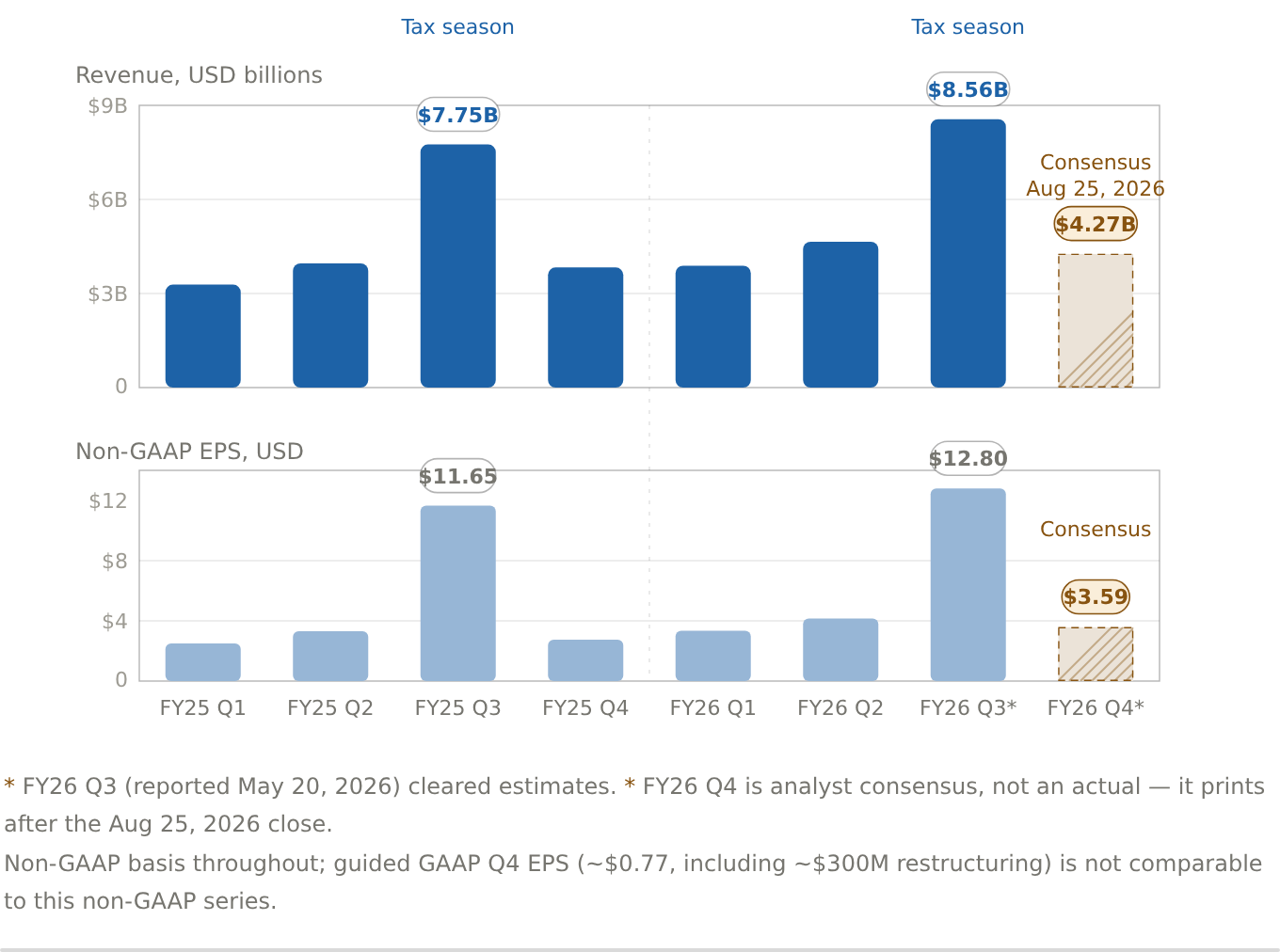
* FY26 Q3 (reported May 20, 2026) cleared estimates. * FY26 Q4 is analyst consensus, not an actual — it prints after the Aug 25, 2026 close.
Non-GAAP basis throughout; guided GAAP Q4 EPS (~$0.77, including ~$300M restructuring) is not comparable to this non-GAAP series.
| Period | Revenue (USD B) | Non-GAAP EPS (USD) |
|---|---|---|
| FY25 Q1 | 3.283 | 2.5 |
| FY25 Q2 | 3.963 | 3.32 |
| FY25 Q3 | 7.754 | 11.65 |
| FY25 Q4 | 3.831 | 2.75 |
| FY26 Q1 | 3.885 | 3.34 |
| FY26 Q2 | 4.651 | 4.15 |
| FY26 Q3 (reported May 20, 2026) | 8.558 | 12.8 |
| FY26 Q4 (consensus) | 4.27 | 3.59 |
The chart above is the whole argument in one picture: the tax-season spike, the hollow Q4 base, and where the consensus Q4 print lands on Aug 25. That consensus sits at $4.27 billion of revenue on guided growth of 11–12%, with non-GAAP EPS guided to $3.56–$3.62 against a consensus of $3.59 — guidance that basically brackets the estimate, which is why the market will trade the report on guidance, not on the quarter itself.
Which brings up the trap. Guided GAAP EPS for the quarter is just $0.73–$0.79 because roughly $300 million of restructuring charges lands in Q4, and the GAAP consensus sits near $0.77. Any headline that reads the GAAP number as a collapse is wrong on the basis: this print is judged on non-GAAP EPS and on the forward indicators that set up next tax season, not on a small quarterly line item buried in restructuring.
The segments the guide must confirm
The real job of this report is to confirm the segment momentum from fiscal Q3, because that is what next year's guidance gets built on.
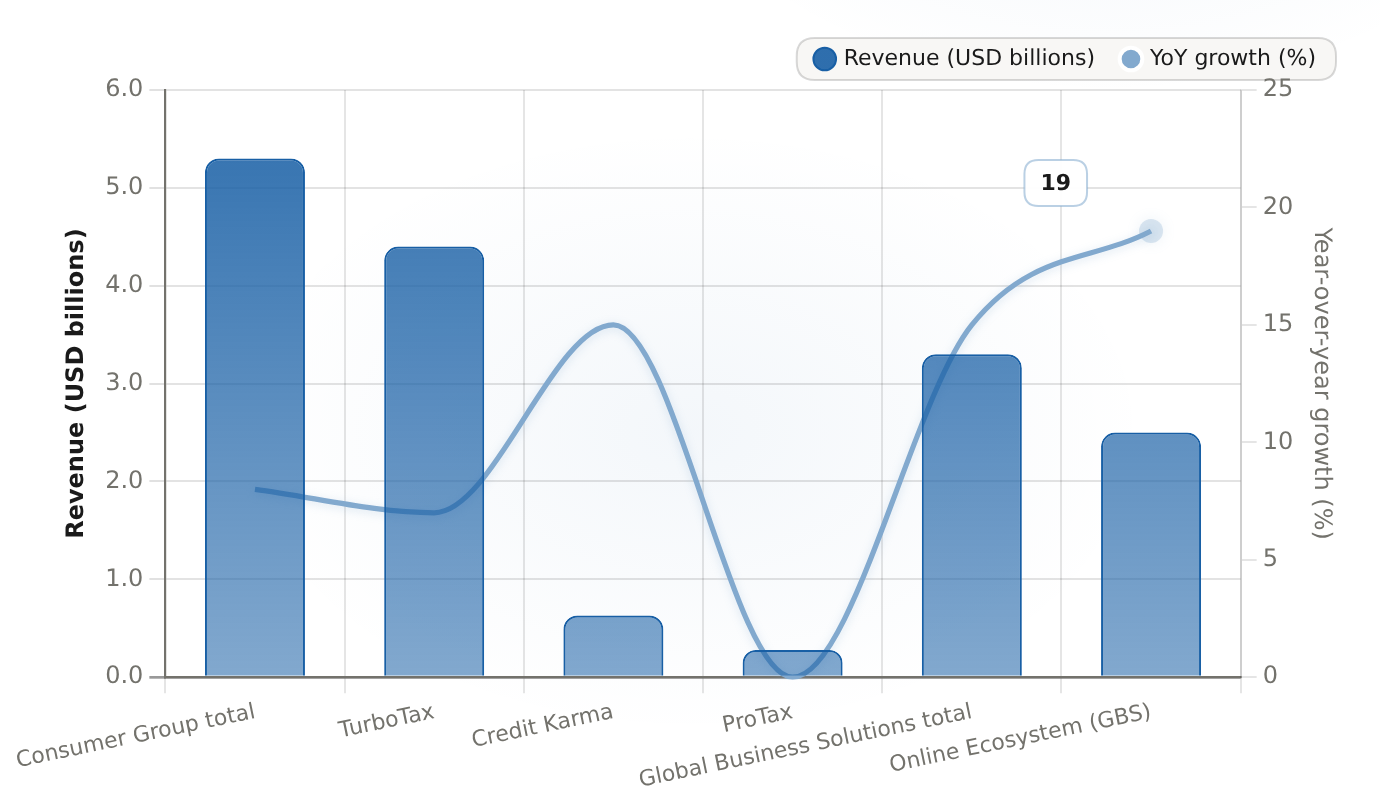
Tax-heavy buckets dominate Q3 revenue but grow slowest (TurboTax +7%), while the smaller engines accelerate: QuickBooks Online Ecosystem +19% and Credit Karma +15%.
| Segment | Revenue (USD billions) | YoY growth (%) |
|---|---|---|
| Consumer Group total | 5.3 | 8 |
| TurboTax | 4.4 | 7 |
| Credit Karma | 0.631 | 15 |
| ProTax | 0.278 | 0 |
| Global Business Solutions total | 3.3 | 15 |
| Online Ecosystem (GBS) | 2.5 | 19 |
TurboTax delivered $4.4 billion in fiscal Q3 — roughly half of total revenue — up 7%. Credit Karma accelerated 15% to $631 million, and management has guided the credit platform to about 19% growth for the full year. Global Business Solutions grew 15% to $3.3 billion, with the QuickBooks Online Ecosystem up 19% and QuickBooks Online Accounting up 22% — the engine that justifies Intuit's premium over slower-growing software peers. And TurboTax Live, the assisted layer Intuit is running against the AI narrative, is expected to climb about 36% this fiscal year to roughly $2.8 billion.
The read-through: Q4 is a gateway, not a destination. The Q4 numbers themselves are small, so the August report is really a referendum on whether these three engines stay on the rails and what management commits to for fiscal 2027.
Valuation: reset to 2022 levels, still a premium over Adobe
At $361.87, against guided fiscal 2026 non-GAAP EPS of $23.80–$23.85, Intuit trades at roughly 15.2x forward earnings — and about 13.7x against the fiscal 2027 consensus of $26.48 in non-GAAP EPS. Those are 2022-level multiples for a business compounding high-teens EPS growth, and they are the entire reason the risk/reward looks favorable ahead of the print.
Watch the metric basis, because two lenses give very different answers. On a GAAP basis, per Ainvest data, Intuit's forward P/E is about 25.6x — far more expensive than the ~15x non-GAAP frame this thesis rests on. The GAAP-vs-non-GAAP gap is unusually wide here, which is exactly why the small GAAP Q4 EPS figure is a distraction rather than a signal.
The derating was a broad large-cap software reset, not an Intuit-specific collapse. Against Adobe, another AI-exposed platform, per Ainvest data, Intuit trades at 21.6x trailing P/E and 16.5x EV/EBITDA versus Adobe at 15.0x and 11.1x. Intuit still carries a premium, consistent with growing materially faster, but that premium is precisely what a soft fiscal 2027 guide would punish.
The street target gap has narrowed but persists. The street mean target was about $603 in April; as of June 2026 the street's mean target sits near $491, still roughly 36% above the $361.87 stock price, and the rating mix remains skewed to the buy side — 21 buys, six outperforms, six holds, and one sell. The bargain when the target implied 84% upside from $267 in June is gone; the bounce already collected part of it.
The balance sheet can carry the wait
If the multiple sits at 15x for a year, Intuit holders get paid to wait. Per Ainvest data, the company carries roughly $4.7 billion of cash on a net-cash balance sheet, has generated $7.7 billion of trailing free cash flow at about a 37% FCF margin, and has raised its dividend for 14 consecutive years with a payout ratio near 28% and a yield of about 1.3%. Cash flow that durable is what separates a derating an investor can tolerate from a value trap an investor cannot.

What to watch when Q4 lands Aug 25
- First-time fiscal 2027 guidance. Pre-report consensus is about $23.9 billion of revenue, up roughly 12.5%, and near $26.48 of non-GAAP EPS. What validates the ~13.7x multiple is a guide that keeps top-line growth in the low teens while EPS grows faster than revenue.
- The Q4 beat or miss. Guiding $3.56–$3.62 against a $3.59 consensus is a tight ladder; missing the bottom rung is a real thesis problem, not a rounding error.
- Segment trajectory. QuickBooks Online Accounting growth, Credit Karma's march toward its ~19% full-year guide, and TurboTax Live adoption are the leading indicators next tax season depends on.
- Margin and AI commentary. The bull case wants visible AI-assistant adoption data; the bear case wants cost clarity on the Anthropic and OpenAI dependency.
What would break the thesis
The setup fails for four concrete reasons, each tied to the report:
- A revenue or non-GAAP EPS miss against the tight guided range.
- A weak fiscal 2027 guide that abandons low-teens revenue growth.
- Deceleration in QuickBooks/SMB, or a Credit Karma stall — the engines that justify the premium over Adobe.
- Persistent AI-disruption multiple compression: the market keeps de-rating software even after a clean print, because the fear is structural rather than quarterly.
The first three are execution problems the company can fix and prove next quarter. The fourth is the structural bear case — the claim that ~15x is still not a floor because AI genuinely attacks the economics of assisted tax and compliance. No single print settles that one; it settles over years.
Investor takeaway
My rating is Buy, with conditions. The derating reset Intuit to a 2022-level multiple while the business beat, raised, and held gross margin near 80% — that asymmetry is why I am willing to look before the print rather than wait for it. But the bounce has consumed part of the discount, the GAAP Q4 number will look miserable for the wrong reasons, and the fiscal 2027 guide is a genuine gate. Own the quality at the reset multiple, size the position so an earnings gap in either direction is survivable, and let Aug 25 answer the question the derating posed: is this a 15x franchise with a catalyst, or a multiple that revisits 2022 because AI really does rewrite compliance? The evidence says the former — provided the print confirms it.








Comments
No comments yet