
Interstellar Object 3I/ATLAS and Its Implications for Space-Focused Investment Sectors


 Aime Summary
A Catalyst for Planetary Defense and Observational Innovation
3I/ATLAS's passage through the solar system has underscored the urgency of refining planetary defense systems. The European Space Agency (ESA) leveraged data from its ExoMars Trace Gas Orbiter to triangulate the comet's trajectory with tenfold precision, a technique now being replicated for future interstellar object tracking. 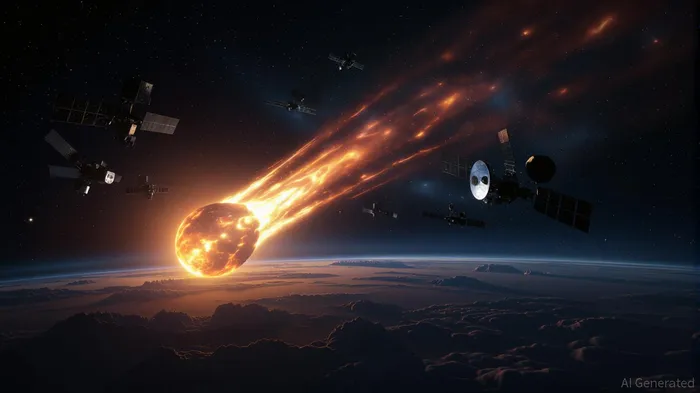 This effort, described as a "planetary defense rehearsal," highlights the value of multi-location data integration-a capability now prioritized by investors. For instance, the ESA's Ramses mission, a joint project with JAXA targeting asteroid Apophis, received €955 million in funding for its Space Safety program, reflecting a 30% increase in planetary defense allocations.
Meanwhile, anomalies observed in 3I/ATLAS-such as non-gravitational acceleration without visible gas jets-have exposed gaps in current observational tools. This has spurred demand for disruptive innovations like quantum spectrometers and AI-driven observatories, which could revolutionize how we analyze interstellar objects. The comet's study has also validated the strategic importance of Mars-based observation platforms, with the ESA and NASA collaborating to refine methodologies for tracking celestial threats.
Investment Trends: From Launch Costs to Small Satellites
The broader space economy has seen a surge in investment, with $3.3 billion in deal value across 166 transactions in 2025 alone. Reduced launch costs-some vehicles now deliver payloads to orbit for as little as $1,500 per kilogram-have democratized access to space, fueling growth in satellite broadband and Earth-observation technologies. The small satellite market, projected to reach $260.56 billion by 2029, is a prime beneficiary, driven by companies leveraging 3I/ATLAS-related advancements in miniaturized instrumentation.
Defense-driven priorities are also reshaping the sector. Firefly Aerospace's $855 million acquisition of SciTec, Inc. underscores the shift toward dual-use technologies, with missile warning and space domain awareness systems attracting significant capital. Similarly, the UK's National Space Innovation Programme (NSIP) allocated £17 million to 17 projects, including those focused on in-orbit servicing and advanced satellite technologies, signaling a strategic pivot toward sovereign capabilities.
Emerging Opportunities in Astronomy-Driven Innovation
3I/ATLAS has catalyzed interest in missions targeting interstellar objects. The ESA's Comet Interceptor, slated for a 2029 launch, aims to intercept a future interstellar visitor, building on the data gathered from 3I/ATLAS. Private firms are also exploring niche opportunities: startups specializing in photon-propulsion systems and cryogenic material analysis are attracting venture capital, as the comet's composition hints at new insights into cosmic origins.
Moreover, the comet's trajectory has reignited debates about the role of AI in space exploration. The Southwest Research Institute (SwRI) proposed a mission to design a spacecraft capable of intercepting interstellar comets, leveraging machine learning to optimize trajectory calculations. Such projects highlight the convergence of astrophysics and artificial intelligence, a sector projected to grow as investors seek to monetize data from interstellar object studies.
Conclusion: A New Era of Space Investment
The passage of 3I/ATLAS has not only expanded our scientific understanding but also redefined investment priorities in space technology. From planetary defense systems to AI-driven observatories, the comet's legacy is evident in the surge of funding for innovation. As the global space economy approaches $613 billion in 2024-with commercial ventures accounting for 78% of growth-the alignment of scientific curiosity and market demand is creating fertile ground for long-term returns. Investors who position themselves at the intersection of astronomy and technology may find themselves at the forefront of a new era in space exploration.

Delivering real-time insights and analysis on emerging financial trends and market movements.
Latest Articles
Stay ahead of the market.
Get curated U.S. market news, insights and key dates delivered to your inbox.






Comments
No comments yet