
Interstellar Comet 3I/ATLAS Races Through Solar System at Record Speed
 Aime Summary
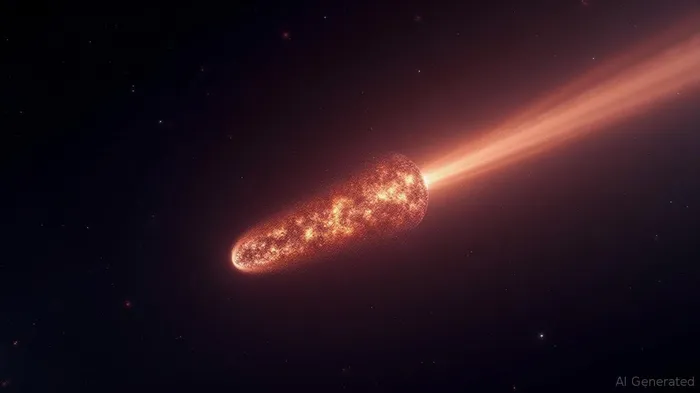
A sharp new image captured by the Hubble Space Telescope provides the clearest insight yet into the interstellar comet 3I/ATLAS, an extraterrestrial visitor racing through our solar system. On July 21, Hubble, utilizing its Wide Field Camera 3, documented 3I/ATLAS while it was 277 million miles away from Earth. This unparalleled observation reveals a teardrop-shaped cocoon of dust emanating from the comet's icy nucleus and shows the beginnings of its signature tail.
This interstellar comet, first identified on July 1, has been accelerating at a breathtaking speed of 130,000 miles per hour as it traverses the solar system. The swift pace of 3I/ATLAS makes it the fastest known object of extra-solar origin to journey through our cosmic neighborhood. Analysts predict that as the comet approaches the sun, its composition and size characteristics will become clearer, thanks to coordinated observations from various space-based and ground-based observatories. The comet's nucleus, hidden within its coma, is estimated to be as large as 3.5 miles in diameter or as small as 1,000 feet, according to a study pending publication in The Astrophysical Journal Letters.
NASA's Hubble, James Webb Space Telescope, Transiting Exoplanet Survey Satellite (TESS), Neil Gehrels Swift Observatory, and ground-based instruments like the W.M. Keck Observatory in Hawaii will extend their observational reach to discern the chemical composition of this celestial object. Although 3I/ATLAS is set to remain visible through September, it will soon swing too close to the sun, obstructing its view from Earth until early December, when it emerges on the other side.
The origins of 3I/ATLAS remain enigmatic, akin to glimpsing a fleeting rifle bullet: rapid, untraceable, and inherently mysterious. Lead study author David Jewitt, a University of California, Los Angeles professor of astronomy, expressed the difficulty in determining the comet's genesis due to its hyperbolic trajectory and centuries traveling through interstellar space, increased by gravitational encounters with stars and nebulae.
This is only the third confirmed interstellar object observed in our solar system, following 1I/'Oumuamua in 2017 and 2I/Borisov in 2019, each expanding our understanding of planetary systems outside our own. As astronomers predict, the Vera C. Rubin Observatory's capability is poised to reveal more such visitors from other star systems, possibly identifying a range of five to fifty interstellar objects over the next decade. Discoveries of such travelers offer a unique opportunity to study their ancient composition and draw comparisons with native solar system comets.
As researchers continue to explore the depths of space, the interstellar object 3I/ATLAS represents not only a testament to the power of modern telescopes like Hubble and Rubin Observatory but also highlights the collaborative efforts scientists employ globally to unravel celestial mysteries. Jewitt underscores the notion that these discoveries are increasingly feasible due to advancements in sky survey technologies, thrusting humanity further into the cosmic frontier. 3I/ATLAS embodies an expansive possibility—a glimpse into other worlds.

Stay ahead of the market.
Get curated U.S. market news, insights and key dates delivered to your inbox.






Comments
No comments yet