
The Intersection of Renewable Energy Adoption and Social Equity in Emerging Markets


 Aime Summary
Renewable Energy as a Catalyst for Social Equity
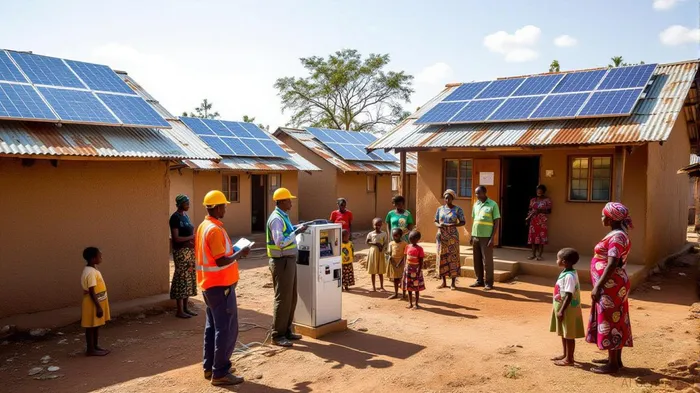
Renewable energy projects in emerging markets are uniquely positioned to address energy poverty while advancing ESG (Environmental, Social, and Governance) metrics. A 2025 study reveals that renewable energy alleviates energy poverty both directly-by expanding access to electricity-and indirectly-by fostering economic opportunities and improving health outcomes. For instance, decentralized solutions like solar microgrids and off-grid systems have proven critical in reaching rural populations, where over 600 million people in Africa alone lack electricity. These systems not only reduce reliance on fossil fuels but also empower communities through job creation and localized energy ownership.
The link between ESG performance and poverty reduction is further reinforced by empirical evidence. Research indicates that ESG factors exert a nonlinear influence on energy transitions, with their impact intensifying in lower-income countries where GDP per capita is below a certain threshold. This suggests that targeted ESG-driven investments can yield outsized returns in terms of both climate action and social equity.
Overcoming Investment Barriers: De-Risking and Innovation
Despite the promise of clean energy, investment in emerging markets remains constrained by perceived risks such as political instability and currency volatility according to the World Economic Forum. To unlock capital, innovative strategies like blended finance and financial guarantees are proving essential. The PIDG's GuarantCo, for example, has provided $27 million in guarantees to African power producers, mobilizing up to $270 million in private capital and enabling the addition of 200–300 megawatts of renewable energy to the grid. Such de-risking mechanisms not only attract private investors but also align with ESG frameworks by prioritizing sustainable, inclusive growth.
 Data-sharing initiatives are equally vital. By improving transparency and addressing misperceptions about market risks, stakeholders can build confidence in clean energy projects. Countries like Chile and Brazil have demonstrated the effectiveness of structured approaches, including regulatory frameworks and energy auctions, in scaling renewable capacity. These models offer replicable blueprints for other emerging economies.
Case Studies: Measurable Impact in Africa and Southeast Asia
Concrete examples highlight the transformative potential of clean energy in emerging markets. In Kenya, M-KOPA's pay-as-you-go solar systems have reached over 3 million households, enhancing financial inclusion while reducing carbon emissions. Similarly, Nigeria's Access Bank has integrated ESG principles into its operations, securing a USD 280 million syndicated loan tied to sustainability-linked metrics. These initiatives underscore how renewable energy can drive poverty reduction through job creation and infrastructure development.
In Southeast Asia, Indonesia's Just Energy Transition Partnership (JETP) exemplifies a forward-looking approach. A World Resources Institute (WRI) study projects that every US$1 billion invested in Indonesia's renewable sector could generate US$1.41 billion in economic returns, while creating 2.8 million jobs and slashing power sector emissions by 90% by 2050. Such outcomes align with the region's net-zero goals and highlight the scalability of clean energy solutions.
The Path Forward: Scaling Impact Through Collaboration
The global clean energy transition in emerging markets hinges on bridging a significant financing gap. Annual investment in these regions must surge from $770 billion in 2022 to $2.2–2.8 trillion by the early 2030s to meet climate and development targets. Achieving this will require robust public-private partnerships, as public funding alone is insufficient. Institutions like the Green Finance Institute and the World Bank are pivotal in providing actionable best practices and building local financial expertise according to Reuters.
Moreover, localized ESG frameworks tailored to regional priorities are essential. In Brazil, for instance, sustainable governance and innovation have had a more pronounced impact on social performance than environmental outcomes, illustrating the need for context-specific strategies.
Conclusion
Renewable energy adoption in emerging markets represents a unique convergence of environmental stewardship and social progress. By leveraging de-risking tools, data-sharing, and replicable models, investors can unlock high-impact opportunities that align with long-term ESG and poverty-reduction goals. As the examples of Kenya, Nigeria, and Indonesia demonstrate, the clean energy transition is not merely a climate imperative-it is a pathway to equitable, sustainable development.

Blending traditional trading wisdom with cutting-edge cryptocurrency insights.
Latest Articles
Stay ahead of the market.
Get curated U.S. market news, insights and key dates delivered to your inbox.






Comments
No comments yet