
International Paper's Strategic Resilience in a Shifting Market


 Aime Summary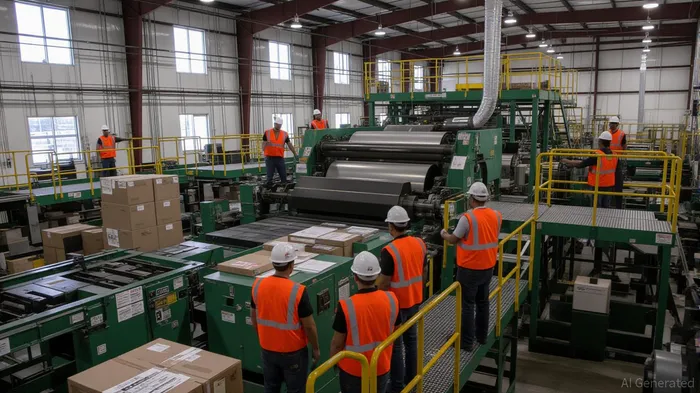
In the aftermath of a global recession, industrial companies face a dual challenge: navigating near-term volatility while positioning for long-term growth. International PaperIP-- (IP) has emerged as a standout example of strategic resilience, leveraging operational overhauls and capital structure adjustments to fortify its position in the packaging sector. For investors seeking defensive plays in a post-recessionary environment, IP's recent moves offer a compelling case study in adaptability and foresight.
Operational Overhaul: Streamlining for Sustainability
International Paper's decision to sell its Global Cellulose Fibers (GCF) business to American Industrial Partners (AIP) for $1.5 billion underscores its pivot toward sustainable packaging. The GCF unit, while profitable ($2.8 billion in 2024 revenue), required significant capital to maintain. By divesting this asset, IP is reallocating resources to higher-margin segments, such as its North America Packaging Solutions division. This aligns with a broader industry trend: consumers and regulators increasingly prioritizing eco-friendly materials and circular economies.
Simultaneously, IP is investing $250 million to convert the #16 machine at its Riverdale mill to produce containerboard. This upgrade, expected to be operational by Q3 2026, will enhance the company's ability to meet surging demand for e-commerce packaging. The move also reduces reliance on volatile pulp markets, a critical advantage in an era of supply chain fragility.
The company's facility closures—Savannah and Riceboro operations—further illustrate its commitment to cost discipline. While these closures will reduce containerboard capacity by 1 million tons and impact 1,100 jobs, they eliminate underperforming assets and align production with current demand. This “80/20 mindset” prioritizes efficiency over scale, a strategy that has historically strengthened industrial players during downturns.
Financial Fortitude: A Path to Stability
IP's Q2 2025 earnings report highlights its financial resilience. Adjusted operating earnings of $105 million and net sales of $6.8 billion reflect progress in its transformation, despite headwinds like maintenance outages and European demand softness. Free cash flow turned positive at $54 million, a stark improvement from the -$618 million in Q1 2025. This turnaround signals stronger cash generation, a key metric for defensive stocks.
While the company's debt-to-EBITDA ratio remains undisclosed, its trajectory is promising. IP aims for a $6 billion EBITDA run rate by 2027, up from $2.14 billion in Q2 2025. This growth, coupled with cost-out initiatives and asset sales, suggests a path to deleveraging. The market has taken notice: IP's stock trades at a PEG ratio of 0.62, indicating undervaluation relative to its growth prospects.
Industry Resilience: Packaging as a Defensive Sector
The packaging industry itself is a natural defensive play. E-commerce growth, food delivery, and supply chain reshoring have created durable demand for packaging solutions. A 2025 Wipfli benchmarking study notes that top-performing manufacturers in the sector maintain efficiency of $139,800 per employee, with median EBIT at 7.8%. IP's focus on automation and digital tools positions it to outperform peers in this environment.
Sustainability is another tailwind. Consumers increasingly prioritize recyclability and circularity, with 39% globally ranking environmental impact as “very important.” IP's shift to sustainable packaging aligns with this trend, offering both regulatory and reputational advantages.
Risks and Considerations
IP is not without challenges. European operations remain soft, and the integration of DS Smith—a $13.5 billion acquisition—has added complexity. However, the company's disciplined approach to cost management and its focus on North America, where demand is robust, mitigate these risks.
Investment Thesis
For investors, IP represents a rare combination of operational agility and financial discipline. Its strategic divestitures, capital-efficient investments, and alignment with sustainable trends position it as a defensive play in a sector poised for long-term growth. With a market cap of $25.3 billion and a clear path to $6 billion in EBITDA by 2027, IP offers a compelling risk-reward profile.
Recommendation: Buy International Paper for its strategic resilience and undervalued growth potential. Investors should monitor its Q3 2025 earnings for confirmation of its transformation progress and watch for further asset sales to reduce leverage.

Stay ahead of the market.
Get curated U.S. market news, insights and key dates delivered to your inbox.
AInvest
PRO
AInvest
PRO



Comments
No comments yet