
The Interconnected Volatility of Precious Metals and Global Indices Amid Market Uncertainty


 Aime Summary
In an era marked by geopolitical tensions, , and shifting , the relationship between precious metals and global stock indices has become a focal point for investors seeking . From 2023 to 2025, gold and silver have demonstrated their resilience as safe-haven assets, often moving in opposition to equities during periods of market stress. This dynamic underscores the importance of understanding and leveraging timing strategies to navigate fragmented markets.
The Negative Correlation: Gold as a Portfolio Diversifier
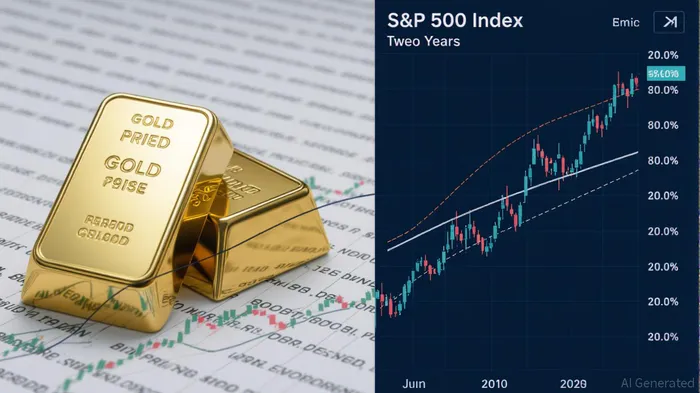
Gold's role as a to equity markets has been reinforced in recent years. Data from 2023–2025 reveals a strong negative correlation between gold and global indices like the S&P 500, particularly during market drawdowns exceeding 3%. For instance, ,
, . This divergence highlights gold's ability to preserve capital and generate risk-adjusted returns during uncertainty.
The correlation deepens in times of . During the Russia-Ukraine war and U.S.-China trade tensions, gold prices often rose as equity markets faltered.
A study analyzing the Nikkei 225 and gold prices found that while the Nikkei 225 is influenced by global economic conditions, gold's low correlation with Japanese equities has historically made it a valuable diversifier for local portfolios. This dynamic is further amplified by the "," where investors shift from fiat-based assets to hard assets like gold to hedge against monetary dilution caused by persistent deficits and debt monetization
according to research.
Silver and Industrial Metals: Dual-Function Assets in Turbulent Times
Silver, with its dual role as both an and a safe-haven asset, has also shown unique behavior during market uncertainty. In 2025, silver prices
amid weak dollar conditions and geopolitical risks, driven by ETF inflows and industrial demand. The FTSE 100, which includes companies like Fresnillo (a major silver producer),
benefited from this trend, as a weaker British pound and global trade tensions boosted demand for hard assets. This interplay between silver and equity indices illustrates how industrial metals can serve as both and growth indicators in fragmented markets.
Strategic Diversification: Leveraging Precious Metals in a Fragmented Market
The toward precious metals reflects a broader shift in investor behavior.
Gold's performance in 2025, validating its role as an . Meanwhile, the FTSE Global All Cap Precious Metals and Mining Index
, far outpacing broader equity markets. These trends suggest that investors are increasingly prioritizing assets with over those tied to fiat currencies.
Diversification strategies must also account for regional dynamics. In the Middle East and Turkey, for example, physical gold demand has
surged due to currency devaluation risks. Similarly, platinum and palladium, which
in 2025, reflect growing demand for hard assets in sectors like automotive and energy.
Timing Strategies: Breakouts, Correlations, and Policy Signals
Timing is critical in capitalizing on the of precious metals and indices. A technical analysis of the gold-to-S&P 500 ratio in 2025 revealed a breakout above key resistance levels,
signaling a potential . This pattern was reinforced by gold's performance against the Dow Jones and NYSE Composite, with the S&P 500 representing the final major hurdle. Additionally, the silver-to-gold ratio, currently at 1.27%, indicates strong
according to analysis.
also play a pivotal role. The U.S. Federal Reserve's anticipated and dollar weakness have historically supported precious metals, as seen in silver's 2025 rally
according to market analysis. Conversely, gold retreated in Q3 2025 amid dollar strength and Fed pause signals, underscoring the importance of monitoring monetary policy
according to reports. Investors must also consider the dollar index's inverse relationship with gold, which remains a key dynamic in timing strategies
as documented.
Conclusion: A Long-Term Shift in Investor Behavior
The interconnected volatility of precious metals and global indices reflects a structural shift in asset allocation. As and geopolitical tensions reshape markets, investors must prioritize that incorporate hard assets. Gold and silver, with their proven resilience and low correlations to equities, offer a compelling hedge against . However, success requires a nuanced understanding of timing, , and policy signals. In a fragmented market environment, those who adapt to these dynamics will be best positioned to navigate uncertainty and capitalize on emerging opportunities.

Stay ahead of the market.
Get curated U.S. market news, insights and key dates delivered to your inbox.






Comments
No comments yet