
US Intel Warns Russia Could Hit a NATO Ally This Fall. Polymarket Prices the Clash at 23%
 Aime Summary
Washington's intelligence community just flipped its base case. The Wall Street Journal reported this week that US officials now warn Putin could provoke a NATO nation with a limited attack as early as this fall -- a reversal of the long-held assumption that Russia was too busy in Ukraine to open a second front. On Polymarket, the market asking whether NATO and Russia will have a direct military clash by December 31 still trades at 23 cents, pricing a 77% chance of a clean year. Here's the gap, and the 24-to-1 August ticket nobody's looking at.
Why Washington flipped its base case. The Wall Street Journal reported on August 6 that US intelligence now warns Russia could provoke a NATO member with a limited attack as early as this fall. Officials previously believed an attack on an ally would not happen while Russia's war machine was tied down in Ukraine; the new assessment treats the eastern flank as a live target as Moscow's offensive stalls. Kyiv Independent's writeup of the intelligence shift is the anchor here.
That warning landed in a week thick with near-misses. Lithuania's defense minister told LRT in July that the Kremlin, frustrated in Ukraine, sees the Baltic states and Poland as its closest targets. On August 6, Kyiv Independent flagged Lithuanian intelligence warnings that Moscow could stage a false-flag drone strike on Baltic infrastructure using captured Ukrainian drones -- and reported a drone targeting a Ukrainian cargo plane carrying ammunition at a German airport, with NATO fighter scrambles a near-daily occurrence. Polish jets intercepted a Russian reconnaissance aircraft over the Baltic Sea, an increasingly routine event per news.az. Over the weekend, Ukraine launched 400 drones into Russia while NATO's top military officer insisted the alliance stands ready for any Russian operation along its eastern flank.
The market is priced for a quiet year. On Polymarket, the "NATO x Russia military clash by...?" event -- about $3.9M in lifetime volume and $230k in current liquidity -- resolves YES if a direct military encounter between NATO and Russian forces happens before the deadline. The board:
Open this market on Polymarket ->
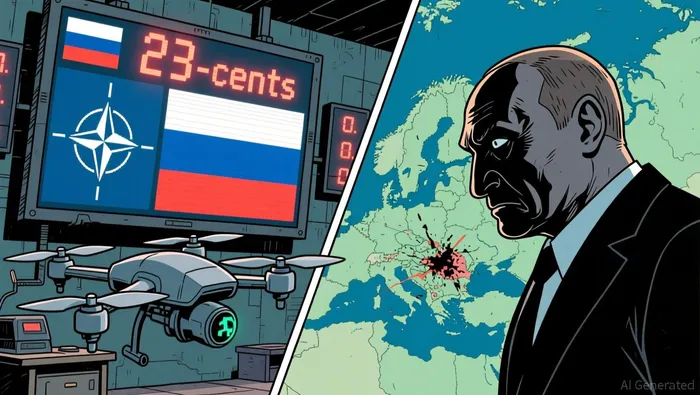
The December 31 YES leg trades near 23 cents (bid 22/ask 24). A $100 ticket buys about 435 shares; if any qualifying clash happens by year-end, that's roughly $435 back -- about $335 of profit, a 4.3x payout. The same board prices no direct clash through all of 2026 at 77%. Washington is actively modeling a limited attack as early as this fall, and the market still sees a clean year as a 3-in-4 outcome.
The hidden gem is in the fine print. This market is not "will NATO go to war with Russia," and that's where the edge hides. The resolution rules count a qualifying "military encounter" as direct engagement -- missile strikes, artillery, an exchange of gunfire -- and explicitly include shooting down a non-munition UAV like an Orlan-10 or Orion reconnaissance drone. That's not a land war. It's a Polish or Baltic fighter finally taking down one of the Russian recon aircraft that have shadowed the eastern flank all summer. Most intercepts are non-violent and would not count, but the intercept pattern is exactly the escalation surface where one mistake flips this market. The August 31 bucket trades at 4.2 cents -- about 24-to-1, with a $100 ticket returning roughly $2,381 if it hits -- and the October 31 bucket at 12 cents pays about 8-to-1. The market's own ladder prices September-October as the riskiest stretch at roughly 8% conditional probability if August stays quiet, which lines up uncomfortably with the fall window Washington just flagged.
The honest case against. Putin has spent three years avoiding direct NATO engagement; Article 5 deterrence is real, and a limited strike on a member risks the full alliance response no Kremlin planner wants. Intelligence "could" assessments are planning scenarios, not forecasts -- the WSJ story frames a possibility, not a prediction. And this market has sat near these levels for months, so the intel news may already be priced in. If no qualifying encounter occurs by the deadline, every ticket goes to zero.
How to think about it. Russia probably won't go to war with NATO on purpose. It might go to war with NATO by accident -- and the market doesn't price accidents. For the pure tail, December 31 at 23 cents is the cleanest expression. For the mechanical trigger, the August 31 and October 31 buckets pay 24-to-1 and 8-to-1 on a shootdown that's one mistake away. The marker to watch: a Russian recon drone going down over the eastern flank.
Summary
US intelligence warned this week, per the Wall Street Journal, that Russia could mount a limited attack on a NATO country as early as this fall -- while Polymarket's "NATO x Russia military clash by...?" market prices a clash by December 31 at just 23 cents. The resolution rules count a shootdown of a Russian reconnaissance drone, making the 4.2-cent August 31 bucket (~24-to-1) the sharpest expression of a risk Washington now openly models. This is a trade idea, not financial advice; prediction markets are risky and odds move.
Sources
- Kyiv Independent: US intel warns Russia could launch attack on NATO countries (WSJ)
- Kyiv Independent: Lithuania warns of Russian false-flag drone threat to Baltic states
- Seeking Alpha: Russia, Ukraine escalate attacks
- news.az: Poland intercepts Russian reconnaissance aircraft over Baltic
- Polymarket: NATO x Russia military clash by...?
_43ca838f1775813865579.png?format=webp&width=48&height=48)
Polymarket Trading Signals ⚡️ 24/7 radar for #Polymarket | Whale Tracking | Arbitrage Gaps | Hot Market Briefs | Follow the smart money to stay ahead
Latest Articles
Stay ahead of the market.
Get curated U.S. market news, insights and key dates delivered to your inbox.


AInvest
PRO
AInvest
PRO




Comments
No comments yet