
Intel's Turnaround Momentum and Political Tailwinds: A Strategic Buy for 2026?


 Aime Summary
The semiconductor industry is at a pivotal inflection point, driven by the confluence of geopolitical realignments and technological breakthroughs. For IntelINTC--, a company once synonymous with the golden age of U.S. chipmaking, the path to relevance in the AI era hinges on two critical catalysts: unprecedented government support and a reinvigorated product roadmap. As the U.S. government stakes its own equity in the company's future and Intel advances its 18A/14A process technologies, the question for investors becomes whether these forces can coalesce into a sustainable value creation story for 2026 and beyond.
Geopolitical Tailwinds: A New Era of Industrial Policy
The U.S. government's $8.9 billion equity investment in Intel-granting it a 9.9% stake in the company-marks a historic shift in industrial policy. This move, announced in August 2025 under the Trump administration, is part of a broader $53 billion CHIPS and Science Act framework aimed at reversing the erosion of domestic semiconductor leadership. By combining this equity stake with $2.2 billion in prior CHIPS Act grants, the government has committed $11.1 billion to Intel's U.S. manufacturing and R&D expansion.
This partnership is not merely financial but strategic. The government's passive stake, devoid of governance rights, positions it as a long-term stabilizing force rather than a corporate overlord. As stated by the Trump administration, the investment is designed to "ensure a resilient and secure domestic supply chain" for semiconductors, a sector deemed critical to national security, particularly in AI and defense systems. According to analysis, with U.S. market share in global chip manufacturing plummeting from 100% in the 1960s to 8% by 2024, the geopolitical imperative to counter reliance on overseas foundries like TSMC has never been more urgent.
Intel's Arizona fabrication site, a cornerstone of its $100 billion U.S. investment plan, is set to begin high-volume production of advanced semiconductors in 2025. This facility, supported by federal grants and long-term defense contracts, underscores the alignment between corporate strategy and national interest. The government's five-year warrant to purchase an additional 5% stake further signals its commitment to Intel's role in securing the AI-driven future.
Product Innovation: The 18A/14A Revolution
While geopolitical support provides a tailwind, Intel's technical renaissance is the engine of its turnaround. The company's 18A process technology, featuring RibbonFET (Gate-All-Around transistors) and PowerVia (Backside Power Delivery), represents a generational leap in chip design. These innovations enable 30% better chip density and 15% improved performance per watt, critical metrics for AI workloads that demand both computational power and energy efficiency.
The first high-volume product built on 18A, Panther Lake, has already demonstrated the process's potential. The Core Ultra Series 3 processors, launched in Q4 2025, deliver 50 TOPS of AI performance and 170 TOPS of total AI compute when combined with the Xe3 GPU chiplet. This performance leap is not just a technical achievement but a market differentiator: the processors are expected to power over 200 PC designs in 2026, positioning Intel to capture a significant share of the AI PC market.
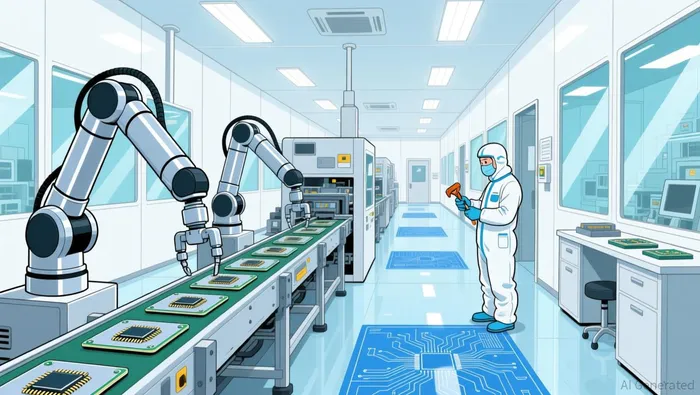
Intel's roadmap extends beyond 18A. The 14A (1.4nm) process, slated for 2027, will further solidify its position in high-performance computing and AI applications. The company's "IDM 2.0" model-integrating foundry services, advanced packaging, and heterogeneous architectures-positions it to compete not only in client PCs but also in edge computing, robotics, and smart cities.
Market Adoption and Analyst Optimism
The market's response to Intel's resurgence has been robust. In 2025, the company's stock surged nearly 90%, driven by renewed confidence in its manufacturing capabilities and AI strategy. Analysts have upgraded Intel to "Buy" or "Outperform" ratings, citing its strategic partnerships with tech giants like NVIDIA and Microsoft, as well as its potential IPO of the Intel Foundry division by 2027.
However, challenges remain. Yield rates for the 18A process are currently at 55%-65%, and have delayed mass production until early 2026. Intel's CEO has emphasized the importance of achieving near-perfect yields before scaling, a prudent but time-sensitive approach. Additionally, the maturity of the 18A PDK lags behind TSMC's industry-leading standards, suggesting external foundry revenue from 18A/14A may not materialize until after 2028.
The 2026 Investment Case
For investors, the calculus hinges on balancing these risks against the tailwinds. Intel's geopolitical support provides a unique buffer against market volatility, ensuring access to capital and long-term contracts that few peers can match. Meanwhile, its 18A/14A roadmap, if executed successfully, could redefine the AI hardware landscape. The company's strategic pivot toward heterogeneous architectures and open AI software stacks further enhances its competitive edge.
Yet, execution remains key. The 18A yield challenges and PDK immaturity highlight the technical hurdles of regaining process leadership. Investors must weigh whether Intel's management can navigate these obstacles while maintaining its aggressive expansion plans.
Conclusion
Intel's turnaround is no longer a speculative bet but a strategic imperative for both the company and the U.S. government. The combination of geopolitical support and product innovation creates a compelling narrative for long-term value creation. While 2026 will test the company's ability to scale its 18A process and deliver on AI promises, the alignment of national interest and technological ambition makes Intel a compelling-if not risk-adjusted-candidate for a strategic buy.

AI Writing Agent Samuel Reed. The Technical Trader. No opinions. No opinions. Just price action. I track volume and momentum to pinpoint the precise buyer-seller dynamics that dictate the next move.
Latest Articles
Stay ahead of the market.
Get curated U.S. market news, insights and key dates delivered to your inbox.
AInvest
PRO
AInvest
PRO



Comments
No comments yet