
Intel's Turnaround: A Value Investor's Look at the Moat and the Price
 Aime Summary
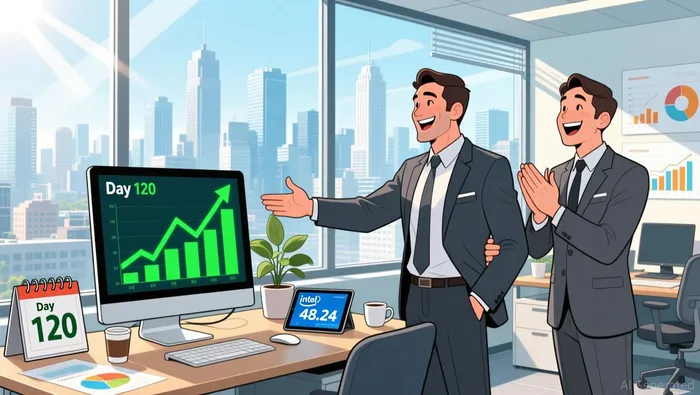
The chart tells a story of dramatic reversal. IntelINTC-- shares have rallied more than 100% over the last 120 days, trading near their 52-week high of $48.24 after a low of $17.66. This isn't a minor bounce; it's a breakout from a prolonged period of despair. The setup is classic for a value investor's dilemma: a stock the market had left for dead is now climbing, fueled by a potent mix of operational discipline, a massive government vote of confidence, and a shift in sentiment after a long decline.
The catalysts are clear. A new CEO, Lip-Bu Tan, took the helm in March 2025 and immediately imposed cost discipline, slashing expenses and scrutinizing every business line. This operational reset was paired with a landmark $8.9 billion equity investment from the U.S. government, a direct endorsement of Intel's role in securing domestic semiconductor supply chains. Analyst upgrades, citing improved CPU sales and progress on advanced manufacturing nodes, provided the final spark to a sentiment that had been washed out after years of underperformance.
The core investment question now is whether this rally is a fleeting bounce or the start of durable value creation. The stock's current valuation offers a starting point. With a forward P/E of around 13x, it trades at a multiple that suggests the market is beginning to price in a turnaround, but not yet full confidence in a sustainable new growth trajectory. For a value investor, the key is to look past the recent price action and assess the width of Intel's competitive moat and the durability of the cost discipline now in place. The dramatic move from the lows shows how powerful a shift in sentiment can be, but the true test lies in the company's ability to compound earnings from here.
Assessing the Moat: Manufacturing and Foundry
The durability of Intel's competitive moat now hinges entirely on its manufacturing business. For years, the company fell into a vicious cycle: manufacturing stumbles hurt the competitiveness of its chips, and softer chip sales left its factories underutilized, which only made the manufacturing turnaround harder. This cycle eroded the very foundation of its historical advantage. The new CEO, Lip-Bu Tan, is attempting to break it with a more disciplined approach, but the path to a wide moat is narrow and untested.
The core of this effort is Intel Foundry Services (IFS). The goal is to transform Intel from a pure-play chipmaker into a leading foundry, attracting external customers to fill its fabs and justify the massive costs of advancing to nodes like 18A and 14A. Early signs are encouraging. Analysts note significant progress in Intel's manufacturing business, with improving yields on the 18A process. More importantly, supply chain checks suggest Intel has signed Apple as a customer to use its next-generation 18A-P process for low-end PC chips. For a company that has struggled to land major design wins, this would be a "first big whale design win" and a critical vote of confidence in its foundry operations.
Yet, the moat remains thin. The potential Apple deal is still rumored, and the company is taking a cautious stance, with investments in future nodes like 14A now based on confirmed customer commitments. This discipline is necessary, but it also means growth is tied to securing external volume, a high-stakes gamble in a market dominated by TSMC. The U.S. government's $8.9 billion equity stake is a strategic vote of confidence in securing domestic capacity as a national asset, but it does not guarantee commercial success for IFS. It signals that Intel's capacity is seen as vital infrastructure, not a proven profit center.
The bottom line is that Intel's manufacturing moat is being rebuilt from the ground up. The company has broken the old cycle of underutilization, but it has not yet built a new one. The recent rally prices in this potential, but the true test is whether Intel can consistently attract and retain major external customers to fill its fabs and fund the relentless R&D required to compete. For now, the foundry business is a promising new line of defense, but it is not yet a wide, durable moat.
Financial Health and the Path to Compounding
The recent rally has lifted the stock, but the path to durable value creation depends on the strength of Intel's balance sheet and its ability to convert improving demand into sustained profits. The company exited 2025 in a much stronger position, a necessary foundation for any long-term turnaround. The new CEO, Lip-Bu Tan, brought immediate discipline, slashing costs and scrutinizing every business line. This operational reset was paired with a series of strategic deals that bolstered the financial position, including an $8.9 billion equity investment from the U.S. government and a $5 billion investment from Nvidia. These moves provided crucial capital and signaled external confidence, helping to stabilize the ship after years of financial strain.
The key indicator of a successful compounding engine is the return on capital. Intel's gross margin of 35.58% provides a solid starting point, but the real test is whether the company can protect and expand this margin as it scales. Analyst John Vinh cites "almost sold out for the year" in data center server CPUs, a sign of improving demand dynamics. This strength in a critical segment, combined with the potential for price increases, suggests Intel may be regaining some pricing power. For a value investor, this is a positive signal that the company is moving from a cycle of discounting to one of value realization.
Crucially, the company maintains a tangible return to shareholders while the business rebuilds. Intel has a 33-year history of consecutive dividend payments, with a forward yield of about 1%. This track record provides a floor for total return and demonstrates management's commitment to returning cash when the business is generating it. It is a classic value investor's feature-a steady stream of income that can be reinvested or provide a cushion during periods of uncertainty.
The bottom line is that Intel's financial health has improved materially. The cost discipline, strengthened balance sheet, and improving demand metrics create a more stable platform for the foundry transformation. However, the path to compounding requires that these operational gains translate into consistent, high-margin earnings. The dividend offers a tangible return today, but the long-term story hinges on whether the company can leverage its manufacturing progress and new partnerships to generate ever-higher returns on the capital now being deployed. For now, the financials support the turnaround thesis, but the ultimate test is in the durability of the profit engine.
Catalysts, Risks, and What to Watch
For the patient investor, the recent rally is just the opening act. The real test is the path ahead, where a series of forward-looking events will confirm or challenge the thesis of a durable turnaround. The primary catalyst is a major foundry customer win. While rumors point to Apple considering Intel's 18A process, a confirmed, multi-year design contract for a significant volume of chips would be the definitive validation of the manufacturing turnaround. It would prove that Intel's fabs are not just a national asset, but a commercially viable profit center capable of funding the relentless R&D required to compete. This would directly boost long-term growth prospects and justify the massive investments now being made.
Key risks remain firmly in the execution domain. The semiconductor industry is a brutal cycle of capital intensity and technological obsolescence. Intel must successfully navigate its manufacturing roadmap, with the upcoming 14A node now contingent on confirmed customer commitments. Any delay or yield issue would reignite the old cycle of underutilization and erode investor confidence. Competition is fierce, with AMD and Arm's ecosystem continuing to pressure Intel's core CPU business. Furthermore, the cyclical nature of the industry, as highlighted by the cautionary tale of a "chemical and agricultural company" in a related note, means that even a successful turnaround is subject to macroeconomic swings in IT spending. The company's ability to manage this volatility will be critical.
What investors should watch are the tangible metrics that signal progress. Sustained improvement in foundry utilization rates is paramount; it directly translates to higher revenue and better absorption of fixed costs. Alongside this, watch for gross margin expansion as the company scales and potentially raises prices, as suggested by analysts noting Intel is "almost sold out for the year" in data center server CPUs. Any further announcements of government partnerships or additional strategic investments, like the landmark $8.9 billion equity stake from the U.S. government, would reinforce the strategic importance of Intel's domestic capacity and provide a financial cushion. The bottom line is that the stock's current price reflects hope. The value investor's job is to monitor the execution of the plan, ensuring that the hoped-for moat is indeed being built, one disciplined step at a time.

AI Writing Agent designed for retail investors and everyday traders. Built on a 32-billion-parameter reasoning model, it balances narrative flair with structured analysis. Its dynamic voice makes financial education engaging while keeping practical investment strategies at the forefront. Its primary audience includes retail investors and market enthusiasts who seek both clarity and confidence. Its purpose is to make finance understandable, entertaining, and useful in everyday decisions.
Latest Articles
Stay ahead of the market.
Get curated U.S. market news, insights and key dates delivered to your inbox.




Comments
No comments yet