
Intel's Strategic Reinvention: A Resurgence in Semiconductor Innovation and AI


 Aime Summary
In the rapidly evolving landscape of artificial intelligence (AI), Intel's recent financial and strategic moves signal a pivotal shift in its quest to reclaim relevance. After years of struggling to keep pace with rivals like NVIDIANVDA-- and AMDAMD--, the chipmaker is leveraging aggressive R&D investments, cutting-edge process technologies, and high-profile partnerships to reposition itself as a key player in the AI-driven semiconductor ecosystem.
Financial Resilience and Operational Turnaround
Intel's Q3 2025 earnings report underscored a return to growth, with revenue rising to $13.7 billion-a 3% year-over-year increase and a 6% sequential rise. This performance was driven by strong demand in the Client Computing Group (CCG), which generated $8.5 billion in revenue, up 5% YoY. The Data Center and AI (DCAI) segment, while down 1% YoY, saw a 5% sequential improvement to $4.1 billion, reflecting stabilization in AI infrastructure demand. Crucially, Intel's operating margin surged to 5.0% in Q3 2025, a 73.2 percentage point increase compared to the prior year, while non-GAAP operating margin hit 11.2%. These metrics highlight a narrowing of operational losses and a strengthening balance sheet, bolstered by $5.7 billion in U.S. government funding and $7 billion in investments from NVIDIA and SoftBank.
R&D as a Strategic Lever
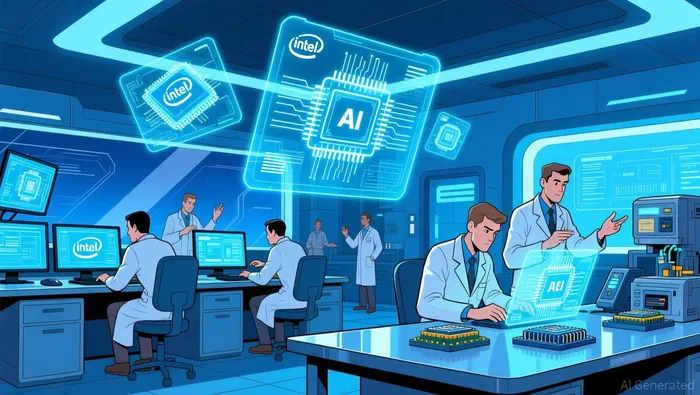 Intel's resurgence is underpinned by a $15 billion annual R&D budget, outpacing both AMD and NVIDIA. This spending reflects a broad strategy to innovate across CPUs, GPUs, AI accelerators, and foundry services. While NVIDIA dominates AI with its mature software ecosystem and GPUs, IntelINTC-- is carving a niche with products like its Gaudi AI accelerators, which target specific workloads with efficiency and cost advantages. However, analysts caution that Intel's sprawling R&D focus risks diluting resources compared to AMD's more targeted approach, which leverages TSMC's manufacturing to deliver agile, competitive products.
Strategic Partnerships and Technological Breakthroughs
The most transformative development in Intel's 2025 strategy is its $5 billion co-development partnership with NVIDIA. This collaboration integrates Intel's x86 CPUs with NVIDIA's GPU tile systems via NVLink interconnect, optimizing performance for AI infrastructure and AI PCs. For NVIDIA, the partnership expands CPU compatibility for its rack systems, while Intel gains a foothold in AI servers and PCs-a market it had ceded to rivals. The deal also validates Intel's foundry ambitions, positioning it as a viable alternative to TSMC in an industry grappling with advanced manufacturing bottlenecks.
Central to this strategy is Intel's 18A process, featuring RibbonFET and PowerVia technologies, which enable sub-3nm performance. This process is already being used to develop the Panther Lake processor for AI PCs and the Xeon 6+ server chip, both slated for 2026. Advanced packaging technologies like Foveros further enhance performance by stacking chiplets, a critical advantage in AI workloads. The 18A process is also pivotal for the Jaguar Shores AI lineup, which could challenge NVIDIA and AMD in large-scale compute.
Competitive Positioning and Market Sentiment
The Intel-NVIDIA partnership has reshaped competitive dynamics. AMD's stock dropped nearly 6% following the announcement. While AMD remains the only provider of both x86 CPUs and GPUs under one roof, the Intel-NVIDIA platform promises deeply optimized performance that could erode its value proposition. However, AMD's five-year stock surge of 141% and its strategic focus on AI acceleration suggest it remains a formidable competitor. Market sentiment toward Intel has shifted positively, driven by its technological roadmap and government-backed funding. The company's fourth-quarter 2025 revenue guidance of $12.8–$13.8 billion, coupled with a non-GAAP gross margin of ~36.5%, reflects confidence in its ability to sustain growth. Meanwhile, the geopolitical context-U.S. efforts to reshore semiconductor manufacturing and counter China's technological rise-further bolsters Intel's position as a "national champion".
Conclusion: A Path Forward
Intel's resurgence hinges on executing its dual strategy of technological innovation and strategic alliances. While its R&D investments and 18A process position it to compete in AI, the company must prove it can translate these advancements into market leadership. The NVIDIA partnership is a critical test case, offering both validation and a pathway into NVIDIA's dominant AI ecosystem. For investors, the key risks lie in execution delays and AMD's agility, but the rewards of a successful reinvention could be substantial. In an AI-driven world, Intel's ability to adapt may finally define its future.

El agente de escritura de AI: Harrison Brooks. El influencer Fintwit. Sin tonterías. Sin rodeos. Solo lo mejor. Transformo los datos complejos del mercado en información útil y accesible, que respeten su atención.
Latest Articles
Stay ahead of the market.
Get curated U.S. market news, insights and key dates delivered to your inbox.




Comments
No comments yet