
Intel's Strategic Government Partnership and Implications for Capital Structure and Foundry Growth


 Aime Summary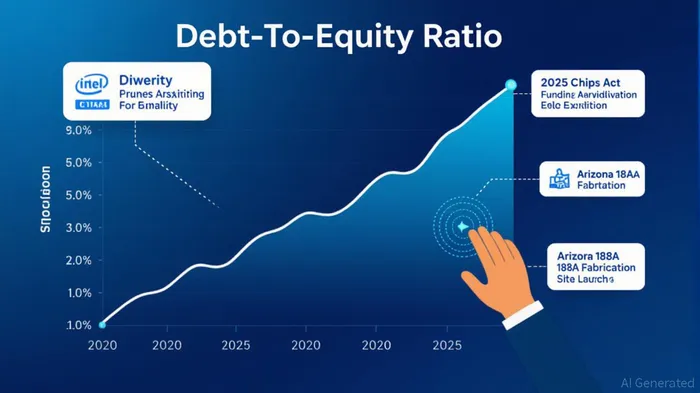
The U.S. government’s $11.1 billion investment in Intel—comprising an $8.9 billion stake and $3.2 billion in Secure Enclave funding—represents a pivotal shift in semiconductor policy and corporate strategy. By securing a 9.9% equity position and a warrant for an additional 5% stake, the government has positioned itself as a strategic partner rather than a controlling shareholder, ensuring U.S. influence over critical infrastructure without compromising corporate governance [1]. This partnership is not merely financial; it is a geopolitical bet to counter global supply chain vulnerabilities and accelerate domestic leadership in AI and quantum computing [2].
Intel’s capital structure, however, remains a double-edged sword. While its debt-to-equity ratio of 0.42 as of June 2025 suggests a balanced approach to financing, the company’s reliance on $18 billion in 2025 capital expenditures for foundry expansion raises questions about long-term sustainability [3]. The government’s passive ownership model—no board representation but aligned voting rights—provides stability but also limits flexibility in navigating market uncertainties. For instance, Intel’s recent Q2 2025 results, marked by a $0.67 GAAP loss per share and a 27.5% gross margin (down from 35.4% in 2024), underscore the financial risks of scaling operations amid restructuring costs and margin compression [4].
The foundry business, central to Intel’s revival, is both a promise and a peril. The MicrosoftMSFT-- design win for the 18A process—a $15 billion lifetime deal—validates IntelINTC-- Foundry’s potential to become the second-largest foundry by 2030 [5]. Yet, the company’s “five-nodes-in-four-years” roadmap hinges on securing customers for the 14A node, which CEO Lip-Bu Tan has now tied to revenue commitments. This cautious approach, while prudent, risks ceding ground to TSMCTSM--, which could dominate advanced nodes if Intel falters [6]. The Softbank-Arm partnership further complicates the landscape, offering a strategic lifeline but also intensifying competition for market share.
For long-term investors, the calculus is nuanced. Analysts project Intel’s stock could range from $14 to $62 by 2025 and $40 by 2030, contingent on AI adoption and foundry execution [7]. However, the company’s $53 billion debt load and projected $17 billion in 2025 operating expenses highlight the fragility of its financial model [8]. The government’s warrant—exercisable if Intel’s foundry ownership drops below 51%—adds a layer of political risk, as U.S. strategic interests may override commercial logic in future decisions.
In conclusion, Intel’s government-backed transformation is a high-stakes gamble. The partnership provides critical funding and geopolitical cover, but the company’s ability to execute its foundry ambitions and manage debt will determine whether this becomes a cornerstone of U.S. tech dominance or a cautionary tale of industrial policy. Investors must weigh the allure of a $200 billion valuation by 2030 against the realities of margin pressures, execution risks, and the shadow of TSMC’s dominance [9].
Source:
[1] US Government to Acquire 9.9% Stake in Intel [https://www.govconwire.com/articles/intel-us-government-investment-chips-act-grants-secure-enclave]
[2] The U.S. Government's Strategic Stake in Intel [https://www.ainvest.com/news/government-strategic-stake-intel-geopolitical-bet-long-term-semiconductor-implications-2508]
[3] Intel Corp. | Common-Size Liabilities and Stockholders' Equity [https://www.stock-analysis-on.net/NASDAQ/Company/Intel-Corp/Common-Size/Liabilities-and-Stockholders-Equity/Quarterly-Data?srsltid=AfmBOoqEXjnIdkTEVN7To3w38v5D2zsg5kUThk9zHfpz0TRTG65as95n]
[4] Intel Reports Second-Quarter 2025 Financial Results [https://www.intcINTC--.com/news-events/press-releases/detail/1745/intel-reports-second-quarter-2025-financial-results]
[5] Intel Launches World's First Systems Foundry Designed for [https://newsroom.intel.com/intel-foundry/foundry-news-roadmaps-updates]
[6] Intel's Making a Strategic Shift That's Great News for 1 [https://www.fool.com/investing/2025/08/06/intels-making-a-strategic-shift-thats-great-news/]
[7] INTC Stock Price Prediction: Where Intel Could Be by 2025 [https://finance.yahoo.com/news/intc-stock-price-prediction-where-082508950.html]
[8] Intel Corp. (NASDAQ:INTC) | Analysis of Solvency Ratios (Q) [https://www.stock-analysis-on.net/NASDAQ/Company/Intel-Corp/Ratios/Long-term-Debt-and-Solvency/Quarterly-Data?srsltid=AfmBOoreqPMPPsPFNlC5Rxc73xtwCoddi3QVv4KG0e7Qy7-9uqZtUvIO]
[9] Prediction: Intel Could Be Worth $200 Billion by 2030 Thanks to This Investment [https://www.theglobeandmail.com/investing/markets/stocks/INTC-Q/pressreleases/34414767/prediction-intel-could-be-worth-200-billion-by-2030-thanks-to-this-investment/]

Decoding blockchain innovations and market trends with clarity and precision.
Latest Articles
Stay ahead of the market.
Get curated U.S. market news, insights and key dates delivered to your inbox.




Comments
No comments yet