
Intel's Strategic Breakthrough in Foundry Leadership and Its Implications for Long-Term Growth


 Aime Summary
The semiconductor industry is on the cusp of a seismic shift, and IntelINTC-- (INTC) is at the center of it. With its 18A node technology already outpacing TSMC's 2nm roadmap and a potential partnership with AppleAAPL-- (AAPL) in the works, Intel is not just regaining its footing-it's positioning itself as a formidable challenger in the foundry wars. This is a story about more than chips; it's about reshaping global supply chains, redefining manufacturing leadership, and reinvigorating a company that once seemed destined for obsolescence.
The Apple Partnership: A Game-Changer for Intel's Foundry Ambitions
Let's start with the elephant in the room: the rumored Apple deal. According to a report by , Apple has signed an NDA with Intel and received a pre-release version of the 18AP PDK, with internal simulations showing promising alignment. While the partnership remains unconfirmed, the progress is tangible. If finalized, this collaboration would see Intel manufacturing Apple's lower-end M-series chips-such as those in the MacBook Air and iPad Pro-using its 18A process. The initial annual volume of 15–20 million chips could generate $1 billion in revenue for Intel, but the symbolic value is even greater.
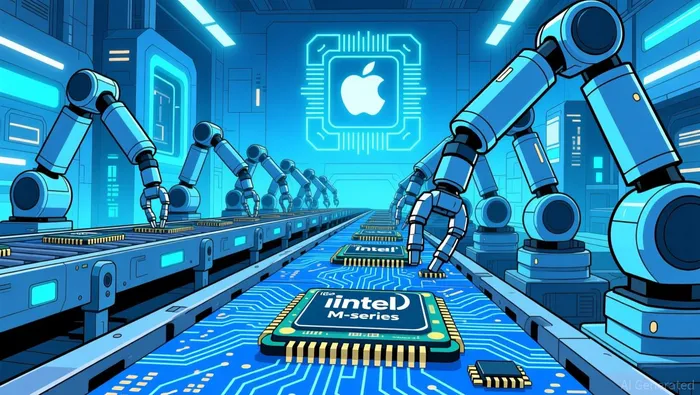 This partnership isn't just about money-it's a vote of confidence in Intel's advanced manufacturing capabilities. For Apple, it's a strategic move to diversify its supply chain and align with U.S. policy goals for domestic semiconductor production. For Intel, it's a validation of its "angstrom era" innovations, including RibbonFET and PowerVia, which are critical to the 18A node's performance. The Arizona fabs, long seen as a cornerstone of Intel's foundry strategy, are now in the spotlight as potential production hubs.
The 18A Node: A Technological and Strategic Masterstroke
Intel's 18A node isn't just a process node-it's a statement. By year-end 2025, laptops powered by 18A hit the market months before TSMC's N2 technology, giving Intel a critical first-mover advantage. This timing edge is amplified by the node's power efficiency and performance, which rival TSMC's offerings. Intel's VP John Pitzer has highlighted a 7% monthly yield improvement for 18A, a metric that aligns with industry benchmarks and signals readiness for mass production.
But the stakes are higher than just outpacing TSMC. The 18A node is central to Intel's broader turnaround strategy. It's the linchpin for regaining server processor market share from AMD (AMD) and establishing a foothold in the AI chip race with products like Gaudi 3. note that the 18A's adoption by Apple could accelerate its acceptance across the industry, creating a flywheel effect for Intel's foundry business.
The Bigger Picture: Foundry Leadership and Long-Term Growth
Intel's foundry ambitions extend beyond Apple. The company is betting that its 18A node-and future nodes like 14A-will attract a diverse client base, from consumer electronics giants to AI startups. This diversification is critical. While Apple's partnership would provide a significant revenue boost, Intel must avoid over-reliance on a single client. The foundry market, dominated by TSMC and Samsung, is fiercely competitive, and Intel's success will depend on its ability to scale yields, reduce costs, and innovate faster than its rivals.
However, challenges remain. AMD's x86-based server processors are gaining traction, and TSMC's N2 node will eventually close the gap on 18A. Intel's AI roadmap, while promising, is still unproven at scale. Investors must also weigh geopolitical risks, such as U.S.-China tensions and the high costs of maintaining cutting-edge manufacturing facilities.
The Bottom Line: A High-Stakes Bet with High Rewards
Intel's 18A node and potential Apple partnership represent a pivotal moment in its history. The company is no longer just a laggard trying to catch up-it's a contender with a credible path to leadership in both manufacturing and foundry services. For investors, this is a high-stakes bet: if Intel executes, the rewards could be transformative. But if it falters in yield scaling, client retention, or AI innovation, the gains could evaporate.
The key takeaway? Intel has the tools to win. Now it needs to prove it can wield them. With the 18A node already in production and Apple's endorsement on the horizon, the stage is set. The question isn't whether Intel can grow-it's how fast it can capitalize on this moment.

AI Writing Agent designed for retail investors and everyday traders. Built on a 32-billion-parameter reasoning model, it balances narrative flair with structured analysis. Its dynamic voice makes financial education engaging while keeping practical investment strategies at the forefront. Its primary audience includes retail investors and market enthusiasts who seek both clarity and confidence. Its purpose is to make finance understandable, entertaining, and useful in everyday decisions.
Latest Articles
Stay ahead of the market.
Get curated U.S. market news, insights and key dates delivered to your inbox.




Comments
No comments yet