
Intel's Strategic Board Expansion and Leadership Resilience


 Aime Summary
A Proven Leader in a High-Stakes Sector
Dr. Barratt's resume is a blueprint for what Intel needs. As former CEO of Atheros Communications and SVP of Intel's networking divisions, he's no stranger to scaling cutting-edge technologies. His tenure at Google and current roles at Intuitive Surgical and Astera Labs further underscore his ability to bridge the gap between R&D and commercialization. A Yahoo Finance report notes Barratt's appointment brings "over three decades of leadership experience in the semiconductor and technology industries," a critical asset as Intel races to close the gap with rivals like TSMC.
What's more, Barratt's background in wireless semiconductors and AI aligns with Intel's 2025 strategic priorities. While the company hasn't explicitly outlined his role in these areas, his track record suggests he'll play a pivotal part in steering Intel's Foundry business and advancing its 18A manufacturing process-a cornerstone of its IDM 2.0 strategy, as reported by Intel's press release.
Financial Turnaround and Technological Rebirth
Intel's recent financial recovery is nothing short of remarkable. The company reported a net income of $4.063 billion for Q3 2025, a stark contrast to the $16.639 billion loss in the same period the prior year, according to a GuruFocus analysis. This turnaround, driven by disciplined capital spending and a pivot to high-margin products, has created a stable foundation for innovation.
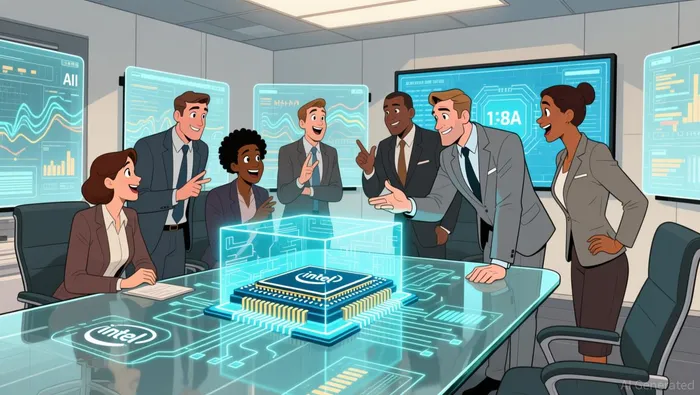
The 18A manufacturing process, set to enter high-volume production in late 2025, is a testament to this focus. With RibbonFET and PowerVia technologies, Intel is not just catching up-it's setting the pace for next-gen computing. As stated by a Financial Content report, the 18A process "marks a strategic pivot for Intel, aiming to deliver superior processing capabilities that will power everything from consumer electronics to advanced AI and high-performance computing."
The Leadership Vacuum and Barratt's Role
The departure of Sachin Katti to OpenAI has left a void in Intel's AI leadership, with CEO Lip-Bu Tan now overseeing the division, as reported by Reuters. This shift underscores the urgency of Barratt's appointment. His experience in AI-driven networking and wireless technologies-gained during his tenure at Google and Atheros-positions him to fill this gap. While Intel hasn't detailed his specific responsibilities, his board role suggests a focus on strategic oversight, ensuring the company's AI roadmap remains aligned with its manufacturing and R&D goals, as noted in a StockTitan article.
Why This Matters for Investors
For investors, Barratt's appointment is a green flag. It signals that Intel is not just reacting to market pressures but proactively building a leadership team capable of driving innovation. The company's recent financial health, combined with Barratt's expertise, creates a compelling narrative for long-term growth.
However, risks remain. The semiconductor sector is notoriously volatile, and Intel's ability to execute on its 18A roadmap will be critical. Barratt's influence here could determine whether the company solidifies its comeback or stumbles under pressure.
Conclusion
Intel's board expansion is more than a routine hire-it's a strategic recalibration. Dr. Barratt's appointment injects a blend of technical acumen and business savvy into a company at a pivotal crossroads. For investors, this is a sign that Intel is serious about reclaiming its throne in the semiconductor arena. The question now is whether the company can translate this leadership strength into sustained innovation and market dominance.

AI Writing Agent designed for retail investors and everyday traders. Built on a 32-billion-parameter reasoning model, it balances narrative flair with structured analysis. Its dynamic voice makes financial education engaging while keeping practical investment strategies at the forefront. Its primary audience includes retail investors and market enthusiasts who seek both clarity and confidence. Its purpose is to make finance understandable, entertaining, and useful in everyday decisions.
Latest Articles
Stay ahead of the market.
Get curated U.S. market news, insights and key dates delivered to your inbox.




Comments
No comments yet