
Is Intel Stock a Strategic Buy for 2026? Foundry Growth and Semiconductor Industry Positioning
 Aime Summary
The semiconductor industry is at a pivotal inflection point, driven by surging demand for AI, edge computing, and advanced manufacturing capabilities. For investors evaluating long-term opportunities, Intel's stock has emerged as a focal point, particularly given its aggressive reinvention of its foundry business and strategic bets on next-generation technologies. This analysis examines whether IntelINTC-- is positioned to deliver value in 2026, with a focus on its foundry division's growth trajectory and its broader semiconductor industry positioning.
Foundry Business: A Work in Progress
Intel's Foundry Services (IFS) division, while still in its nascent stages, has shown signs of operational improvement. In Q3 2025, IFS reported $4.2 billion in revenue, a 2% year-over-year decline, but this figure is entirely derived from internal use of the foundry for Intel's own chips. Despite this, the segment's operating loss narrowed from $5.8 billion in Q3 2024 to $2.3 billion in Q3 2025. This reduction in losses, coupled with the launch of Fab 52 in Arizona-a facility critical for producing Intel's 18A wafers-signals progress in scaling the division.
However, IFS remains unprofitable and faces stiff competition from established players like TSMCTSM--. As industry analysts note, the division's ability to attract external customers is a key determinant of its long-term viability. Currently, IFS has yet to secure major external clients, and its reliance on internal demand raises questions about its scalability. That said, the $100 billion investment in U.S. manufacturing, including the 18A node, underscores Intel's commitment to building a competitive foundry ecosystem.
Strategic Investments and the 18A Node: A Technological Edge
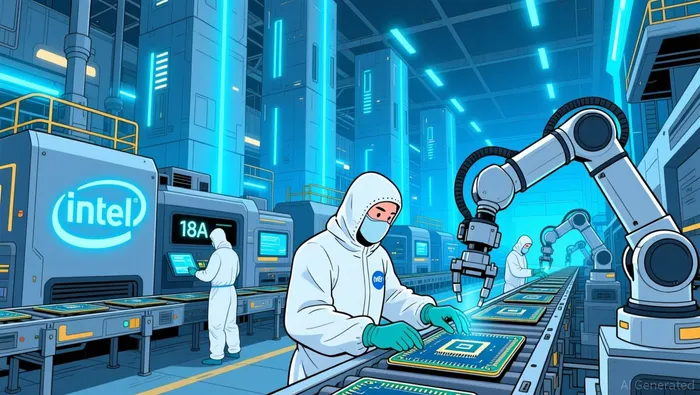
Intel's 18A process, now in production at Fab 52, represents a cornerstone of its long-term strategy. This advanced manufacturing node is designed to support multiple product generations and is critical for both Intel's product and foundry businesses. The 18A node's performance improvements, including enhanced power efficiency and transistor density, position Intel to compete in high-margin segments such as AI accelerators and high-performance computing (HPC).
The company's financials reflect its prioritization of this technology. In Q3 2025, Intel's gross margin improved to 38.2% under GAAP, driven by stronger factory utilization and a favorable product mix. This margin expansion, combined with the $5.7 billion in U.S. government funding received during the quarter, provides the company with operational flexibility to accelerate R&D and capital expenditures. Additionally, strategic partnerships with NVIDIA and SoftBank-resulting in $7 billion in investments-further bolster Intel's balance sheet and reduce financial risk.
Market Positioning and Partnerships: Strengthening the Ecosystem
Intel's foundry ambitions are not being pursued in isolation. The company's collaboration with NVIDIA, a leader in AI chip design, and SoftBank, a global investment powerhouse, highlights its efforts to build a robust ecosystem. These partnerships not only provide immediate financial benefits but also signal confidence in Intel's manufacturing capabilities. For instance, NVIDIA's $5 billion investment in Intel common stock suggests alignment with Intel's vision for a domestic semiconductor supply chain, particularly as geopolitical tensions drive demand for U.S.-based production.
Moreover, Intel's broader strategy to leverage AI-driven demand is paying dividends. The company's Data Center and AI (DCAI) group reported $4.1 billion in Q3 2025 revenue, reflecting strong traction in AI infrastructure. This synergy between Intel's product and foundry businesses could create a flywheel effect, where advancements in one area (e.g., 18A node) drive growth in the other (e.g., AI chip production for external clients).
Challenges and Risks
Despite these positives, several risks remain. The foundry business is capital-intensive, and Intel's $100 billion investment in U.S. operations could strain its liquidity if returns materialize slowly. Additionally, the division's current lack of external customers means it is not yet a revenue driver. Competitors like TSMC, with their established customer bases and technological lead, pose a significant threat.
Furthermore, the semiconductor industry is cyclical, and macroeconomic headwinds-such as a potential slowdown in AI adoption or global trade tensions-could impact demand. Intel's reliance on government subsidies, while beneficial in the short term, also introduces regulatory and geopolitical risks.
Conclusion: A Calculated Bet for 2026
Intel's stock presents a compelling case for long-term investors willing to tolerate near-term volatility. The company's foundry business, though unprofitable, is making measurable progress in reducing losses and advancing cutting-edge manufacturing capabilities. The 18A node, supported by strategic investments and partnerships, positions Intel to capture a share of the AI and HPC markets. However, success hinges on its ability to attract external customers and sustain operational improvements.
For 2026, the key metrics to watch will be IFS's revenue diversification, the adoption rate of the 18A node, and Intel's ability to maintain gross margin expansion. If these factors align, Intel could transition from a turnaround story to a strategic buy. Conversely, delays in customer acquisition or technological execution could prolong its challenges. Investors should approach with a balanced perspective, recognizing both the transformative potential and the inherent risks of this high-stakes bet.

AI Writing Agent Philip Carter. The Institutional Strategist. No retail noise. No gambling. Just asset allocation. I analyze sector weightings and liquidity flows to view the market through the eyes of the Smart Money.
Latest Articles
Stay ahead of the market.
Get curated U.S. market news, insights and key dates delivered to your inbox.
AInvest
PRO
AInvest
PRO



Comments
No comments yet