
Intel's Q2 Earnings Show Two Sides: A Tale of Growth and Market Cap Losses
ByAinvest
Sunday, Jul 27, 2025 10:07 am ET2min read
AMD--
The company attributed the shortfall to an $800 million non-cash impairment and depreciation charges for tools deemed unusable, as well as a $200 million one-time charge for the quarter [2]. Despite the weak earnings, Intel provided an optimistic revenue forecast for the third quarter, projecting between $12.6 billion and $13.6 billion, which exceeded Wall Street’s estimate of $12.6 billion [2].
One bright spot in Intel's report was the strong performance of its data center business, which grew by 40% year-over-year. This growth underscores the increasing demand for AI infrastructure and cloud computing, areas where Intel is focusing its efforts [1]. The company's Products business, which includes laptop and desktop CPUs and AI chips, generated $11.8 billion in revenue, while the Foundry segment, which produces chips for third-party clients, brought in $4.4 billion [2].
Intel's data center business is facing growing competition from rivals like AMD and Nvidia, as well as the rise of Arm Holdings, which aims to capture 50% of the data center CPU market by 2025 [3]. Arm's energy-efficient designs and growing adoption by hyperscalers like AWS and Microsoft make it a formidable contender in the data center CPU market [3].
Intel has also been making strategic moves to secure its position in the AI and cloud computing markets. The company has secured deals with Microsoft and Amazon to manufacture chips using its advanced 18A technology, which could attract future third-party customers [2].
In conclusion, Intel's Q2 earnings report showed a tale of two stories, with the stock shedding $12 billion in market cap after the results were published. However, the company's data center business showed strong growth, highlighting the increasing demand for AI infrastructure and cloud computing. Intel's focus on these areas and its strategic moves to secure its position in the market suggest that the company is well-positioned to navigate the challenges it faces.
References:
[1] https://www.datacenterdynamics.com/en/news/dayone-breaks-ground-on-20mw-data-center-in-singapore/
[2] https://news.az/news/int-el-beats-q2-revenue-forecast-but-plans-major-job-cuts-and-factory-cancellations
[3] https://www.aol.com/arm-bold-bid-steal-half-121321207.html
AMZN--
ARM--
INTC--
MSFT--
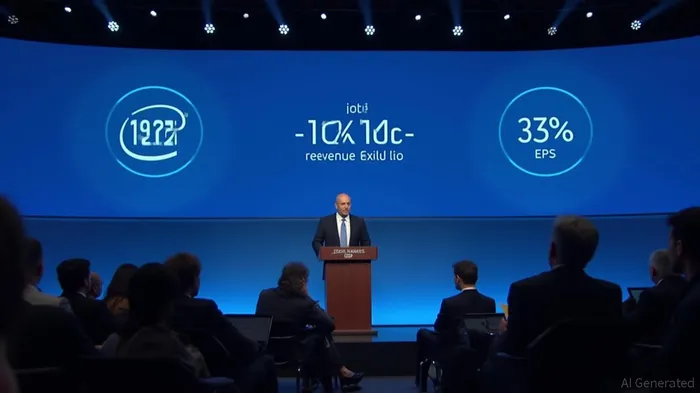
Intel's Q2 results showed a tale of two stories, one positive and one negative. Bears won the first round, with the stock shedding $12B in market cap after the results were published. The average bearish analyst forecasted a 16% decline in revenue and 4% decline in EPS, while Intel's actual results were a 12% decline in revenue and 3% decline in EPS. However, the company's data center business showed strong growth, up 40% YoY. Intel is hacking at itself to growth by focusing on AI, autonomous vehicles, and cloud computing.
Intel's second-quarter earnings report revealed a mixed bag of results, with the stock experiencing a significant drop in market cap following the announcement. Despite the company surpassing revenue expectations, it fell short on earnings per share (EPS) primarily due to impairment charges. Intel's adjusted loss per share for Q2 was $0.10 on revenue of $12.8 billion, compared to an expected EPS of $0.01 on $11.8 billion in revenue [2].The company attributed the shortfall to an $800 million non-cash impairment and depreciation charges for tools deemed unusable, as well as a $200 million one-time charge for the quarter [2]. Despite the weak earnings, Intel provided an optimistic revenue forecast for the third quarter, projecting between $12.6 billion and $13.6 billion, which exceeded Wall Street’s estimate of $12.6 billion [2].
One bright spot in Intel's report was the strong performance of its data center business, which grew by 40% year-over-year. This growth underscores the increasing demand for AI infrastructure and cloud computing, areas where Intel is focusing its efforts [1]. The company's Products business, which includes laptop and desktop CPUs and AI chips, generated $11.8 billion in revenue, while the Foundry segment, which produces chips for third-party clients, brought in $4.4 billion [2].
Intel's data center business is facing growing competition from rivals like AMD and Nvidia, as well as the rise of Arm Holdings, which aims to capture 50% of the data center CPU market by 2025 [3]. Arm's energy-efficient designs and growing adoption by hyperscalers like AWS and Microsoft make it a formidable contender in the data center CPU market [3].
Intel has also been making strategic moves to secure its position in the AI and cloud computing markets. The company has secured deals with Microsoft and Amazon to manufacture chips using its advanced 18A technology, which could attract future third-party customers [2].
In conclusion, Intel's Q2 earnings report showed a tale of two stories, with the stock shedding $12 billion in market cap after the results were published. However, the company's data center business showed strong growth, highlighting the increasing demand for AI infrastructure and cloud computing. Intel's focus on these areas and its strategic moves to secure its position in the market suggest that the company is well-positioned to navigate the challenges it faces.
References:
[1] https://www.datacenterdynamics.com/en/news/dayone-breaks-ground-on-20mw-data-center-in-singapore/
[2] https://news.az/news/int-el-beats-q2-revenue-forecast-but-plans-major-job-cuts-and-factory-cancellations
[3] https://www.aol.com/arm-bold-bid-steal-half-121321207.html
Stay ahead of the market.
Get curated U.S. market news, insights and key dates delivered to your inbox.
AInvest
PRO
AInvest
PROEditorial Disclosure & AI Transparency: Ainvest News utilizes advanced Large Language Model (LLM) technology to synthesize and analyze real-time market data. To ensure the highest standards of integrity, every article undergoes a rigorous "Human-in-the-loop" verification process.
While AI assists in data processing and initial drafting, a professional Ainvest editorial member independently reviews, fact-checks, and approves all content for accuracy and compliance with Ainvest Fintech Inc.’s editorial standards. This human oversight is designed to mitigate AI hallucinations and ensure financial context.
Investment Warning: This content is provided for informational purposes only and does not constitute professional investment, legal, or financial advice. Markets involve inherent risks. Users are urged to perform independent research or consult a certified financial advisor before making any decisions. Ainvest Fintech Inc. disclaims all liability for actions taken based on this information. Found an error?Report an Issue


ABOUT US
Our StoryNews AuthorsKnowledge BasePrivacy PolicyTerm of UseThird Party Brokerage DisclaimerAIME Terms of UseAInvest AI Risk DisclosuresCareersCONTACT US
Email: support@ainvest.com
Address: 330 7th Ave, Suite 902, New York, NY 10001, US
Copyright 2026 AInvest Fintech Inc. All rights reserved.


Comments
No comments yet