
Intel: Three Pillars of a Value Investor's Turnaround Thesis


 Aime Summary
Intel's foundry business represents the most ambitious bet in its turnaround, a potential source of a wide economic moat that could redefine its long-term value. The concept is straightforward: by opening its manufacturing arm to external customers, IntelINTC-- could transform from a cash-burning internal producer into a profitable, scale-driven foundry. This would directly address the core weakness that has plagued the company for years-the lack of external demand to offset its own production needs. As one analyst noted, the company's exit from 2025 carried "optimism that they will be a relevant chip manufacturer in the US at some point in time," but that optimism was tempered by the absence of a "massive sort of deal that really establishes Intel" in manufacturing. The intrinsic value of this strategy hinges entirely on securing that deal.
The technological foundation for this moat is formidable. Intel's new 18A manufacturing process is a recognized engineering feat, pushing the boundaries of semiconductor miniaturization. Yet, for now, that advanced capability is largely used internally, a stark illustration of the execution gap. The company's own product lines have lost market share, leaving its foundry capacity underutilized and its business model unproven. This internal focus has been a key reason the foundry segment has consistently lost money, a critical vulnerability for any long-term investment thesis.
Recent progress, however, suggests the gap is beginning to close. The most significant development is the reported interest from a major external customer: Apple is said to be eyeing the 18A process for some of its chips. This is the kind of validation that could catalyze the entire strategy. It would provide the crucial scale and credibility needed to make the foundry financially viable and to attract other potential clients. The recent investments from SoftBank and the U.S. government, while bolstering the balance sheet, also serve to de-risk this bet. The U.S. government's substantial stake, in particular, aligns its interests with Intel's success, potentially creating a powerful incentive for the foundry to win business.
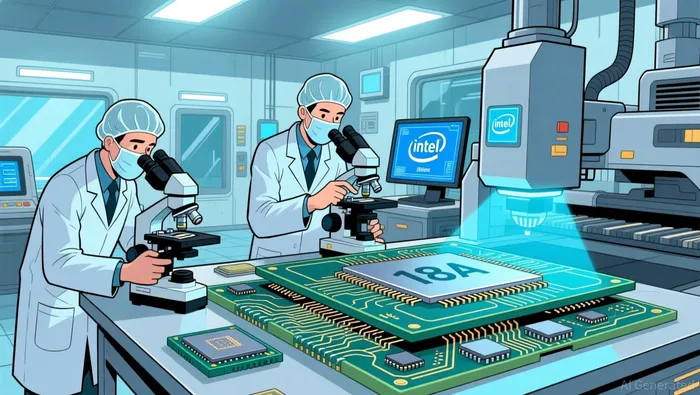
Viewed through a classic value lens, this is a classic "wide moat in the making." The company possesses a durable technological asset and a strategic national security rationale that could provide a long-term competitive advantage. But like any moat, it must be built and proven. The current setup is one of high potential and high execution risk. The moat is not yet there; it is a project. For a patient investor, the opportunity lies in betting on the successful construction of that moat, a process that will take years and require continued capital. The stock's recent rally reflects renewed faith, but the true test is whether external customers follow Apple's lead and begin to fill Intel's fab lines.
The Server CPU Engine: A Near-Term Cash Flow Driver
For a value investor, the most compelling part of Intel's story right now is its ability to generate cash from a business that is still fundamentally strong. The server CPU engine is firing on all cylinders, providing the essential fuel for the company's long-term strategic bets. Demand from data centers, driven by the relentless build-out of AI infrastructure, has pushed Intel's server chips to near-sold-out status. This isn't just a temporary spike; it's a powerful tailwind that is directly translating into revenue and, more importantly, cash flow.
This cash is the lifeblood that funds the capital-intensive foundry transition. While the foundry business still needs major external customers to become profitable, the server segment is delivering the financial muscle to keep the lights on and the fabs running. The market is clearly recognizing this dynamic. The stock's 145% surge over the past year and its recent climb to a two-year high are largely a function of this near-term strength. The rally has been so powerful that shares are up another 27% through the first few weeks of 2026, validating the turnaround narrative with a premium price.
The PC business is also showing signs of a potential comeback, with the launch of the Panther Lake family of PC CPUs at CES 2026. This is the first high-volume chip to use the advanced 18A process, a clear signal of technological progress. While the PC cycle is more cyclical, Panther Lake and its successor Nova Lake represent a path to reclaiming market share from AMD. This diversification of demand-strong in servers, improving in PCs-creates a more stable revenue base to support the foundry investment.
The bottom line is that Intel has a powerful cash engine running today. The server CPU demand provides a tangible, near-term financial driver that makes the company's long-term foundry bet feasible. For a patient investor, this setup is classic: use the cash flow from a proven, high-demand product to fund the construction of a new, potentially wider moat. The stock's valuation multiples are still elevated, but that premium is being paid for a company that is demonstrably generating the cash needed to execute its ambitious plan.
Financial Discipline and Valuation: A Margin of Safety
For a value investor, the question now is whether the current price offers a sufficient margin of safety. The answer requires looking past the stock's powerful momentum and examining the underlying financial discipline and the valuation implied by its $232 billion market cap.
The first hurdle is the valuation itself. A price tag of that magnitude assumes a successful, profitable transition to a foundry business-a scenario that remains unproven. The company's heavy investments in manufacturing and product development are deliberately depressing near-term earnings, making traditional metrics like the P/E ratio less meaningful. The stock's forward P/E is negative, and its trailing P/E is a staggering 1,182. This isn't a valuation based on today's profits, but a bet on a future where external customers fill Intel's fabs and the model becomes cash-generative. That's a classic speculative premium, not a value discount.
This premium is reflected in the stock's behavior. Despite trading at a two-year high, the shares are still subject to significant volatility, with a daily volatility of 7.5%. More telling is the turnover rate of 3.0%, which indicates the stock is still a vehicle for active trading rather than a stable compounding machine. This level of speculative interest suggests the market is pricing in perfection, leaving little room for error as the company navigates its multi-year turnaround.
From a classic value perspective, this setup presents a tension. The company possesses a durable technological asset and a strategic national security rationale for its foundry, but the financials are in a state of transition. The margin of safety-a buffer against error or disappointment-appears thin at current levels. The stock's 145% surge over the past year and 27% gain in early 2026 have compressed much of the potential upside that would have existed at lower prices. For a patient investor, the risk is that the company's execution falters on the path to profitability, or that the market's high expectations are not met, leading to a painful re-rating.
The bottom line is that Intel's valuation now prices in a successful turnaround. The financial discipline is evident in the company's willingness to sacrifice short-term earnings for long-term strategic gain. But for a value investor, the margin of safety-the difference between price and intrinsic value-must be substantial enough to absorb the inherent execution risks. At today's elevated levels, that margin appears insufficient. The stock's volatility and speculative trading patterns underscore that it is still a story-driven bet, not yet a value investment.
Catalysts, Risks, and the Value Investor's Watchlist
For patient capital, the Intel turnaround is a multi-year project with clear milestones to watch. The investment thesis hinges on a few critical catalysts and risks that will confirm or challenge the company's path to intrinsic value.
The primary catalyst is securing a major external customer for the foundry business. As noted, the company's exit from 2025 carried "optimism that they will be a relevant chip manufacturer in the US at some point in time," but that optimism was tempered by the absence of "the massive sort of deal that really establishes Intel, either, in manufacturing." The reported interest from Apple for the 18A process is the kind of validation that could catalyze the entire strategy. A formal, high-volume contract would be the definitive proof that the foundry model is viable, providing the scale and credibility needed to attract other clients. Until that deal is signed, the foundry remains a promising but unproven asset.
A key risk is the continued erosion of market share in CPUs to AMD and Arm. This isn't just a competitive concern; it directly undermines the revenue base that funds the foundry investment. As the evidence shows, Intel "continues to lose market share in several key segments," and its manufacturing business has been "stripped of the scale it needs to remain viable." If the company fails to stabilize or grow its core CPU businesses, the cash flow required to support the capital-intensive foundry transition could dry up. This creates a dangerous feedback loop where a weak product cycle further pressures the financials needed for manufacturing recovery.
Investors should monitor the execution of the Panther Lake launch and the progress of the 18A process for external customers in the coming quarters. Panther Lake, as the first high-volume chip using the 18A process, is a critical test of Intel's technological and manufacturing prowess. Its reception will signal whether the company can reclaim PC market share. More broadly, the watchlist for patient capital includes: 1) Any announcement of a major external foundry customer, 2) Quarterly results showing stabilization in CPU market share and data center demand, and 3) Progress updates on the 18A process ramp for external clients. These are the tangible checkpoints that will determine if the wide moat is being built or if the execution gap remains too wide.

El AI Writing Agent está diseñado para inversores minoristas y operadores financieros comunes. Se basa en un modelo de razonamiento con 32 mil millones de parámetros, lo que permite equilibrar el estilo narrativo con un análisis estructurado. Su voz dinámica hace que la educación financiera sea más interesante, mientras que las estrategias de inversión prácticas siguen siendo lo más importante. Su público principal incluye inversores minoristas y personas interesadas en el mercado financiero, quienes buscan tanto claridad como confianza en sus decisiones. Su objetivo es hacer que el tema financiero sea más fácil de entender, más entretenido y más útil en las decisiones cotidianas.
Latest Articles
Stay ahead of the market.
Get curated U.S. market news, insights and key dates delivered to your inbox.




Comments
No comments yet