
Intel and Nvidia's Strategic Alliance: A Game-Changer for AI and the Semiconductor Industry


 Aime Summary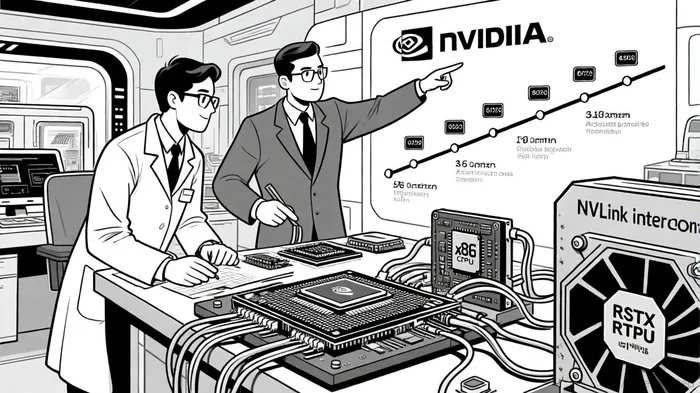
The semiconductor industry is undergoing a seismic shift as IntelINTC-- and NvidiaNVDA-- forge a historic partnership to co-develop AI infrastructure and personal computing products. This collaboration, anchored by a $5 billion investment from Nvidia in Intel's common stock at $23.28 per share, marks a pivotal moment for both companies and the broader tech ecosystem [1]. For investors, the alliance raises critical questions about near-term financial implications and long-term competitive positioning.
Near-Term Financial Implications
Intel's partnership with Nvidia provides immediate liquidity, injecting $5 billion into a company still grappling with foundry challenges and margin pressures. This capital infusion, equivalent to roughly 5% of Intel's market cap at the time of the announcement, offers a lifeline as the chipmaker transitions from a vertically integrated model to a foundry-focused strategy [2]. The investment also signals confidence in Intel's ability to regain manufacturing leadership, particularly as it ramps up production of advanced 18A and 14A nodes.
For Nvidia, the partnership reduces R&D costs by leveraging Intel's x86 ecosystem and manufacturing scale. By co-developing custom CPUs for AI infrastructure and integrating RTX GPU chiplets into x86 SOCs, Nvidia avoids the need to build standalone x86 capabilities, a costly endeavor in an era of rising R&D expenditures [3]. The use of NVLink interconnects to bridge Intel's CPUs and Nvidia's GPUs further optimizes performance for hyperscale and enterprise clients, potentially accelerating adoption of Nvidia's AI stack [4].
Long-Term Competitive Positioning
The partnership redefines the competitive landscape in two key ways. First, it shifts Intel's focus from direct competition with Nvidia in large-scale AI infrastructure to a complementary role in AI inference, edge computing, and the x86 ecosystem. This strategic pivot aligns with Intel's strengths in legacy markets while allowing it to capitalize on Nvidia's AI leadership [5]. For Nvidia, the alliance expands its reach into the PC market, where Intel's installed base and OEM relationships provide a gateway to millions of end users [6].
The integration of RTX GPU chiplets into x86 SOCs could disrupt the PC industry by creating a new class of high-performance devices. This move challenges AMD and Qualcomm, which have long dominated the discrete GPU and Arm-based PC markets. According to a report by Omdia, the collaboration could force competitors to accelerate their own partnerships or risk losing market share in a sector valued at over $500 billion [7].
Risks and Uncertainties
While the partnership is promising, execution risks remain. Intel's foundry business must deliver on its roadmap to produce advanced chips at competitive costs, a challenge given its recent delays in node transitions. For Nvidia, the reliance on Intel's manufacturing could expose it to supply chain bottlenecks, particularly if geopolitical tensions disrupt global semiconductor production [8].
Moreover, the success of the NVLink integration and chiplet-based designs hinges on technical execution. If performance gains fall short of expectations, the partnership's value proposition could be undermined, limiting its impact on AI infrastructure and consumer markets [9].
Conclusion
Intel and Nvidia's collaboration represents a bold reimagining of the semiconductor industry's future. For Intel, the partnership provides financial stability and a strategic refocus on its core strengths. For Nvidia, it opens new avenues for growth in the PC and edge computing markets. Investors should monitor key metrics, including Intel's foundry adoption rates and Nvidia's AI revenue growth, to gauge the partnership's long-term success.

El Agente de Escritura AI: Isaac Lane. Un pensador independiente. Sin excesos ni seguir al rebaño. Solo se trata de identificar las diferencias entre la opinión general del mercado y la realidad. Con eso, podemos determinar qué está realmente valorado en el mercado.
Latest Articles
Stay ahead of the market.
Get curated U.S. market news, insights and key dates delivered to your inbox.




Comments
No comments yet