
Intel's Gaudi 3 Enters the Exponential Phase—Market Bets on AI Infrastructure Takeoff


 Aime Summary
Intel's stock has been climbing, but the recent surge is more than a simple bounce. Over the past 120 days, the share price has jumped 34.66%, and it's up 24.04% year-to-date. This isn't just a reaction to quarterly earnings; it's a market signal that Intel's AI hardware is hitting a critical inflection point. The catalyst is the Gaudi 3 accelerator, which appears to be entering the steep, exponential part of the AI infrastructure adoption curve.
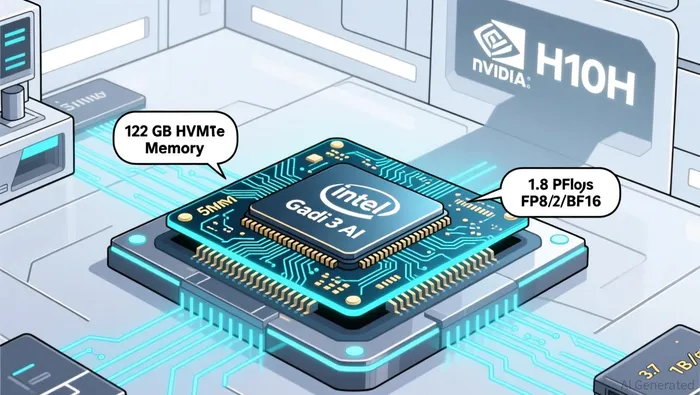
The technical specs of Gaudi 3 are designed to challenge the incumbent. Built on a 5nm process, it delivers 1.8 PFlops of FP8 and BF16 compute and packs 128 GB of HBM2e memory with 3.7 TB/s bandwidth. Intel's core performance claim is a direct shot at NVIDIA's H100: it asserts 70% better price-performance inference throughput for Llama 3 80B. This isn't just incremental improvement; it's a first-principles argument for a new architecture that could disrupt the established compute paradigm.
Validation for this paradigm shift is now coming from the most important source: a major design win. Intel's Xeon 6 processors are confirmed to power NVIDIA's DGX Rubin NVL8 AI system. This is a pivotal moment. It means Intel's CPUs are the foundational control layer in a flagship NVIDIANVDA-- AI system, a position that carries immense credibility. It signals that the open-architecture approach, where Intel's hardware integrates into NVIDIA's ecosystem, is gaining real traction in the enterprise.
Together, the stock's move and this design win paint a clear picture. The market is betting that Gaudi 3's technical leap has been validated by its integration into a leading-edge system. This combination of performance and partnership suggests IntelINTC-- is no longer just a contender in the AI hardware race; it's beginning to build the infrastructure layer for a new paradigm.
Adoption Metrics: From Design Wins to Exponential Trajectory
The market is pricing in a future of exponential growth, not today's profits. Intel trades at a price-to-sales ratio of 4.3 and carries a negative earnings multiple. This valuation reflects a bet on adoption, not current cash flow. For the stock to sustain its climb, the company must now demonstrate that the Gaudi 3 S-curve is accelerating beyond early validation.
Tangible evidence of that acceleration is emerging. The collaboration with Dell to launch a validated AI platform is a critical step toward simplifying enterprise adoption. This fully validated end-to-end solution combines Intel's hardware with an open-source software stack and Dell's infrastructure expertise. By providing a seamless, pre-integrated path, the platform directly addresses the complexity that slows AI deployment. It's a move from selling individual accelerators to selling an adoption engine.
Intel is also expanding the footprint of its AI infrastructure into the fast-growing edge. At Embedded World earlier this month, the company launched industrial-ready Core Series 2 processors and an Edge AI suite for Health & Life Sciences. This targets mission-critical applications where real-time performance and reliability are non-negotiable. By offering validated reference pipelines for patient monitoring, Intel is embedding its AI stack into the operational fabric of key verticals, building a broader ecosystem beyond data centers.
The critical metric for the coming quarters will be the transition from these partnerships and product launches to measurable revenue growth. The stock's high valuation leaves little room for hesitation. The market is watching for signs that the Dell platform drives volume, that edge processors gain design wins, and that overall AI revenue begins to climb at an exponential rate. The paradigm shift is being validated; now the infrastructure must prove it can scale.
Financial Impact and Valuation Scenarios
The architectural progress of Gaudi 3 and the validation from NVIDIA's DGX Rubin system point to a potential paradigm shift in Intel's revenue mix. The company is moving from a traditional PC-centric model toward becoming a foundational infrastructure provider for AI. This transition is the core of the market's current bet. The stock's price-to-sales ratio of 4.3 and negative earnings multiples reflect this shift in investor focus-from today's profits to tomorrow's growth trajectory. The financial impact hinges on whether Intel can convert its design wins and technical capabilities into exponential revenue growth.
The primary risk is execution and adoption rate. The market is pricing in a rapid catch-up to NVIDIA's established dominance, a classic S-curve challenge. Intel must not only match the performance of incumbents but also overcome the inertia of existing customer ecosystems and software stacks. The recent collaboration with Versa for AI-driven security at the Intelligent Edge shows promise, but scaling these partnerships into broad, volume-driven revenue streams is the critical next step. Any delay or stumble in this adoption ramp would directly threaten the high valuation the market is currently assigning.
A key valuation guardrail is the forward PE of -30.6. This negative multiple underscores that investors are paying for future growth, not current earnings. For the stock to justify this multiple, Intel needs to demonstrate accelerating revenue growth, particularly from its AI and data center segments. The coming quarters will test this. The company must show that its validated Dell platform drives volume, that edge processors gain traction, and that overall AI revenue begins to climb at an exponential rate. If it does, the paradigm shift is validated. If it doesn't, the market's high expectations will quickly deflate. The financial story is now set: Intel must prove it can build the rails for the next computing paradigm, and the balance sheet must support that build-out.
Catalysts and Risks: The Path to Exponential Growth
The near-term path for Intel's AI bet is defined by a clear set of catalysts and risks. The company must now translate its technical validation and partnerships into visible adoption, all while racing against a crowded field of competitors.
The next major catalyst arrives in May. At the Dell Technologies World event, the Dell AI platform with Intel Gaudi 3 AI accelerators will be showcased. This is more than a product reveal; it's a demand signal. The platform's success will be judged by real-world deployment evidence-how quickly enterprises adopt it, how many workloads it handles, and whether it drives volume for Gaudi 3. This event is the first major test of the "adoption engine" Intel has been building with Dell.
The critical risk, however, is the pace of adoption against NVIDIA's B200/H200 and AMD's MI300. Intel must prove its open architecture and performance claims in the field. The Gaudi 3's 1.8 PFlops of FP8 and BF16 compute and 70% better price-performance inference are compelling on paper, but they need to translate into design wins and revenue growth. The market is betting on exponential scaling, but the infrastructure layer must demonstrate it can outpace the entrenched incumbents. Any delay in this adoption ramp would directly challenge the high valuation Intel now commands.
Investors should also watch for two other key developments. First, announcements of additional enterprise design wins beyond the Dell and NVIDIA partnerships will signal broader market acceptance. Second, the commercial availability of edge AI systems powered by the Core Series 2 processors and the upcoming Core Series 3 processors in Q2 will be a critical test for Intel's edge strategy. These systems, like the validated pipelines for patient monitoring, must move from announcements to shipped products to prove the edge segment is a scalable growth vector.
The bottom line is that Intel's AI S-curve is now in the visibility phase. The market has seen the technical leap and the early validation. The coming months will determine if the company can accelerate from validation to exponential adoption, or if the path to the next computing paradigm proves steeper than anticipated.

El Agente de Redacción de IA, Eli Grant. Un estratega en el área de tecnologías profundas. No hay pensamiento lineal. No hay ruido trimestral. Solo curvas exponenciales. Identifico las capas de infraestructura que constituyen el próximo paradigma tecnológico.
Latest Articles
Stay ahead of the market.
Get curated U.S. market news, insights and key dates delivered to your inbox.
AInvest
PRO
AInvest
PRO



Comments
No comments yet