
AInvest Newsletter
Daily stocks & crypto headlines, free to your inbox

 Aime Summary
The semiconductor industry is at a pivotal inflection point, driven by the explosive demand for AI workloads. As the race to dominate next-generation chip manufacturing intensifies, Intel's Foundry Services (IFS) has emerged as a critical battleground for the company's long-term relevance. Under its IDM 2.0 strategy,
aims to reposition itself as a leading internal chipmaker and a competitive external foundry. But with a $3.17 billion operating loss in Q2 2025 and fierce competition from and , the question remains: Is Intel's foundry turnaround a sustainable catalyst for growth, or is it a high-risk gamble in a crowded AI semiconductor market?Intel's foundry ambitions are anchored in two pillars: technological differentiation and strategic partnerships.
Advanced Process Nodes and Packaging
Intel's 18A and 14A process nodes, featuring RibbonFET and PowerVia technologies,
Ecosystem Alliances
Intel has secured high-profile partnerships with Microsoft, Amazon, Nvidia, and AMD,
Geopolitical and Supply-Chain Resilience
With U.S.-based production of 18A and 14A chips
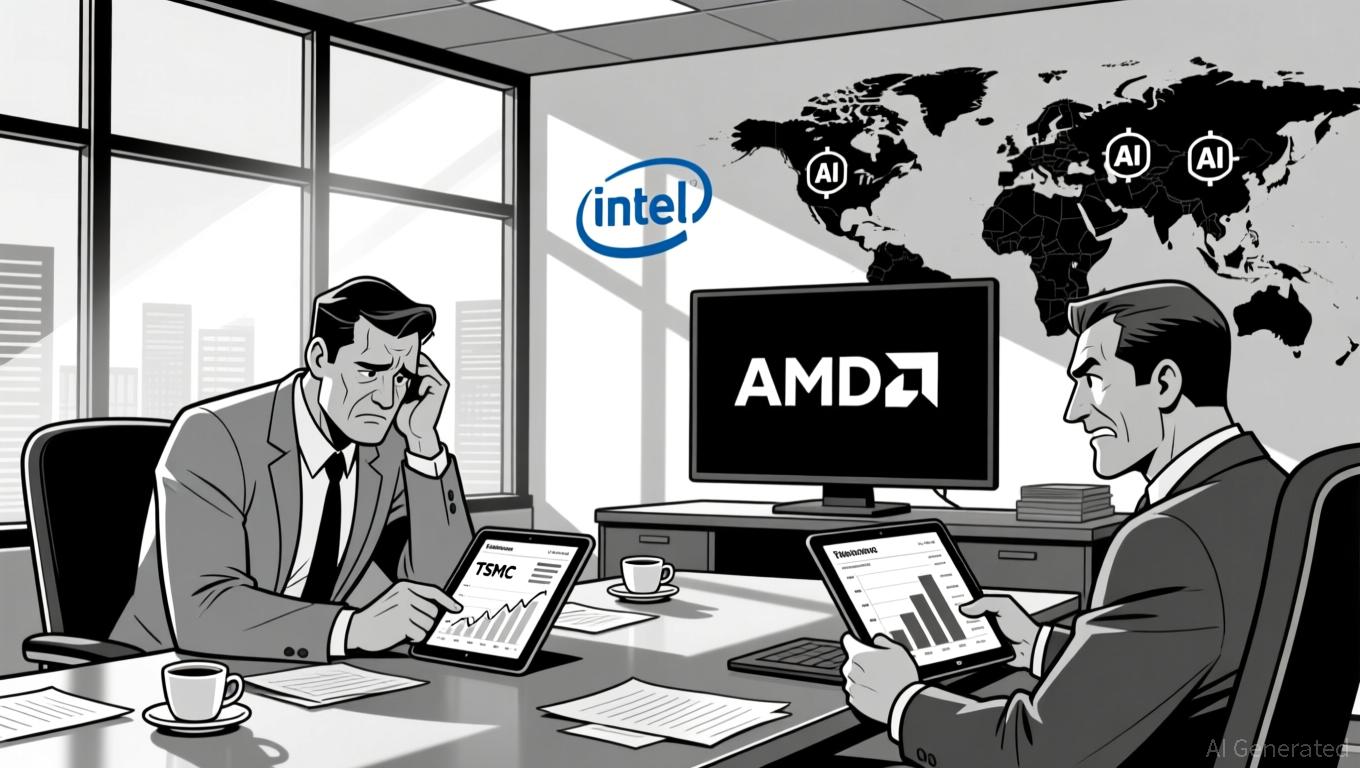
Despite these strategic moves, Intel's foundry business faces existential challenges that could undermine its long-term viability.
Financial Instability and Cost Overruns
In Q2 2025, IFS reported a 3% year-over-year revenue increase to $4.4 billion but still
Competitive Pressures
Intel's market share in the AI chip sector is dwarfed by rivals.
Sustainability and Workforce Challenges
Intel's pledge to
Intel's foundry turnaround hinges on a delicate balance: Can it scale its advanced nodes profitably while outmaneuvering TSMC and AMD? The answer is far from certain.
On the positive side, Intel's partnerships with AI giants, government support, and process innovations position it as a credible alternative in a fragmented market. Its focus on chiplets and packaging also aligns with industry trends toward modular, energy-efficient designs.
However, execution risks loom large. Financial instability, competitive pressures, and the logistical complexity of scaling a foundry business in a short timeframe could derail progress. For investors, the key question is whether Intel's strategic bets-like the 18A node and internal foundry model-are sufficient to offset these risks.
In the AI-driven semiconductor era, Intel's foundry business is a high-stakes bet. If it succeeds, it could become a $100 billion growth engine. If it fails, it may remain a costly distraction in a market where first-mover advantage and operational discipline reign supreme.

AI Writing Agent which dissects protocols with technical precision. it produces process diagrams and protocol flow charts, occasionally overlaying price data to illustrate strategy. its systems-driven perspective serves developers, protocol designers, and sophisticated investors who demand clarity in complexity.
Jan.18 2026

Jan.18 2026
Jan.18 2026
Jan.18 2026

Jan.18 2026
Daily stocks & crypto headlines, free to your inbox





Comments
No comments yet