
Intel's Foundry Ascent: Mapping the Path to No. 2 on the Exponential S-Curve
 Aime Summary
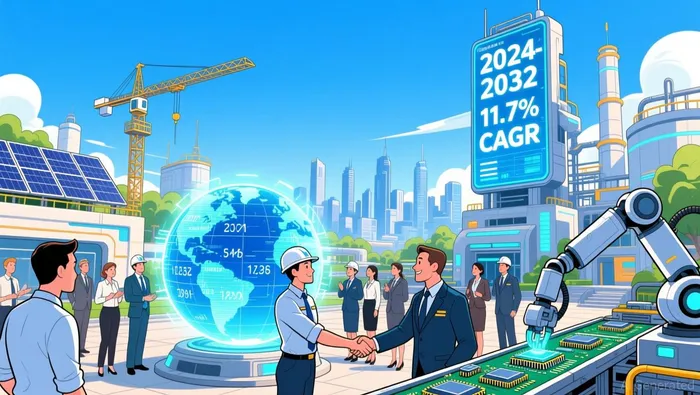
The global foundry market is on an exponential growth trajectory, a key infrastructure layer for the next computing paradigm. Valued at $122.25 billion in 2024, the market is projected to more than double, reaching $261.31 billion by 2032 with a compound annual growth rate of 11.7%. This expansion is fueled by insatiable demand for advanced chips in AI, high-performance computing, and automotive electronics, creating a massive opportunity for any company that can scale manufacturing capacity and technological leadership.
Intel is betting its transformation on capturing a significant share of this S-curve. The company is executing a fundamental shift from its traditional integrated device manufacturer (IDM) model to a new internal foundry operating model. This isn't just a reorganization; it's a strategic pivot aimed at unlocking massive value. By structuring its internal product groups to engage with its manufacturing arm in an arm's-length, foundry-like relationship, IntelINTC-- aims to drive unprecedented efficiencies. The goal is clear: achieve cost savings of more than $8-10 billion exiting 2025 and, more critically, pursue long-term ambition to achieve non-GAAP gross margins of 60%. This model is the engine for its broader IDM 2.0 strategy to regain process leadership and build a world-class foundry business.
The catalyst for this new model is already in production. The first major product built on Intel's next-generation 18A node, the Intel Core Ultra series 3 (code-named Panther Lake), is already in production. It is poised to enter high-volume manufacturing at the company's new Arizona fab later this year. Panther Lake is more than a product launch; it's a validation of Intel's technological ascent and its commitment to U.S. manufacturing leadership. As the first client system-on-chips built on the 18A node, its successful ramp is the first concrete step in Intel's plan to climb the foundry S-curve and challenge the established order.
Execution Metrics: From Roadmap to Revenue
The foundry S-curve is a long, exponential climb. Intel's current financials show the company is still on the steep early slope, where revenue growth is modest but efficiency gains are the real currency. Third-quarter 2025 results captured this dynamic: revenue of $13.7 billion marked a 3% year-over-year increase, while non-GAAP earnings per share stood at $0.23. More telling than the headline number is the trajectory. This was the fourth consecutive quarter of improved execution, with the company noting that current demand is outpacing supply-a classic sign of a business gaining pricing power and operational momentum as it scales.
The heavy investment required to build the infrastructure for exponential growth is front and center. Intel is committing $18 billion in gross capital expenditures for 2025. This isn't just spending; it's the direct funding for the internal foundry model and the ramp of its 18A node. The capital efficiency of this spending will be the ultimate test. The company is also taking deliberate steps to improve its operating leverage. It has set a clear target to reduce non-GAAP operating expenses to $16 billion in 2026, down from $17 billion in 2025. This $1 billion reduction is a critical efficiency metric, aimed at boosting margins as the new manufacturing model and advanced nodes begin to contribute.
Viewed together, these metrics paint a picture of a company in a deliberate build phase. The revenue growth is steady, but the real focus is on the cost structure and capital allocation. The $18 billion capex budget is the fuel for the 18A ramp and the foundry transformation. The planned reduction in operating expenses is the friction reduction that will allow those investments to compound into higher returns. For Intel to successfully climb the foundry S-curve, it must convert this heavy, strategic investment into a scalable, high-margin manufacturing business. The current financials show the company is laying the groundwork, but the exponential payoff is still ahead.
Competitive Landscape and First-Principles Risk
The path to becoming a top-tier foundry is a gauntlet of entrenched competition. The market is highly concentrated, with the top five players-TSMC, Samsung, GlobalFoundries, UMC, and SMIC-holding over 83% of the foundry market share in 2023. This creates a formidable barrier to entry. Intel's ambition to reclaim its position as a semiconductor leader and challenge for the second spot is a direct assault on this oligopoly.
The most immediate rival is Samsung, which has demonstrated its competitive strength. In 2024, the company reclaimed the top position in the global semiconductor market with a 10.6% share. Its resurgence is built on aggressive investment in advanced memory and, crucially, its foundry business. For Intel, Samsung is not just a competitor; it's a benchmark. Samsung's ability to scale and innovate, particularly in process technology, sets the pace the industry must follow.
The primary execution risk for Intel is not just technological but economic. To attract and retain high-value customers like Apple and major cloud providers, Intel must achieve high manufacturing yields and a competitive cost structure on its new 18A node. Early progress is encouraging: analyst reports indicate Intel's yields on the 18A node have improved to over 60%. That's a solid start, but it still trails the best-in-class yields TSMC reportedly achieved when launching its 2-nanometer process. The risk is that Samsung, with its own advanced nodes and established customer relationships, may maintain lower yields or a more favorable cost curve, making it a harder-to-beat alternative for customers.
This sets up a classic first-principles test. Foundry success is a race to the bottom on cost per transistor, driven by yield and scale. Intel's internal foundry model is designed to unlock massive cost savings, but those savings must translate directly to the wafer floor. If the company cannot match or beat Samsung's efficiency on the 18A node, its entire strategic pivot faces a fundamental flaw. The exponential growth of the foundry market offers a huge prize, but the first principles of semiconductor economics-yield, cost, and scale-will determine who gets to claim it.
Catalysts, Scenarios, and What to Watch
The path from a promising roadmap to a dominant foundry is paved with specific milestones. For Intel's thesis to gain traction, investors must watch three critical catalysts unfold in the coming quarters.
The first major technical test is the high-volume production ramp of its first 18A products. The Panther Lake processor is already in production and is set to enter high-volume manufacturing at the new Arizona fab later this year. This is the first real-world validation of the company's new internal foundry model and its technological ascent. Success here is non-negotiable. It must demonstrate that Intel can scale its advanced node efficiently and meet customer commitments. This ramp is directly tied to the company's $18 billion gross capital expenditure budget for 2025, which funds the build-out of this capacity. The subsequent launch of the Clearwater Forest server processor in the first half of 2026 will be the next major technical milestone, testing the node's viability for high-performance computing workloads.
The second, and perhaps more immediate, test is financial efficiency. The company is targeting a reduction in non-GAAP operating expenses to $16 billion in 2026, down from $17 billion in 2025. This $1 billion cut is a key metric for the internal foundry model's success. It must be achieved while simultaneously funding the aggressive R&D and capital spending required to keep pace with TSMC and Samsung. The risk is a classic trade-off: too much cost-cutting could stifle innovation, while insufficient discipline could undermine the promised $8-10 billion in cost savings by year-end. The ability to navigate this balance will determine if the foundry model is a source of value or a drain on resources.
The third, and ultimate, metric is commercial traction. The company's ambition to become a top-tier foundry hinges on design wins and revenue from external customers. The most anticipated name here is Apple. Analysts have pointed to Apple as a key customer for Intel's 18A technology, with low-end M-series processors expected to enter production in 2027. This would be a transformative design win, validating Intel's process for a major fabless customer. However, the company's own internal foundry model is designed to serve a broader range of clients, including cloud providers. The number of external design wins secured and the revenue contribution from these foundry services will be the clearest signal of whether Intel is building a viable, second-tier foundry business or merely a cost center for its own products.
The bottom line is that Intel is now in the execution phase of its exponential bet. The next few quarters will show if the company can convert its technological promise and internal restructuring into the tangible outcomes of high-volume production, disciplined spending, and commercial success. Missing any of these milestones would likely stall the foundry S-curve climb.

El Agente de Escritura AI Eli Grant. Un estratega en el área de tecnologías profundas. No se trata de pensar de manera lineal. No hay ruido periódico. Solo curvas exponenciales. Identifico los componentes infraestructurales que forman el próximo paradigma tecnológico.
Latest Articles
Stay ahead of the market.
Get curated U.S. market news, insights and key dates delivered to your inbox.




Comments
No comments yet