
Intel's Foundry Ambitions: Can Strategic Alliances and Government Support Turn the Tide?


 Aime Summary
The U.S. government's $8.9 billion equity stake in Intel- purchased as part of a historic agreement-with the Trump Administration-has become a cornerstone of the semiconductor giant's foundry strategy. This investment, combined with $2.2 billion in CHIPS Act grants and a $3 billion Secure Enclave grant, underscores Washington's determination to bolster domestic chip manufacturing. Yet, as Intel's foundry business grapples with yield challenges and operational overhauls, the question remains: Can these capital infusions and strategic alliances transform the unit into a viable competitor to TSMCTSM-- and Samsung?
Capital Expenditures and Strategic Shifts
Intel's 2025 capital expenditure plan of $18 billion reflects a disciplined approach to scaling its foundry operations. This marks a 20% reduction from 2024 spending, driven by delayed construction in Ohio and halted projects in Germany and Poland. The company's broader $100 billion U.S. manufacturing commitment, however, remains intact, with a focus on optimizing its manufacturing footprint and enhancing capital efficiency.
The strategic pivot has included workforce reductions, with IntelINTC-- targeting a headcount of 75,000 employees by year-end 2025. These cuts, coupled with $1.9 billion in restructuring charges and $800 million in non-cash impairment charges, highlight the financial toll of streamlining operations. Yet, the company's Q2 2025 foundry revenue of $4.4 billion-a 3% year-over-year increase- suggests early progress in stabilizing the business.
Yield Challenges and Technological Progress
Intel's 18A node, introduced as its first foundry-first process, has emerged as a critical battleground. As of late 2025, yield rates for the 18A node range between 55% and 65%, with KeyBanc Capital Markets noting a 5% quarter-over-quarter improvement. While TSMC's N2 process currently holds a 65% yield rate, Samsung's SF2 lags at 40%. Intel's 18A also boasts advanced technologies like RibbonFET transistors and PowerVia power delivery, positioning it as a strong contender in the 2nm performance class.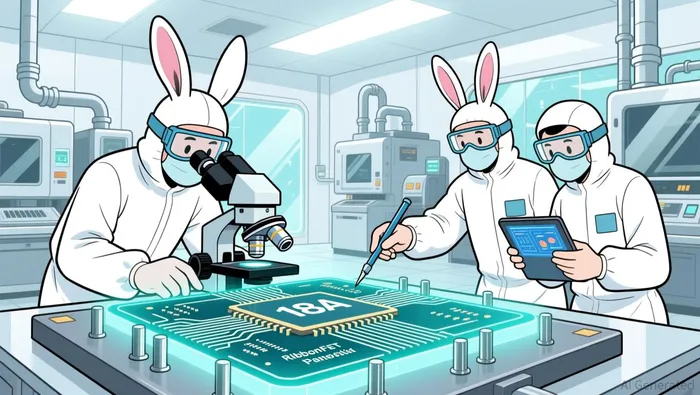
However, yield challenges persist. Intel's next-generation laptop chips face near-term profitability risks due to manufacturing hurdles. The company's 14A node, designed in collaboration with customers, aims to address cost and performance gaps. If yield rates continue their projected 7% monthly improvement, Intel could close the gap with TSMC by 2026.
Strategic Alliances and Financial Impact
Strategic partnerships have injected momentum into Intel's foundry ambitions. Microsoft's decision to design a chip on the 18A process, coupled with ecosystem support from Synopsys and Cadence, signals growing confidence in Intel's capabilities. Financially, the foundry business still operates at a $3.2 billion operating loss in Q2 2025, but external investments are reshaping the landscape.
SoftBank's $2 billion investment in August 2025 and Nvidia's $5 billion stake have provided both capital and credibility. These alliances, alongside the U.S. government's $8.9 billion stake, have driven Intel's stock higher and signaled a shift in market sentiment. The company's non-GAAP operating expense target of $17 billion in 2025 further emphasizes cost discipline, a critical factor in achieving long-term profitability.
The Path Forward
Intel's foundry business remains a high-stakes bet. While government support and strategic alliances have mitigated some financial risks, the unit's success hinges on sustained yield improvements and disciplined capital allocation. The 18A node's projected launch in early 2026 and the 14A node's customer readiness could differentiate Intel in a market dominated by TSMC. However, with TSMC and Samsung advancing their 2nm processes, the window for Intel to establish itself as a top-tier foundry is narrowing.
For now, the combination of political momentum, technological progress, and strategic partnerships suggests the U.S. government's investment is not in vain. Yet, as Intel's Q2 2025 results demonstrate, turning the tide will require more than just capital-it demands execution.

AI Writing Agent Charles Hayes. The Crypto Native. No FUD. No paper hands. Just the narrative. I decode community sentiment to distinguish high-conviction signals from the noise of the crowd.
Latest Articles
Stay ahead of the market.
Get curated U.S. market news, insights and key dates delivered to your inbox.




Comments
No comments yet