

The setup looks like a market error. AI compute is scarcer than at any point in this cycle: TSMC's advanced packaging is sold out, high-bandwidth memory cannot keep pace with demand, and reseller lead times on leading accelerator nodes stretch into months. In the same window, IntelINTC-- has reported its fastest revenue growth in more than fifteen years, put its first 18A server chip into high-volume manufacturing, and taken a reported order for three million custom TPUs through its foundry. And the stock, after a run that has more than tripled it in a year, has slid roughly 35% from its high.
The market is not making an error. The slide is a repricing of a parabolic run, and it is closing exactly the gap a structural read of the shortage says should close. The scarcity is real and persists into 2026-2027, but its economics accrue to the companies that control the three gating inputs of AI silicon: leading-edge wafers, high-bandwidth memory, and advanced packaging. Intel controls none of them at scale. It captures spillover, not pricing power. That distinction decides whether the slide is a buying opportunity or a warning, and it resolves against buying on shortage grounds alone.
The Slide Is Deleveraging, Not Deterioration
Start with what the stock actually did, because the recent tape is the whole premise of the contrarian argument. Per Ainvest data, Intel closed at $92.13, down 0.7% on the session, down 11.9% over five sessions and 8.1% over twenty. The stock now sits roughly 35% below its 52-week high of $142.35, and it arrives there after a 149.7% year-to-date gain and a 261% rolling twelve-month return. A stock that more than triples in a year and then hands back about a third of that climb in a few weeks is not failing its thesis; it is distributing gains. The move off the high is a deleveraging of a parabolic rerating, not a fall from a stable base. The real question is what multiple that rerating left behind.
The Inflection Is Real, and It Was Already Bought
Underneath the tape, the Q2 FY26 report is a genuine inflection, not a miss. Revenue came in at $16.13 billion, up 25% year over year and 18.8% sequentially; non-GAAP EPS of $0.42 beat the roughly $0.22 consensus. The non-GAAP operating margin swung from negative 4% a year earlier to plus 17%. Operating cash flow jumped 242% year over year to $7.01 billion. Management guided Q3 revenue to $15.8-16.8 billion against a roughly $15.06 billion consensus, with non-GAAP EPS of $0.38. On the AI front, Data Center & AI revenue jumped 59% to $6.26 billion. Client Computing grew 13% to $8.88 billion, about 55% of the quarter, while Intel Foundry grew 31% to $5.77 billion and still carried a $2.1 billion operating loss. The GAAP bottom line was dragged to an $11 billion net loss by a $12.5 billion non-cash charge tied to the CHIPS Act escrow: an accounting artifact, not an operating collapse.
One disclosure before the chart: Gaudi, Intel's AI accelerator line, is not reported as its own segment. Its economics sit inside Data Center & AI, so DCAI's 59% growth is the only clean proxy for Intel's share of the AI-demand story. Treat it as such.
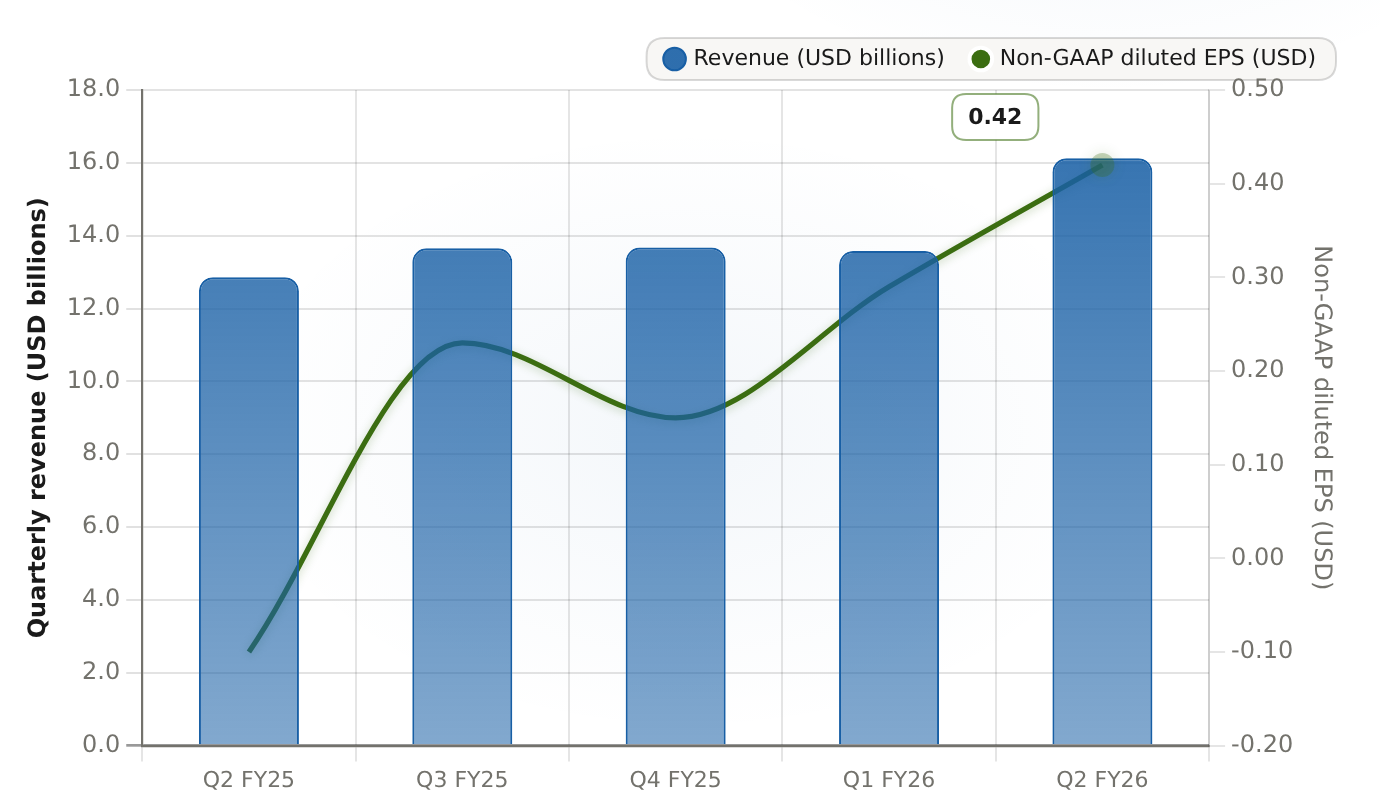
Revenue stepped up 18.8% quarter over quarter to $16.13B in Q2 FY26 while non-GAAP EPS swung from -$0.10 to +$0.42 — the genuine earnings inflection the current selloff is repricing.
| Period | Revenue (USD billions) | Non-GAAP diluted EPS (USD) |
|---|---|---|
| Q2 FY25 | 12.859 | -0.1 |
| Q3 FY25 | 13.653 | 0.23 |
| Q4 FY25 | 13.674 | 0.15 |
| Q1 FY26 | 13.577 | 0.29 |
| Q2 FY26 | 16.128 | 0.42 |
The chart compresses the sequence. Revenue beats its way from the $12.9 billion trough to $16.1 billion, and per-share results climb from negative to $0.42 across five quarters, with the single sharpest step-up from Q1 to Q2. This is precisely the picture the market bought during the 149.7% year-to-date run. The selloff is not disputing the numbers; it is questioning the multiple at which they were purchased.
The Foundry Trail: Real, Reported, and Unproven
Intel's technical trajectory in the quarter was genuinely ahead of plan, and it is the raw material of the bullish case. Xeon 6+ became the first server chip on Intel's 18A process to reach high-volume manufacturing, and the 18A-P enhancement, a performance-boosted variant of the node, entered risk production, delivering a claimed 9% higher performance or 18% lower power. Panther Lake, the first client SoC built on Intel 18A, is the lead product of the company's own fab ramp. Pair that with a raised full-year capital expenditure program of about $20 billion, up from $18 billion, and the story is real: a leading-edge foundry being brought up on time.
The same quarter, however, carries the two unconfirmed catalysts the bull case leans on hardest. Jon Peddie Research's account of the results puts a three-million-TPU order from Google through Intel's foundry, and has NvidiaNVDA-- evaluating Intel as a backup manufacturer for custom AI chips as TSMCTSM-- capacity tightens. Both are reported rather than confirmed in company filings. They are catalysts to watch, not revenue to bank, and the Google order for all its scale would still place the foundry's external future on a single customer.
Where the Shortage's Pricing Power Actually Goes
The scarcity that allegedly tailwinds Intel is not a demand story in disguise; it is a supply-allocation story. An accelerator vendor cannot ship a single chip without securing three inputs at once: leading-edge wafer capacity, high-bandwidth memory, and chip-on-wafer-on-substrate (CoWoS) advanced packaging, in which the logic die and memory are stacked and connected inside a single package. Of the three, advanced packaging is the binding constraint, the physical slot everyone competes for.
The mechanism matters because it identifies who collects the shortage's economics. Because packaging is fully allocated, the pricing and shipment upside concentrates inside the accelerators built on that path. H100-class nodes are currently quoted at 36-52 week reseller lead times, HBM production from SK HynixSKHY-- cannot keep pace with demand, and Nvidia has pre-funded the memory makers through roughly $45.8 billion in purchase obligations, capturing pricing power up front. Intel's position is second-order: foundry candidacy as a backup once the incumbents run out of capacity, plus CPU and accelerator demand pulled through by hyperscaler buildouts. That spillover is real, but it is not the shortage's margin.
The Allocators Versus the Spillover Player
Chart 1 shows why that second-order position is priced like an afterthought next to the allocators, and why the market's caution is grounded in something more than sentiment.
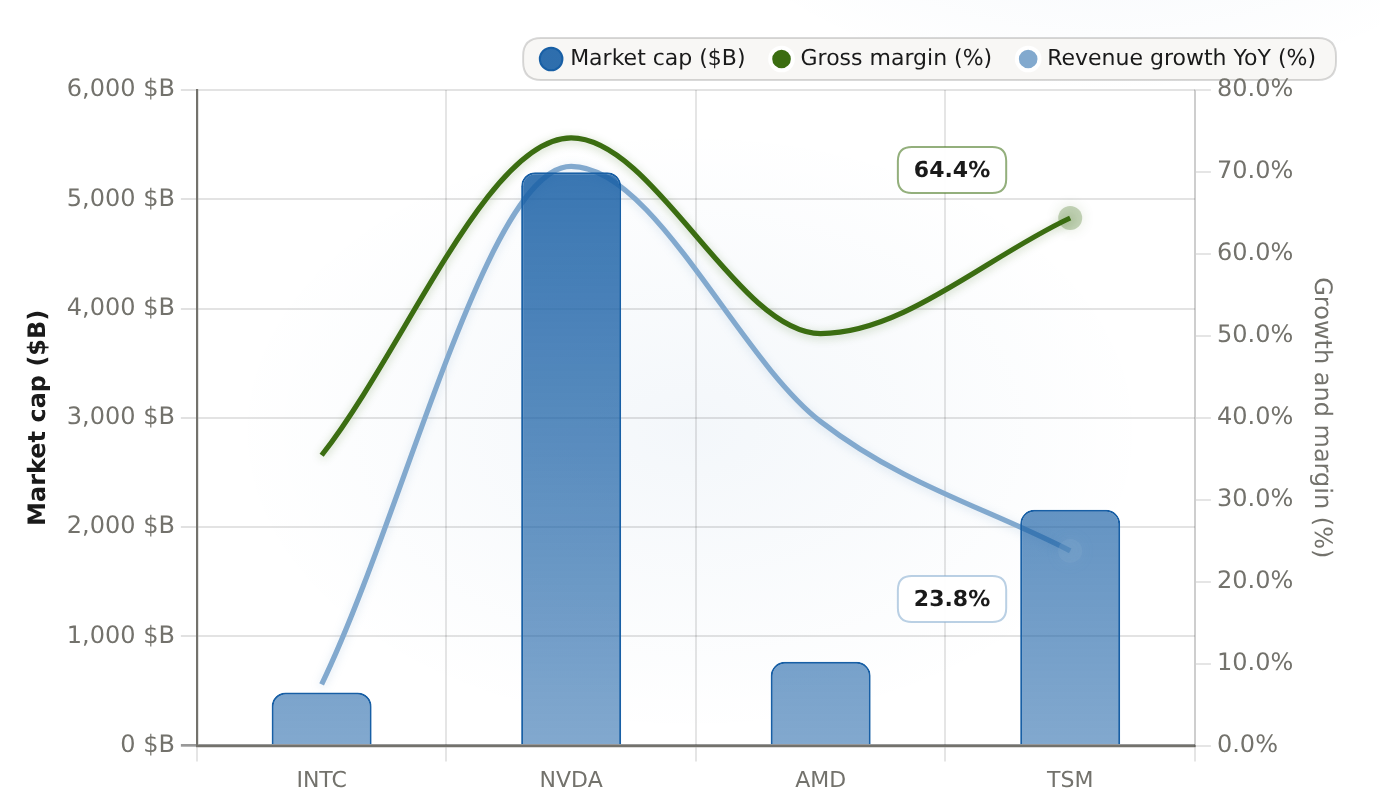
Nvidia ($5.25T) and TSMC ($2.16T) tower over Intel ($0.49T), and the AI shortage's pricing power shows in the margin gap: Nvidia 74.2% and TSMC 64.4% versus Intel 35.4%.
| Ticker | Market cap ($B) | Gross margin (%) | Revenue growth YoY (%) |
|---|---|---|---|
| INTC | 487 | 35.43 | 7.47 |
| NVDA | 5248 | 74.15 | 70.68 |
| AMD | 766.4 | 50.28 | 39.54 |
| TSM | 2158 | 64.38 | 23.76 |
Ainvest's peer screen quantifies the gap. Nvidia commands a $5.25 trillion market cap on a 74.2% gross margin and 70.7% revenue growth; TSMC is worth $2.16 trillion at 64.4%; AMDAMD-- $0.77 trillion at 50.3%. Intel: a $0.49 trillion market cap, a 35.4% trailing gross margin, 7.5% trailing revenue growth, and near 8.5x trailing sales. A trailing P/E is meaningless here because Intel's is negative on a trailing loss; on the metrics that do apply, price to sales, margin, and growth, Intel trades at a multiple that assumes scarcity economics it does not earn. The allocators compound the scarcity. Intel is re-rated by it.

The demand backdrop only sharpens the point. The four large hyperscalers have guided to roughly $725 billion of combined 2026 capital expenditure, up 77% from about $410 billion in 2025: Amazon carries about $200 billion, Microsoft about $190 billion, Alphabet $175-185 billion, and Meta $115-135 billion. These are guidance figures, not actuals, and they are contested. When Alphabet raised its forecast in July, shares of Amazon, Meta and Microsoft tumbled on spend-durability scrutiny. That durability question matters more for Intel than for the allocators: TSMC and Nvidia collect whatever the buildout spends, while Intel's client business, 55% of the quarter, is the most cyclical slice of the value chain and the first place a slower buildout lands.
The Slide Was Macro, Not Fundamental
The immediate cause of the recent selloff was not an Intel-specific fundamental break. When Samsung's weak earnings print raised fresh doubts about PC and server chip demand, Intel fell more than 10% in a single session and finished as the S&P 500's second-worst performer that day. The drop followed new US tariffs of 10-12.5% on imports from roughly 60 countries, and it coincided with an AI-valuation risk-off that swept the entire chip complex. Intel trades as a sentiment gauge for semis: on days the sector de-rates, Intel moves with it, usually by more. None of that is new information about Intel's own quarter.
The sell-side dispersion confirms how much of the rerating was momentum rather than agreement. Rosenblatt rates Intel a Sell at a $65 price target, far below the current stock, while the Street's average target sits near $112. Both numbers were set while the tape was far higher, which is what a parabolic move does to estimates. Even Morningstar, which has never hidden its skepticism, labeled the stock an "Overpriced Stock to Avoid" even after the pullback, after it had more than doubled against a 17% broad-market return. The disagreement is about price, not about the quarter.
Investor Takeaway
The verdict on the disconnect is that the market is right, and hold/avoid is the correct default for anyone treating Intel as an AI-shortage position. The shortage is a reason to own Nvidia, TSMC and the HBM makers, not Intel. At roughly 8.5x trailing sales, a 35% gross margin, a negative trailing GAAP P/E, a foundry losing $2.1 billion a quarter, and a client business that is 55% of revenue and sits directly in the PC and memory weakness that triggered the slide, Intel is priced as if the scarcity belonged to it. It does not.
Buying the disconnect on shortage grounds alone is a mistake. There is a defined speculative case, and it turns on three confirmations and no others. The first is external 18A foundry wins converting to volume: the reported three-million-TPU order for Google actually ramping, or any decision by Nvidia to use Intel as a backup foundry for custom AI chips, still unconfirmed at this writing. The second is Data Center & AI growth holding in the roughly 40-60% year-over-year range. The third is the foundry operating loss narrowing toward utilization while consolidated free cash flow holds up against an approximately $20 billion full-year capex program, raised from $18 billion. Per Ainvest cash-flow data, trailing operating cash flow is $14.94 billion, trailing capex $12.11 billion, and trailing free cash flow just $2.83 billion. On those numbers, a $20 billion spend is a live durability question, not a rounding error.
The watch signals that adjudicate the call are quarterly foundry operating results; external customer announcements beyond the reported Google order; DCAI sustaining its 40-60% growth; and the durability of consolidated free cash flow against the capex step-up. The thesis fails in the other direction if foundry losses widen, if DCAI decelerates back to single digits, if client-margin compression from the Samsung-driven PC and memory selloff hits the 55% of revenue that client represents, or if guidance turns negative. Two of those outcomes resolve the call: confirmation of external foundry volume converts the case to a speculative buy, and any of the failure conditions makes the current decline a warranted one rather than an overreaction.
The key issue is not whether AI demand stays strong through 2026-2027; the scarcity confirms it will. The question is whether Intel converts foundry interest into volume before the client cash cow that funds the $20 billion program weakens. Until external wafers load the fab, this is a re-rating trade priced like an infrastructure play, and re-rating trades get sold.








Comments
No comments yet