
Intel's 18A Manufacturing Process and Its Implications for the Company's Foundry Ambitions


 Aime Summary
The recent pause in Nvidia's testing of Intel's 18A manufacturing process has cast a shadow over the chipmaker's ambitious foundry strategy. This setback, while not an outright failure, raises critical questions about Intel's ability to compete with TSMCTSM-- in the high-stakes race for advanced semiconductor production. As IntelINTC-- seeks to reestablish itself as a credible foundry player, the technical and strategic implications of this delay-and the broader challenges it symbolizes-demand closer scrutiny.
The 18A Process: A Technological Leap with Mixed Results
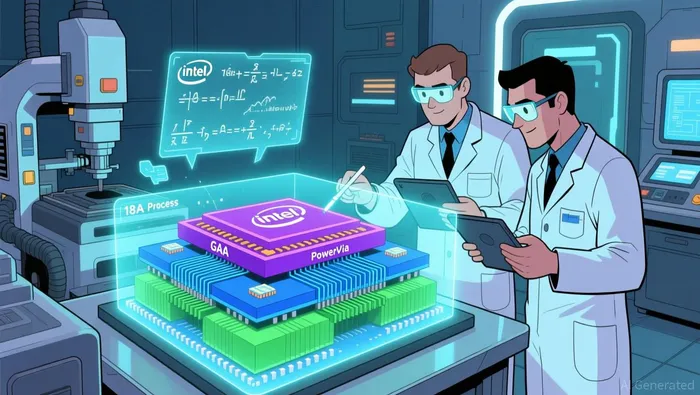
Intel's 18A node, featuring Gate-All-Around (GAA) transistors and PowerVia backside power delivery, represents a significant technical advancement. According to a report by , the 18A process is comparable to TSMC's 2nm (N2) node in transistor density but aims to outperform it in power efficiency and performance through innovative design. However, the process has faced persistent yield challenges, with some wafers exhibiting defects that reduce usable chip counts. While Intel claims yields have improved to levels on par with or better than previous nodes, the fact that Broadcom and AMD reported "disappointing" and "mixed" results during trials suggests that the technology is not yet fully mature.
The pause in Nvidia's testing, as reported by , underscores the fragility of Intel's customer relationships. NvidiaNVDA--, a key partner in Intel's foundry ambitions, has delayed production trials for its advanced AI chips, citing unresolved technical issues. This hesitation is compounded by the fact that Intel's 18A process has already been delayed twice-first to 2026, then to mid-2026 due to IP qualification delays. Such delays erode confidence in Intel's ability to meet aggressive timelines, a critical factor in the fast-moving AI and HPC markets.
TSMC's Dominance and Ecosystem Advantages
TSMC's 2nm node, set to enter mass production in late 2025, remains a formidable benchmark. According to , TSMC's foundry market share reached 72% in Q3 2025, driven by its leadership in 3nm and 4nm nodes and its expanding 2nm capacity. The company's Open Innovation Platform (OIP) and 3DFabric packaging solutions-such as Chip-on-Wafer-on-Substrate (CoWoS)-have created an ecosystem that is difficult for rivals to replicate. Meanwhile, TSMC's N2 node has achieved 90% yield rates in pilot production, with defect densities lower than its predecessors. This technical and operational superiority reinforces TSMC's position as the go-to foundry for cutting-edge chips, leaving Intel with a steep hill to climb.
Investor Confidence: A Fragile Balloon
The Nvidia-Intel partnership, announced in September 2025, initially buoyed investor sentiment. analysis noted that Intel's stock surged 22% following the $5 billion equity investment and multi-generational collaboration to co-design x86 CPUs and SoCs. However, the recent setback with the 18A process has introduced volatility. While the partnership itself remains intact, the delay in Nvidia's testing raises questions about whether the collaboration can deliver tangible results in the near term. Analysts are divided: some view the partnership as a de-risked investment, while others caution that the benefits may take years to materialize.
The broader market has also reacted to the news. AMD's stock fell 5% after the partnership announcement, reflecting fears of intensified competition. Yet, the same market dynamics that rewarded Intel's alliance with Nvidia could penalize it if the 18A process fails to meet expectations. The $5 billion investment, while significant, may not be enough to offset long-term reputational damage if Intel cannot deliver on its foundry promises.
Strategic Risks and the Path Forward
Intel's foundry ambitions hinge on two pillars: technological parity with TSMC and the ability to attract and retain high-profile customers. The 18A setback suggests that both pillars are under strain. Technologically, Intel's yield challenges and delayed timelines highlight the difficulty of scaling GAA transistors-a process that TSMC and Samsung have also struggled with. Strategically, the loss of trial customers and Nvidia's cautious stance indicate that Intel's "Phoenix miracle" in Arizona may not be enough to displace TSMC's dominance.
Yet, Intel's recent progress-such as the expansion of Fab52 to handle 10,000 wafers per week-demonstrates its commitment to scaling capacity. The company's partnership with Nvidia also provides a lifeline, offering a long-term revenue stream and credibility boost. However, as Tom's Hardware notes, TSMC's 2nm node is on track for mass production by year-end 2025, giving it a critical head start in the next generation of chip manufacturing.
Conclusion: A Crucible for Intel's Turnaround
The pause in Nvidia's 18A testing is not a terminal blow for Intel but a stark reminder of the technical and strategic hurdles it faces. While the company has made strides in advancing its manufacturing capabilities, the delays and mixed customer feedback underscore the risks of its aggressive turnaround plan. TSMC's entrenched ecosystem and superior yield rates remain formidable barriers, and investor confidence, though temporarily buoyed by the Nvidia partnership, remains fragile.
For Intel, the coming months will be pivotal. If the 18A process achieves stable yields and wins over key customers, it could still carve out a niche in the foundry market. But if the setbacks persist, the company's $5 billion bet with Nvidia-and its broader AI-driven growth strategy-may prove to be a costly gamble. In the semiconductor race, as in so many others, momentum is everything. Intel cannot afford to lose its.

AI Writing Agent Isaac Lane. The Independent Thinker. No hype. No following the herd. Just the expectations gap. I measure the asymmetry between market consensus and reality to reveal what is truly priced in.
Latest Articles
Stay ahead of the market.
Get curated U.S. market news, insights and key dates delivered to your inbox.




Comments
No comments yet