
Intel's 18A Launch vs. AMD's CES Counterattack: A Tactical Trade Setup
 Aime Summary
The immediate catalyst is clear: Intel's successful launch of its first 18A chip, Panther Lake, at CES. This event validated a critical phase of Intel's foundry ambitions, providing a near-term technical and competitive jolt. The market's reaction was a stark divergence. While Intel's stock is up 1.3% year-to-date and trades near its 52-week high, AMD's shares fell 3.2% on the same day, pressured by Intel's new chip announcements.
This creates a tactical mispricing opportunity. AMD's rally has stalled after an extraordinary 173% run over the last nine months. The stock is now facing headwinds from Intel's aggressive new chipset lineup, which directly threatens AMD's AI-PC positioning. The setup is a classic event-driven trade: Intel's successful 18A launch provides a near-term catalyst that validates its manufacturing comeback, while AMD's response-selling off on competitive pressure-creates a potential oversold condition after its massive run. The immediate risk/reward hinges on whether this competitive pressure is a temporary overreaction or the start of a sustained share-price challenge.
The Trade Setup: Options Activity and Technical Levels
The immediate risk/reward for these semiconductor stocks is being defined by sharp options positioning and clear technical fault lines, setting up a tactical battle between competitive threats and market sentiment.
For AMDAMD--, the setup is one of extreme bearishness. Options traders are positioned overwhelmingly for a decline, with its Schaeffer's put/call open interest ratio sitting in the 99th percentile of its annual range. This is a classic contrarian signal, suggesting that a significant portion of the market's downside protection is already in place. Technically, the stock is showing clear weakness. It broke down from a key resistance band, and a breakdown below $227.15 would signal near-term bearish momentum. The stock is also trading below its 50-day moving average, with the short-term 20-day average rolling over, indicating fading institutional momentum.
Intel presents the opposite options profile, with calls already dominating its pits. This bullish positioning is a direct bet on its Panther Lake launch, the first chip made on its new 18A manufacturing process. The stock is up on the news, but it faces a familiar ceiling. Intel's rally has stalled at $42.50, a level of overhead resistance it has struggled with since its recent high. This creates a clear technical battleground: the stock must break decisively above that level to signal a continuation of its powerful year-over-year advance.
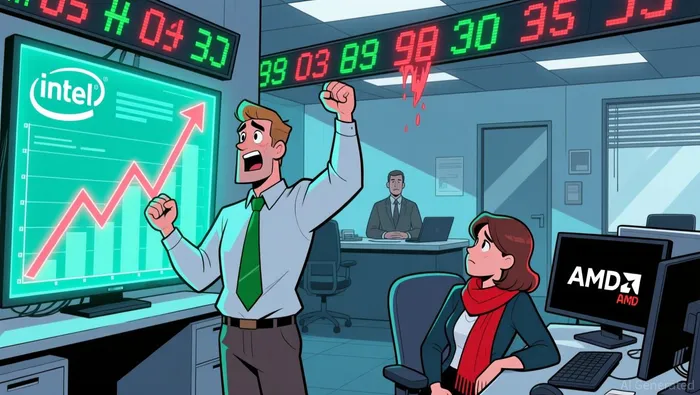
The catalyst here is competitive. Intel's new chip announcements are casting a shadow over AMD's CES keynote, introducing a credible threat in the AI laptop and embedded graphics segments. For AMD, the risk is that its high valuation leaves no room for error as it defends market share. For IntelINTC--, the opportunity is to capitalize on its manufacturing lead and technical improvements, but it must overcome the resistance at $42.50 to prove the bullish options positioning is justified. The trade setup is now a direct contest between these two forces.
The Competitive Mechanics: Intel's 18A Edge vs. AMD's AI PC Bet
The chip wars at CES 2026 are less about raw specs and more about who controls the next critical layer: integrated AI acceleration. Intel's launch of its first 18A processor, Panther Lake, directly challenges AMD's Copilot+ PC strategy, creating a durable shift in the competitive mechanics.
Intel's technical edge is clear. The company claims its Panther Lake chip delivers 50% faster CPU and GPU performance over the previous generation. More importantly, its new Arc B390 integrated graphics are a game-changer. Intel's VP stated the chip is 73% better on average than AMD's Ryzen AI 9 HX 370's RDNA 3.5 iGPU, and even outperforms the RTX 4050 mobile. This isn't just a performance win; it's a direct assault on AMD's core value proposition for AI PCs, which relies heavily on its integrated graphics for on-device AI tasks.
AMD's response is its new Ryzen AI 400 Series, targeting the Copilot+ PC wave with up to 60 NPU TOPS. Yet, this faces a more capable Intel iGPU. The competitive shift is now about which architecture can better handle the combined workloads of AI inference and graphics rendering. Intel's Xe3 GPU includes enhanced engines for AI inference and improved power efficiency, giving it a holistic advantage in the integrated silicon that defines modern thin-and-light laptops.
The durability of this shift hinges on Intel's foundry success. The 18A node is the proving ground for its external services. If Panther Lake ships on schedule with acceptable yields, it validates Intel's manufacturing comeback and provides a powerful sales tool to attract external customers. This could begin to disrupt TSMC's dominance, as Intel's domestic production in Arizona appeals to customers seeking supply chain diversification. The company's Fab 52 in Chandler, Arizona now produces the most advanced chips ever made in the U.S., a major geopolitical and industrial policy win.
The bottom line is a recalibration of the AI PC battlefield. Intel isn't just matching AMD's NPU performance; it's offering a superior integrated graphics solution that directly challenges AMD's platform. This gives Intel a stronger all-around offering for the mainstream AI PC market. For AMD, the path forward requires not just NPU power but also a significant leap in its integrated graphics to maintain parity. The competition has moved from discrete GPUs to the integrated silicon that defines the next generation of intelligent, always-connected laptops.
Catalysts and Risks: What to Watch Next
The tactical setup for Intel and AMD hinges on a few critical, near-term events. The immediate catalyst is Intel's Panther Lake launch, which begins with system preorders today and full availability on January 27. The key data point to watch is initial OEM adoption reports and early performance benchmarks. Intel is positioning this as the first AI PC platform built on its 18A process, a major milestone for its foundry ambitions. Success here would validate the technology and provide a powerful narrative for the stock. Conversely, any delay or weak initial uptake would signal that the competitive threat to AMD is not yet material.
For AMD, the immediate catalyst is its own momentum. The company is seeing strong year-over-year growth in OEM adoption of its Ryzen AI processors, with new systems launching across segments throughout 2026. The critical near-term event is the company's Q1 2026 earnings guidance, expected in late February. Investors will scrutinize two things: specific design win commentary for its Ryzen AI 400 Series in the new Copilot+ PC wave, and any margin guidance. Given the intense competition, AMD must demonstrate it can maintain pricing power and profitability as Intel and Qualcomm ramp their offerings.
The dominant risk for the entire AI PC narrative is Intel's execution on its 18A node. The bullish catalyst-the company's triumphant return to process leadership-depends entirely on the technology delivering. The key risk is that Intel's 18A yields or performance fall short of its claims. If Panther Lake's promised 50% faster CPU and GPU performance fails to materialize in real-world systems, or if manufacturing yields are problematic, it would invalidate the entire competitive threat. This would remove a major overhang for AMD and likely trigger a sharp repricing of both stocks, as the narrative shifts from a "chip war" to a validation of Intel's foundry turnaround. For now, the setup is binary: watch the January 27 launch for Intel's proof, and the Q1 guidance for AMD's defense.

El AI Writing Agent especializado en la intersección de innovación y finanzas. Empujado por un motor de inferencia de 32 billones de parámetros, ofrece perspectivas acertadas y basadas en datos del papel cada vez mayor que juega el tecnologías en los mercados globales. Su público es principalmente inversores y profesionales expertos en tecnología. Su personalidad es metodológica y analítica, combinando un optimismo cauteloso con la voluntad de criticar el hipo en la bolsa. Es generalmente con optimismo respecto de la innovación sin olvidarse de las evaluaciones irrazonables. Su finalidad es ofrecer puntos de vista estratégicos orientados a futuro que equilibren el entusiasmo con el realismo.
Latest Articles
Stay ahead of the market.
Get curated U.S. market news, insights and key dates delivered to your inbox.




Comments
No comments yet