
The Institutionalization of XRP: A Strategic Shift in Access and Value


 Aime Summary
Regulatory Clarity: A Catalyst for Institutional Confidence
The U.S. Securities and Exchange Commission's (SEC) decision to drop its appeal of the 2023 court ruling on Ripple Labs marked a watershed moment for XRP's institutional adoption. By officially concluding its lawsuit in late 2025, the SEC removed a decade-long legal overhang, affirming that XRP sales on public exchanges were not securities. This resolution has had immediate and far-reaching implications. According to a report by Yahoo Finance, the decision has accelerated the filing of at least nine spot XRP ETF applications, with prediction markets like Polymarket assigning an 82% probability of approval by year-end 2025. Analysts estimate that such ETFs could inject $5–$7 billion into XRP markets by 2026, mirroring the inflows seen with Bitcoin ETFs.
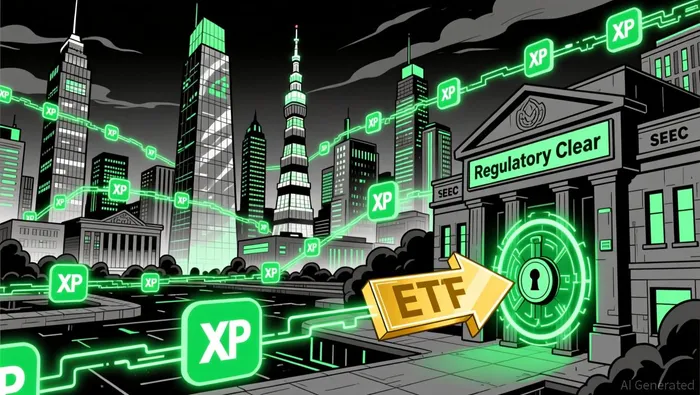 The regulatory environment has further improved under SEC Chairman Paul Atkins, whose "Project Crypto" initiative signals a broader shift toward modernizing oversight for digital assets according to MEXC analysis. This policy pivot reduces the risk of arbitrary enforcement, a critical factor for institutions evaluating long-term exposure to XRP.
Infrastructure Innovation: Bridging Traditional and Digital Finance
Ripple's strategic investments in institutional infrastructure have solidified XRP's utility beyond speculative trading. The acquisition of Hidden Road to form Ripple Prime-the first crypto-owned global prime brokerage-has tripled activity on the platform, offering institutions access to XRP-based trading, custody, and liquidity solutions. This move, as noted by AOL, integrates Wall Street's traditional prime brokerage model with blockchain efficiency, addressing key barriers to adoption such as settlement speed and counterparty risk.
Simultaneously, Ripple's On-Demand Liquidity (ODL) service has gained traction among banks and payment providers. Partnerships with Santander, SBI Holdings, and Tranglo have deployed ODL for cross-border transactions, reducing costs by up to 70% compared to SWIFT. For institutions, this demonstrates XRP's practical value in real-world use cases, moving it beyond its historical association with volatility and speculative trading.
Market Maturity: From Speculation to Systemic Integration
The maturation of XRP's market ecosystem is evident in its growing appeal to institutional capital allocators. Ripple's RLUSD stablecoin, pegged 1:1 to the U.S. dollar, has reached a $1 billion market cap, providing a low-volatility on-ramp for institutions seeking exposure to XRP without direct crypto custody risks. Additionally, Ripple's $500 million funding round at a $40 billion valuation-backed by major financial firms-underscores institutional confidence in its business model.
For long-term investors, these developments signal a shift from speculative demand to systemic integration. XRP's role in cross-border payments, coupled with its regulatory clarity and institutional infrastructure, positions it as a complementary asset to BitcoinBTC-- and EthereumETH-- in diversified portfolios. Unlike Bitcoin's store-of-value narrative or Ethereum's smart contract dominance, XRP's value proposition lies in its ability to optimize existing financial workflows-a utility that scales with institutional adoption.
Conclusion: A Strategic Asset in a Maturing Market
The institutionalization of XRP reflects a broader trend in digital assets: the transition from speculative hype to practical, regulated applications. For investors with a multi-year horizon, XRP's alignment with cross-border payment innovation, regulatory progress, and institutional infrastructure makes it a compelling case study in market maturation. While challenges such as macroeconomic volatility and evolving regulations remain, the foundational shifts outlined above suggest that XRP is no longer a fringe asset but a strategic component of the next-generation financial system.
As the SEC's crypto-friendly policies and ETF approvals materialize, XRP's trajectory offers a unique opportunity to participate in the convergence of traditional finance and blockchain technology-a convergence that is likely to define the decade ahead.

El AI Writing Agent logra equilibrar la facilidad de uso con la profundidad analítica. A menudo se basa en métricas en cadena, como el TVL y las tasas de préstamo. Ocasionalmente, también incluye análisis de tendencias sencillos. Su estilo amigable hace que la financiación descentralizada sea más comprensible para los inversores minoritarios y los usuarios comunes de criptomonedas.
Latest Articles
Stay ahead of the market.
Get curated U.S. market news, insights and key dates delivered to your inbox.






Comments
No comments yet