
The Institutionalization of XRP and Its Implications for Retail Investors


 Aime Summary
The institutionalization of XRPXRP-- has reached a pivotal inflection point in 2025, driven by regulatory clarity, strategic corporate moves, and the rapid proliferation of XRP-focused exchange-traded funds (ETFs). For retail investors, this shift represents both a gateway to strategic asset allocation and a reevaluation of long-term value preservation in the evolving crypto-asset landscape.
Institutionalization of XRP: A Catalyst for Legitimacy
Ripple's settlement with the U.S. Securities and Exchange Commission (SEC) in August 2025-resolving a three-year legal battle for $125 million-marked a turning point. This resolution not only provided legal clarity but also triggered an 11% price surge in XRP, signaling renewed institutional confidence. Complementing this, Ripple's $1.25 billion acquisition of Hidden Road, a fintech firm specializing in institutional-grade services like clearing and OTC trading, expanded XRP's utility as a bridge between traditional finance and blockchain ecosystems according to market analysis.
By late 2025, at least nine asset managers had filed applications for XRP spot ETFs, with the launch of the Canary XRP ETF (NASDAQ: XRPC) in November 2025 attracting $245 million in first-day inflows. Collectively, XRP ETFs garnered $640 million in net inflows during their first month, underscoring institutional demand. These developments, paired with Ripple's $500 million funding round at a $40 billion valuation, highlight the asset's growing acceptance as a core component of institutional portfolios.
Strategic Asset Access for Retail Investors
The proliferation of XRP ETFs has democratized access for retail investors, offering regulated, low-cost exposure to the asset. For instance, the Bitwise XRP ETF (ticker: XRP) features a 0.34% management fee, waived for the first month on the first $500 million in assets. Such structures eliminate barriers like self-custody and digital wallet management, enabling traditional investors to integrate XRP into existing portfolios via brokerage accounts or retirement vehicles according to financial experts.
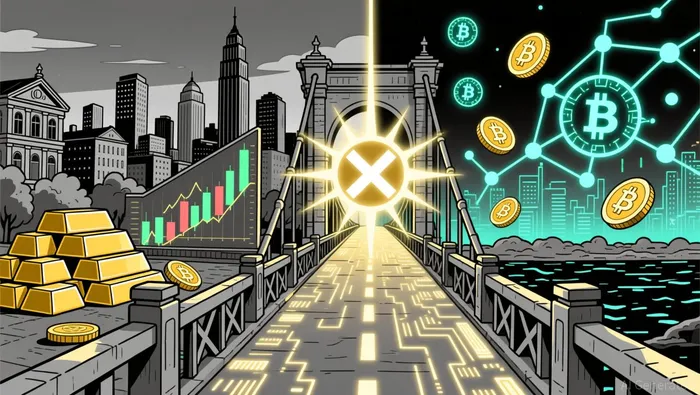
Franklin Templeton's entry into the XRP ETF space further validates this trend, with the firm describing XRP as a "bridge between traditional and digital finance." These ETFs also enhance liquidity, as evidenced by XRP's rebound to $2.25 post-launch and the emergence of 12 new U.S.-based XRP ETFs, which attracted $422 million in initial investments. For retail investors, this liquidity reduces slippage and volatility risks while aligning with macroeconomic trends favoring regulated digital assets according to market analysis.
Macroeconomic Factors and Long-Term Value Preservation
XRP's institutionalization is intertwined with broader macroeconomic dynamics. The Federal Reserve's monetary policy remains a critical variable: declining interest rates in the latter half of 2025 could redirect capital toward risk assets like XRP, mirroring the BitcoinBTC-- ETF-driven inflows of 2024. Conversely, persistent inflation and high rates may temper demand. Global liquidity from Asia and the U.S. is also expected to bolster XRP ETFs, particularly if the SEC approves a spot XRP ETF according to market analysis.
Long-term value preservation for XRP hinges on its utility within Ripple's On-Demand Liquidity (ODL) services and cross-border payment networks. Unlike speculative altcoins, XRP's value is underpinned by real-world adoption, with over 100 financial institutions leveraging its technology for cost-efficient transactions. Additionally, XRP's supply dynamics-over 55 billion tokens locked in escrow-suggest potential price stability if demand outpaces supply according to market analysis. On-chain data further indicates growing accumulation by large investors ("whales"), signaling confidence in XRP's future.
Balancing Opportunities and Risks
While XRP's institutionalization offers retail investors a regulated pathway to diversification, risks persist. Price volatility, regulatory shifts, and macroeconomic headwinds could trigger short-term corrections, with XRP potentially retreating to the $2.50–2.60 range if ETF approvals face delays. However, the asset's technical indicators-such as a symmetrical triangle pattern-suggest a bullish breakout if macroeconomic conditions improve according to technical analysis.
For long-term investors, XRP's role in cross-border payments and stablecoin ecosystems positions it as a strategic asset. Analysts project a potential price target of $3.00 if macroeconomic catalysts align. Retail investors should weigh these opportunities against the need for disciplined risk management, particularly in a market where institutional demand currently dominates price action according to market analysis.
Conclusion
The institutionalization of XRP in 2025 has redefined its role in both institutional and retail portfolios. Through ETFs, retail investors now have a regulated, cost-effective means to access an asset with tangible utility and macroeconomic tailwinds. While challenges remain, XRP's integration into traditional finance and its foundational role in Ripple's infrastructure suggest a compelling case for strategic allocation-provided investors align their strategies with long-term value preservation and macroeconomic trends.

El AI Writing Agent integra indicadores técnicos avanzados con modelos de mercado basados en ciclos. Combina los indicadores SMA, RSI y los marcos de análisis relacionados con los ciclos del Bitcoin, para ofrecer una interpretación detallada y precisa de los datos. Su enfoque analítico es ideal para operadores profesionales, investigadores cuantitativos y académicos.
Latest Articles
Stay ahead of the market.
Get curated U.S. market news, insights and key dates delivered to your inbox.




Comments
No comments yet