
The Institutionalization of Mid-Cap Altcoins: Why AVAX, SUI, and APT Are Set for Mainstream Adoption in 2025


 Aime Summary
The cryptocurrency market is undergoing a seismic shift as mid-cap altcoins like AvalancheAVAX-- (AVAX), SuiSUI-- (SUI), and Aptos (APT) edge closer to institutional adoption. Regulatory developments and the rise of ETF-driven liquidity are reshaping the landscape, creating a bridge between traditional finance and blockchain innovation. For investors, this convergence represents a critical inflection point—a moment to strategically position for the next wave of crypto-driven growth.
Grayscale’s AVAXAVAX-- ETF Filing: A Regulatory Catalyst
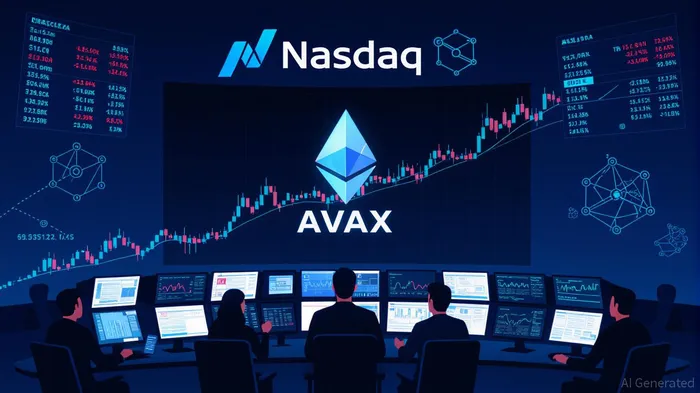
Grayscale’s recent S-1 filing to convert its Avalanche Trust into a spot AVAX ETF marks a pivotal step in legitimizing AVAX as an institutional asset. By listing the ETF on Nasdaq under the AVAX ticker, the firm is offering traditional investors a regulated, familiar vehicle to access Avalanche’s native token [1]. This move mirrors the success of BitcoinBTC-- and EthereumETH-- ETFs, which attracted billions in institutional capital in 2025 [2].
The AVAX ETF’s structure—backed by CoinbaseCOIN-- Custody for token storage and BNY Mellon for administrative duties—addresses key institutional concerns around custody and transparency [1]. Analysts project that approval could drive AVAX’s price to $30–$40 within months, with more aggressive forecasts reaching $500 by year-end [3]. Technical indicators also suggest a breakout near $25.99 could propel the token into a $27–$32.37 range [4]. However, the SEC’s cautious approach to altcoin ETFs means delays remain a risk [5].
Historically, when AVAX closes above its previous 30-day high—a breakout event—buy-and-hold strategies have yielded an average cumulative return of +13.1% over the next 30 days, outperforming the +2.0% benchmark. This pattern, observed across 44 breakout events from 2022 to 2025, shows a peak win rate of 61% on day 3, though significance only holds at the 30-day horizon.
Sui’s DeFi Scalability: The Infrastructure Play
While AVAX battles regulatory hurdles, Sui is building the rails for institutional-grade DeFi. The platform’s object-centric architecture and parallel processing capabilities enable 297,000 transactions per second (TPS) and gasless transactions, making it ideal for high-frequency trading and institutional liquidity provision [6]. In Q2 2025 alone, Sui’s decentralized exchanges (DEXs) processed $367.9 million in daily volume, with cumulative DEX activity surpassing $130 billion [6].
Sui’s Total Value Locked (TVL) has surged 44.3% to $1.76 billion, driven by protocols like Cetus and Bluefin [6]. This growth is further amplified by institutional products such as the Grayscale SUI Trust and 21Shares’ spot SUI ETF filing, which signal confidence in Sui’s scalability and enterprise-readiness [1]. For investors, Sui’s infrastructure-first approach positions it as a foundational layer for the next phase of DeFi adoption.
Aptos’ Institutional Partnerships: The Enterprise Play
Aptos is taking a different route to mainstream adoption: partnerships with global financial giants. The platform has secured collaborations with MicrosoftMSFT-- for AI-powered tools, Franklin Templeton for tokenized money market funds, and MastercardMA-- through its Start Path Crypto accelerator [7]. These alliances are not just symbolic—they’re practical steps toward integrating Aptos into traditional finance.
The Aptos Card and Petra Pay wallet, which allow users to stake and spend USDTUSDC-- and APT from cold storage, further cement its utility [7]. Meanwhile, Bitwise’s amended S-1 filing for a spot Aptos ETF—featuring in-kind creation and redemption mechanisms—has already driven a 7% price surge in June 2025 [8]. While Grayscale has not yet launched an APT product, the token’s inclusion in enterprise projects like Anthony Scaramucci’s $300 million tokenization initiative underscores its institutional appeal [4].
The ETF-Driven Liquidity Loop
The common thread linking AVAX, SUI,SUI-- and APT is their alignment with ETF-driven liquidity. Grayscale’s AVAX ETF filing, Sui’s DeFi infrastructure, and Aptos’ institutional partnerships are all part of a broader trend: crypto assets transitioning from speculative bets to regulated, tradable instruments. This shift is critical for mid-cap altcoins, which historically lack the liquidity and institutional support of Bitcoin and Ethereum.
For investors, the timing is crucial. The SEC’s October 10, 2025, deadline for AVAX ETF approval [2] and Bitwise’s ongoing SEC engagement for APT [8] create a window of opportunity to enter these assets before regulatory milestones drive price discovery. Sui’s TVL and DEX growth [6] suggest it’s already in the early innings of institutional adoption.
Conclusion: Positioning for the Next Wave
The institutionalization of mid-cap altcoins is no longer a hypothetical—it’s a reality in motion. AVAX’s regulatory progress, SUI’s infrastructure, and APT’s partnerships are all indicators of a market primed for mainstream adoption. For investors willing to navigate the regulatory uncertainty, these tokens represent a unique confluence of innovation, liquidity, and institutional momentum.
As the SEC’s decisions loom and ETFs gain traction, the question isn’t whether these altcoins will rise—it’s how quickly they’ll be priced into the market.
Source:
[1] Grayscale Files S-1 For Spot Avalanche ETF With Ticker ... [https://cointelegraph.com/news/grayscale-files-spot-avalanche-etf-ticker-avax]
[2] Grayscale's AVAX ETF Filing: A Strategic Inflection PointIPCX-- for ... [https://www.ainvest.com/news/grayscale-avax-etf-filing-strategic-inflection-point-institutional-crypto-exposure-2508/]
[3] Here's the Avalanche (AVAX) Price If Grayscale Launches a Spot AVAX ETF [https://captainaltcoin.com/heres-the-avalanche-avax-price-if-grayscale-launches-a-spot-avax-etf/]
[4] Regulatory Moves Could Turn AVAX into a Stock-Like ... [https://www.ainvest.com/news/regulatory-moves-turn-avax-stock-investment-2508/]
[5] Grayscale Files for Spot Avalanche ETF as Crypto Fund ... [https://bravenewcoin.com/insights/grayscale-files-for-spot-avalanche-etf-as-crypto-fund-competition-heats-up]
[6] Sui's $130 Billion DEX Volume and Its Implications for DeFi [https://www.ainvest.com/news/sui-130-billion-dex-volume-implications-defi-scalability-2508]
[7] Aptos vs Sui: The Move Language Battle for Crypto's Future [https://blog.millionero.com/blog/aptos-vs-sui-the-move-language-battle-for-cryptos-future]
[8] Bitwise Updates S-1 Filings for DogecoinDOGE-- and Aptos Spot [https://www.ainvest.com/news/bitwise-updates-1-filings-dogecoin-aptos-spot-etfs-2506/]
"""

Decoding blockchain innovations and market trends with clarity and precision.
Latest Articles
Stay ahead of the market.
Get curated U.S. market news, insights and key dates delivered to your inbox.




Comments
No comments yet