
The Institutionalization of Dogecoin: A $200M Treasury Plan and Its Implications for Retail and Institutional Investors


 Aime Summary
The recent announcement of a $200 million DogecoinDOGE-- (DOGE) treasury initiative, led by Elon Musk’s lawyer Alex Spiro and backed by the House of DogeDOGE--, marks a pivotal moment in the evolution of memecoins. This publicly traded vehicle, structured as a public corporation subject to SEC reporting standards, aims to bridge the gap between speculative retail trading and institutional-grade investment. By offering stock-market exposure to Dogecoin without direct token ownership, the initiative could redefine how investors perceive and engage with digital assets, particularly those with infinite supply models like DOGE.
A New Structural Paradigm for Crypto Investment
The treasury’s structure diverges from traditional crypto funds by operating as a public company, a model that aligns with broader trends of firms rebranding to hold digital assets on their balance sheets [2]. Unlike direct token ownership, which exposes investors to liquidity constraints and regulatory ambiguity, this vehicle introduces investor protections and transparency through standardized reporting [3]. For instance, the Grayscale Dogecoin Trust, which charges a 2.5% management fee and is available only to accredited investors, has already demonstrated the demand for institutional-grade crypto products [2]. However, the new treasury’s public listing could democratize access, enabling a wider cohort of investors to participate in Dogecoin’s growth without navigating the complexities of crypto wallets or exchanges.
The initiative’s potential to attract institutional capital is further amplified by Spiro’s legal credibility. His involvement signals a shift in perception, transforming Dogecoin from a “meme” asset into a vehicle for serious capital allocation [1]. This is critical in a market where institutional adoption has historically been hindered by regulatory risks and volatility. By adhering to SEC reporting standards, the treasury could mitigate some of these concerns, though challenges remain. For example, unconfirmed launch dates and operational metrics may deter risk-averse investors, highlighting the need for greater transparency [2].
Regulatory Context and Comparative Precedents
The regulatory landscape for crypto investment vehicles is evolving rapidly. The SEC’s recent decision to permit in-kind creations and redemptions for crypto ETPs (exchange-traded products) has streamlined operations for such funds, reducing costs and enhancing efficiency [4]. Additionally, proposed generic listing standards by exchanges like NYSE Arca and Nasdaq could expedite approvals for Dogecoin-focused ETFs, mirroring the path taken by BitcoinBTC-- and EthereumETH-- [4]. Grayscale’s ongoing efforts to convert its Dogecoin Trust into an ETF underscore this trajectory, with a 75% estimated chance of success by 2025 [1].
However, the regulatory environment remains fraught with uncertainty. The SEC’s delayed decisions on multiple Dogecoin ETF applications—pushed to October 2025—reflect its cautious approach to digital assets [4]. This hesitancy is partly due to Dogecoin’s unique characteristics, such as its infinite supply, which complicates valuation models and regulatory frameworks [3]. In contrast, Bitcoin’s finite supply and established futures markets have facilitated smoother ETF approvals. For Dogecoin to achieve similar legitimacy, the treasury must demonstrate robust governance and risk management practices.
Market Implications and Risk Assessment
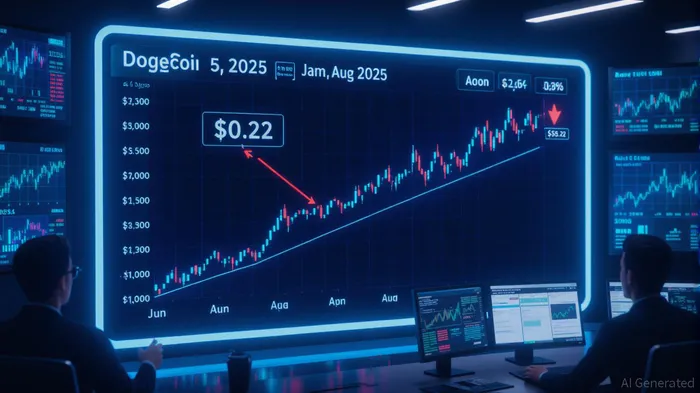
The $200M treasury plan has already triggered a 2% price increase in DOGE, pushing its value to $0.22 [1]. Analysts speculate that a fully realized treasury could drive DOGE toward $0.50, assuming sustained investor confidence and favorable regulatory conditions [4]. However, risks persist. The SEC’s scrutiny of crypto projects—exemplified by its pause of Grayscale’s Digital Large Cap Fund—highlights the potential for regulatory headwinds [4]. Additionally, Dogecoin’s volatility, exacerbated by its infinite supply and speculative trading dynamics, remains a significant concern [3].
For retail investors, the treasury offers a low-barrier entry point to a market segment previously dominated by high-risk traders. Institutional investors, meanwhile, may view it as a hedge against traditional asset classes, particularly in a macroeconomic environment marked by inflation and central bank uncertainty. The key question is whether the treasury can balance innovation with regulatory compliance, ensuring long-term stability without sacrificing the token’s grassroots appeal.
Conclusion: A Catalyst for Broader Institutional Adoption
The $200M Dogecoin treasury represents more than a financial innovation—it is a strategic move to institutionalize a digital asset that has long been dismissed as a novelty. By leveraging Spiro’s legal expertise and aligning with SEC reporting standards, the initiative could set a precedent for other memecoins seeking legitimacy. However, its success hinges on navigating regulatory complexities and addressing inherent risks like volatility and supply dynamics. For investors, the treasury presents an opportunity to participate in a market transformation, but prudence remains essential in an environment where hype and reality often collide.
Source:
[1] Dogecoin Price: Can Musk's $200M Plan Send Doge to ... [https://coingape.com/markets/dogecoin-price-forecast-can-elon-200m-plan-send-it-to-0-50/]
[2] Grayscale Dogecoin Trust [https://www.grayscale.com/funds/grayscale-dogecoin-trust]
[3] Elon Musk's Lawyer to Helm $200M Dogecoin Treasury Play [https://www.blocmates.com/news-posts/elon-musk-s-lawyer-to-helm-200m-dogecoin-treasury-play]
[4] SEC Permits In-Kind Creations and Redemptions for Crypto ETP Shares [https://www.sec.gov/newsroom/press-releases/2025-101-sec-permits-kind-creations-redemptions-crypto-etps]

Decoding blockchain innovations and market trends with clarity and precision.
Latest Articles
Stay ahead of the market.
Get curated U.S. market news, insights and key dates delivered to your inbox.






Comments
No comments yet