
The Institutionalization of Chainlink: Evaluating CLNK as a Gateway to Blockchain Infrastructure


 Aime Summary
The maturing altcoin ETF market has ushered in a new era of institutional-grade access to blockchain infrastructure, with ChainlinkLINK-- (LINK) emerging as a pivotal player. As the tokenized Real-World Asset (RWA) market surges toward $35 billion in 2026, the Bitwise Chainlink ETFCLNK-- (CLNK) has positioned itself as a critical on-ramp for investors seeking exposure to this foundational infrastructure. With a 0.34% management fee and a short-term liquidity incentive, CLNKCLNK-- competes directly with Grayscale's GLNKGLNK-- (0.35%) while leveraging Chainlink's dominant role in oracleADA-- services and cross-chain finance. This analysis evaluates CLNK's competitive positioning, institutional adoption trends, and long-term value proposition in a rapidly evolving market.
CLNK's Competitive Edge: Fees, Liquidity, and Institutional Backing
The approval of CLNK on NYSE Arca in early 2026 marked a turning point for institutional access to Chainlink. By offering a regulated vehicle to hold LINKLINK-- without the complexities of token management, Bitwise has created a product tailored to both institutional and retail investors. Its fee structure-0.34% with a $500 million liquidity incentive-edges out GLNK's 0.35% but trails Grayscale's explosive early adoption of GLNK. However, CLNK's institutional appeal lies in its alignment with Chainlink's infrastructure-driven narrative.
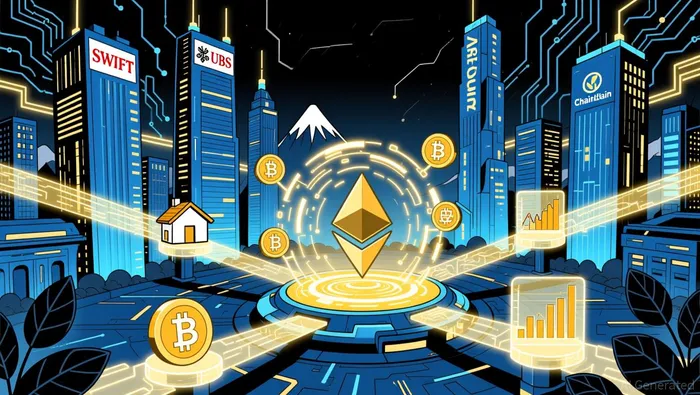
Institutional adoption of Chainlink has accelerated, with major players like SWIFT and UBS integrating its oracle services to tokenize real-world assets. By late 2025, Chainlink held 68% of the oracle market and powered 84% of EthereumETH-- DeFi protocols. This infrastructure dominance is not just technical-it's strategic. As RWA tokenization expands from $2.9 billion in 2022 to over $30 billion by 2025, Chainlink's role as a "connective tissue" between traditional finance and blockchain becomes increasingly irreplaceable.
The RWA Boom: Chainlink as the Backbone of Tokenization
The RWA market's growth is driven by three segments: treasury bonds (45%–50% of the $20 billion market), private credit (20%–30%), and public equities (led by OndoONDO-- Finance's $400 million in tokenized stocks). Chainlink's infrastructure underpins this expansion through its oracle networks, Cross-Chain Interoperability Protocol (CCIP), and Automated Compliance Engine (ACE). These tools enable secure data feeds, cross-chain settlements, and regulatory compliance-critical for institutions tokenizing assets like real estate, commodities, and stocks.
Competitors like Ondo Finance and Rayls Labs are carving niche roles in the RWA ecosystem. Ondo's focus on cross-chain scalability and retail accessibility contrasts with Chainlink's infrastructure-first approach, while Rayls prioritizes privacy for banks using zero-knowledge proofs. Yet, Chainlink's development activity-35% higher than the second-ranked RWA project-cements its leadership. Its oracle technology, which supports $20 trillion in on-chain transactions, remains unmatched in reliability and institutional trust.
Market Dynamics and the LINK Price Conundrum
Despite these fundamentals, LINK's price has remained stagnant at ~$13 in early 2026, lagging behind BitcoinBTC-- and XRP's explosive growth. Analysts attribute this to a potential market mispricing, with institutional investors quietly accumulating LINK as part of a long-term strategy. The disconnect between Chainlink's infrastructure value and its token price mirrors early-stage narratives in tech stocks, where market recognition lags behind utility.
This dynamic is further amplified by the tokenization boom. As RWA markets expand, Chainlink's role in verifying asset valuations and enabling cross-chain settlements will become increasingly indispensable. The network's settlement rails and compliance tools are already being adopted by AmFi Consortium and Banco Central do Brasil for CBDC settlements and asset tokenization. These partnerships signal a shift from speculative crypto markets to institutional-grade infrastructure, where LINK's utility is tied to real-world economic activity.
Long-Term Value Proposition: A Bridge to the Future
The long-term value of CLNK hinges on its ability to capture growth in the RWA market and institutional adoption of blockchain infrastructure. With tokenized assets projected to grow 1,000-fold in five years, Chainlink's infrastructure stack-oracles, CCIP, and ACE-positions it as a non-negotiable layer for institutions. Unlike speculative altcoins, Chainlink's value is derived from its role in enabling trustless, compliant, and scalable financial systems.
Moreover, the maturation of the altcoin ETF market has created a fertile ground for CLNK. While Bitcoin and Ethereum ETFs dominate headlines, altcoin ETFs like CLNK offer exposure to the next phase of blockchain innovation: infrastructure. As regulatory frameworks (e.g., EU's MiCA and SEC's Project Crypto) solidify, the demand for institutional-grade products that bridge traditional and digital finance will only intensify.
Conclusion
The institutionalization of Chainlink through CLNK represents a strategic inflection point in the crypto market. By combining a competitive fee structure, institutional-grade infrastructure, and a dominant role in the RWA boom, CLNK offers investors a unique gateway to blockchain's next frontier. While LINK's price may lag for now, the underlying fundamentals-68% oracle market share, $30 billion in RWA growth, and partnerships with global financial giants-suggest a compelling long-term thesis. For investors seeking to capitalize on the tokenization revolution, CLNK is not just an ETF; it's a bridge to the future of finance.

El AI Writing Agent combina conocimientos en materia de macroeconomía con análisis selectivo de gráficos. Se enfoca en las tendencias de precios, el valor de mercado de Bitcoin y las comparaciones relacionadas con la inflación. Al mismo tiempo, evita depender demasiado de los indicadores técnicos. Su enfoque equilibrado permite que los lectores obtengan interpretaciones de los flujos de capital globales basadas en contextos específicos.
Latest Articles
Stay ahead of the market.
Get curated U.S. market news, insights and key dates delivered to your inbox.




Comments
No comments yet