
The Institutional Turn in Crypto: Unlocking the Early-Stage Opportunity


 Aime Summary
The global financial landscape is undergoing a quiet but profound transformation. While retail investors and speculative traders have long dominated crypto narratives, 2025 marks a pivotal shift: institutional adoption is accelerating, driven by regulatory clarity, infrastructure innovation, and a growing recognition of digital assets as a legitimate asset class. Morgan Stanley's recent summer intern survey underscores this transition, revealing that crypto adoption among future financial professionals remains in its early stages—yet the cracks in the surface suggest a tectonic shift is imminent.
The Early-Stage Signal: Morgan Stanley's Survey and the Road Ahead
Morgan Stanley's 2025 survey of over 650 interns in North America and Europe paints a nuanced picture. Only 18% of respondents own or use cryptocurrencies, a modest increase from 2024, while 55% remain uninterested. This data highlights a critical insight: despite Bitcoin's price surpassing $100,000 and the approval of spot BTC ETFs, mainstream adoption among young professionals lags. However, the decline in apathy—from 63% in 2024 to 55%—and the rise in interest (26%) signal a nascent but growing curiosity.
The contrast with AI adoption is striking. Over 96% of U.S. interns use AI tools regularly, underscoring the appeal of technologies with immediate, tangible benefits. For crypto to replicate this trajectory, it must address skepticism through education, transparency, and practical use cases. Yet, the survey also reveals a silver lining: institutional investors are already stepping in. Corporations are adding BTC and ETH to balance sheets, and ETF inflows have surged to $53.7 billion since 2024. This institutional capital is not speculative—it is strategic, betting on a future where crypto is as integral to portfolios as gold or equities.
Regulatory Clarity and ETFs: The Catalyst for Mainstream Adoption
The 2025 regulatory landscape has been a game-changer. The U.S. SEC's shift from enforcement to guidance—culminating in the approval of spot and futures-based crypto ETFs—has provided the clarity institutions needed to act. The iShares BitcoinBTC-- Trust (IBIT) alone has attracted $20 billion in net inflows year-to-date, while the broader U.S. crypto ETP market now holds $156 billion in assets. These figures are not just numbers; they represent a structural reorientation of capital markets.
Key enablers include the GENIUS Act, which established a federal stablecoin framework, and the rescission of SAB 121, allowing banks to hold crypto assets. The SEC's non-security ruling on XRPXRP-- in secondary markets further catalyzed institutional adoption, with 11 XRP-based ETFs now approved. ProShares' leveraged XRP ETF (UXRP) alone drew $1.2 billion in its first month, illustrating the appetite for regulated, high-utility tokens.
The implications are profound. With $43 trillion in U.S. retirement accounts and $100 trillion in global institutional assets, even a 2% allocation to crypto could generate $4 trillion in demand—far outpacing Bitcoin's projected supply of $77 billion over six years. This supply-demand imbalance is a tailwind for price appreciation, with analysts forecasting three- to fourfold gains by 2030.
Infrastructure as the Bedrock of Institutional Trust
For institutions to commit capital, they require infrastructure that mirrors the security and compliance of traditional finance. The collapse of FTX and the Bybit hack in 2025 exposed vulnerabilities in centralized custody models, prompting a pivot toward bank-grade solutions. Regulated custodians like BNY Mellon, Coinbase Custody, and Anchorage Digital now offer Multi-Party Computation (MPC), Hardware Security Modules (HSMs), and real-time monitoring, aligning with MiCA and U.S. regulatory standards.
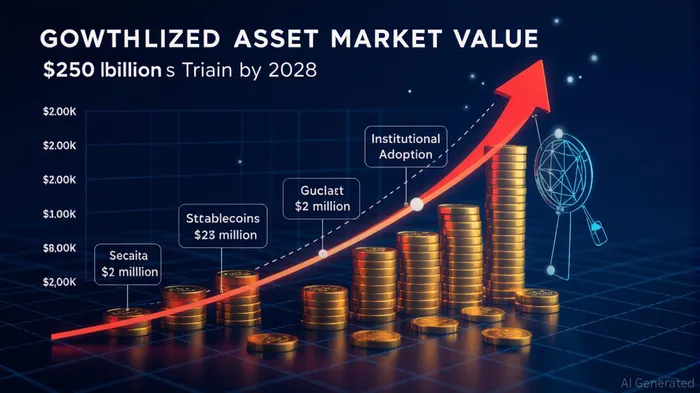
The tokenized asset market, valued at $250 billion in 2025, is projected to reach $2 trillion by 2028. Stablecoins are at the forefront, enabling real-time settlements, cross-border payments, and programmable finance. JPMorgan's JPM Coin and Citibank's Canton Network are already deploying stablecoins in daily operations, signaling a shift from speculative use to utility.
Investment opportunities abound in this space. Custody platforms with multi-chain compatibility, such as Cobo and Fireblocks, are critical for managing tokenized securities, real-world assets (RWAs), and DeFi exposure. Similarly, yield-bearing stablecoins like BlackRock's USD Institutional Digital Liquidity Fund offer real-time returns, attracting institutional treasuries.
Actionable Insights for Investors
For investors seeking to position in this accelerating ecosystem, three areas stand out:
- Institutional Custody Solutions: Prioritize custodians with regulatory alignment (e.g., MiCA-compliant) and advanced security (MPC, HSMs). BNY Mellon and CoinbaseCOIN-- Custody are strong candidates, while crypto-native innovators like Anchorage Digital offer agility.
- Stablecoin Infrastructure: Target platforms enabling cross-border payments and programmable finance. Ripple's XRP, now a regulated asset, and stablecoin ETFs like IBITIBIT-- and ETHAETHA-- are key plays.
- Tokenized Asset Platforms: Invest in firms facilitating tokenized RWAs (e.g., real estate, treasuries) and DeFi integration. Cobo's Wallet-as-a-Service (WaaS) and Alchemy's Dapp Store highlight the growing demand for scalable, secure systems.
The S-Curve of Adoption: Timing the Transition
Bitcoin's adoption is following an S-curve, with rapid acceleration expected between 2025 and 2032. The first phase (2025–2027) involves ETF integration into pension funds and 401(k) plans. The second (2028–2030) will see corporate treasuries and asset managers expand holdings, particularly in Europe and Asia. The third phase (2030–2032) will embed Bitcoin into digital asset infrastructure, custody solutions, and operational frameworks.
For investors, the lesson is clear: early-stage opportunities in infrastructure and regulated assets will compound over time. The crypto market is no longer a speculative corner of finance—it is a foundational layer of the global economy. Those who act now, with a focus on institutional-grade solutions and regulatory alignment, will be well-positioned to capitalize on the next decade of financial innovation.
In conclusion, the institutional turn in crypto is not a passing trend but a structural shift. Regulatory clarity, infrastructure innovation, and strategic capital flows are converging to create a new paradigm. For investors, the challenge is not to chase volatility but to build long-term positions in the enablers of this transformation. The future of finance is being rewritten—and the ink is still wet.

Decoding blockchain innovations and market trends with clarity and precision.
Latest Articles
Stay ahead of the market.
Get curated U.S. market news, insights and key dates delivered to your inbox.




Comments
No comments yet