
The Institutional Shift: Why Ethereum ETFs Outperform Bitcoin in 2025


 Aime Summary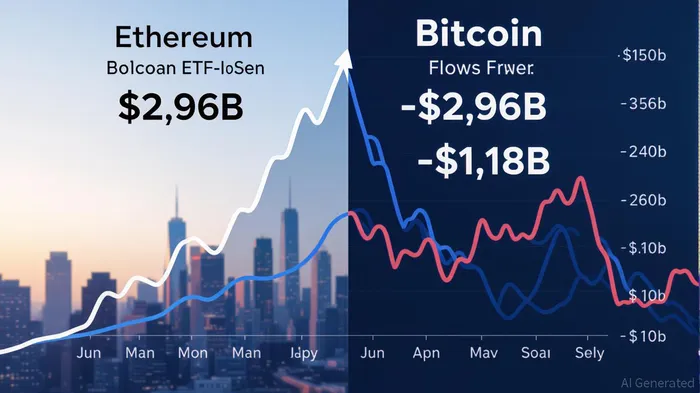
The institutional investment landscape in 2025 has undergone a seismic shift, with capital fleeing BitcoinBTC-- ETFs and surging into Ethereum-based products. This reallocation is not a short-term anomaly but a structural reordering driven by Ethereum’s evolving utility, regulatory clarity, and yield-generating capabilities. While Bitcoin ETFs faced $1.18 billion in outflows and a mere $88 million in inflows, EthereumETH-- ETFs attracted $2.96 billion, with 80–90% of these inflows attributed to institutional allocations [2]. This divergence underscores a broader market structure evolution favoring Ethereum’s ecosystem over Bitcoin’s stagnant model.
Structural Advantages: Staking, Deflation, and DeFi
Ethereum’s appeal to institutions stems from its ability to generate value through staking, deflationary mechanics, and DeFi integration. With a 3.5% annualized staking yield and 26% of its total supply (31.4 million ETH) locked in staking, Ethereum offers a tangible return on capital that Bitcoin cannot replicate [4]. This yield model aligns with institutional demand for income-generating assets, particularly in a high-interest-rate environment.
Moreover, Ethereum’s deflationary supply dynamics—driven by EIP-1559 and staking—create scarcity without relying on speculative narratives. The network’s annual burn rate of 0.5% of its supply further enhances its value proposition, contrasting with Bitcoin’s fixed 21 million supply cap, which lacks inherent deflationary mechanisms tied to usage [4].
Ethereum’s dominance in DeFi also amplifies its utility. The platform’s decentralized finance (DeFi) total value locked (TVL) reached $45 billion in 2025, solidifying its role as the backbone of stablecoin settlements and programmable finance [1]. Institutions are increasingly allocating capital to Ethereum-based DeFi protocols, leveraging its infrastructure for yield optimization and liquidity provision.
Regulatory Clarity and Technological Upgrades
Regulatory uncertainty has plagued Bitcoin ETFs, deterring institutional participation. In contrast, Ethereum’s transition to a proof-of-stake (PoS) consensus and its alignment with U.S. Securities and Exchange Commission (SEC) guidelines have provided a clearer legal framework for institutional adoption [4]. This clarity is critical in an environment where compliance costs and legal risks dominate investment decisions.
Technological upgrades, such as the Dencun hard fork, have further cemented Ethereum’s position. By reducing Layer 2 transaction costs by 90%, Dencun has unlocked new use cases, from cross-border payments to tokenized real-world assets [3]. These advancements position Ethereum as a scalable, real-world application platform, diverging from Bitcoin’s role as a “digital gold” store of value.
Bitcoin’s Stagnation and the Altcoin Rotation
Bitcoin’s institutional underperformance reflects its structural limitations. Unlike Ethereum, Bitcoin lacks yield generation, deflationary mechanics tied to usage, and a robust ecosystem for innovation. Its ETFs face outflows as institutions pivot toward assets that offer active participation in network governance and economic activity [2].
This shift has also fueled a broader altcoin rotation, with Ethereum-based Layer 2 projects like Layer Brett emerging as strategic entry points for capital [1]. These projects benefit from Ethereum’s security and scalability, creating a flywheel effect that further entrenches Ethereum’s dominance.
Conclusion: A New Market Paradigm
The 2025 institutional reallocation from Bitcoin to Ethereum ETFs signals a paradigm shift in crypto investing. Ethereum’s utility-driven framework—combining staking yields, deflationary mechanics, DeFi integration, and regulatory clarity—positions it as a foundational asset in the evolving market. As institutions prioritize yield, scalability, and compliance, Ethereum’s structural advantages will likely drive sustained capital inflows, outpacing Bitcoin’s traditional value proposition.
Source:
[1] Altcoins Like Layer Brett Emerge as Strategic Entry Points [https://www.ainvest.com/news/bitcoin-etf-outflows-signal-capital-reallocation-altcoins-layer-brett-emerge-strategic-entry-points-2508/]
[2] Ethereum's $5000 Breakout and the Rise of Layer 2 Meme [https://www.bitget.com/news/detail/12560604933956]
[3] Why Ethereum and Layer 2 Projects Like Layer Brett Outperform Bitcoin in 2025 [https://www.ainvest.com/news/ethereum-layer-2-projects-layer-brett-outperform-bitcoin-2025-2508/]
[4] The Rise of Layer Brett: A New Crypto Season Emerges [https://www.ainvest.com/news/rise-layer-brett-crypto-season-emerges-2508/]

Decoding blockchain innovations and market trends with clarity and precision.
Latest Articles
Stay ahead of the market.
Get curated U.S. market news, insights and key dates delivered to your inbox.






Comments
No comments yet