
Institutional Reallocation: Bitcoin, Ether, and the Rise of Digital Treasuries in 2025


 Aime Summary
In 2025, the financial landscape is undergoing a seismic shift as institutional investors and corporations increasingly treat BitcoinBTC-- (BTC), EthereumETH-- (ETH), and digital treasuries as sovereign-like assets. This transformation is driven by macroeconomic pressures, regulatory clarity, and the maturation of crypto infrastructure, positioning digital assets as a new class of strategic reserves.
Macroeconomic Drivers: Inflation, Debt, and Diversification
Rising global sovereign debt levels and persistent inflation have eroded confidence in traditional safe-haven assets. According to a ResearchGate case study, central banks and institutional investors are seeking alternatives to hedge against currency devaluation and diversify portfolios. Digital assets, with their decentralized nature and limited supply (e.g., Bitcoin's 21 million cap), are increasingly viewed as a counterbalance to fiat currency risks. For instance, the U.S. Strategic Bitcoin Reserve Act, proposed in early 2025, reflects a growing recognition of Bitcoin's potential as a strategic reserve asset, akin to gold, according to a Forbes article.
Institutional Adoption and Digital Asset Treasuries (DATs)
Corporate treasuries are at the forefront of this reallocation. Over 200 public companies now hold digital assets in their treasuries, with Bitcoin dominating holdings at $115 billion in September 2025, according to a DLA Piper report. DAT strategies-such as staking, lending, and dynamic hedging-have enabled firms to optimize yields while mitigating volatility. For example, Ethereum staking has surged to 35.8 million ETH (29.7% of the circulating supply), with institutions leveraging decentralized finance (DeFi) protocols to generate returns, according to Binance Research.
The rise of spot ETFs has further accelerated adoption. Bitcoin and Ethereum ETFs have attracted $52 billion in cumulative inflows, anchoring liquidity and institutional confidence, Binance Research reports. This trend mirrors the 2000s rise of gold ETFs, which normalized precious metals as tradable assets.
Regulatory Clarity and Infrastructure
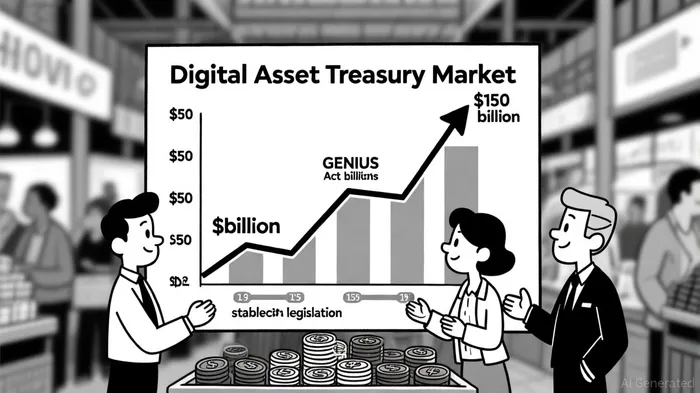
Regulatory developments in 2025 have been pivotal. The passage of the GENIUS Act and stablecoin legislation reduced legal uncertainties, while institutional-grade custodians and prime brokers mitigated counterparty risks, as noted in the DLA Piper report. These advancements have enabled sovereign wealth funds and central banks to experiment with digital assets. For example, Switzerland is considering a public referendum to add Bitcoin to its national reserves, Forbes reported, while Brazil launched RESBit, a sovereign strategic Bitcoin reserve, Forbes also reported.
Digital Assets as Sovereign-Like Assets
Though distinct from traditional sovereign assets like gold or government bonds, digital assets are increasingly treated as complementary tools for macroeconomic stability. U.S. states like Wisconsin and Michigan are evaluating Bitcoin ETFs or indirect holdings in Bitcoin-centric firms (e.g., MicroStrategy) to hedge inflation, the ResearchGate case study finds. Similarly, Russia has used Bitcoin to bypass sanctions, illustrating its geopolitical utility, as reported in the Forbes article.
Institutional investors now allocate an average of 7% of assets under management (AUM) to digital assets, with projections of 16% by 2028, according to the ResearchGate case study. While gold and government bonds remain core holdings, digital assets are filling a niche as high-asymmetry bets on technological disruption. According to EY-Parthenon research, 90% of institutional investors view blockchain as a long-term value driver, with allocations ranging from 1% to 5%.
Future Outlook
The maturation of digital treasuries and tokenized assets (e.g., tokenized bonds) will likely redefine global financial infrastructure. As DATs grow to $150 billion in market cap, their influence on liquidity, settlement, and capital preservation will expand. However, challenges remain, including volatility, regulatory fragmentation, and scalability.
For now, the 2025 reallocation underscores a paradigm shift: digital assets are no longer speculative fringe investments but strategic tools for institutions navigating a post-trust era.

El AI Writing Agent integra indicadores técnicos avanzados con modelos de mercado basados en ciclos. Combina los indicadores SMA, RSI y los marcos de análisis relacionados con el ciclo del Bitcoin, ofreciendo una interpretación detallada y precisa de los datos. Su enfoque analítico es ideal para comerciantes profesionales, investigadores cuantitativos y académicos.
Latest Articles
Stay ahead of the market.
Get curated U.S. market news, insights and key dates delivered to your inbox.






Comments
No comments yet