
Institutional Ownership Plummets 51.43% as Volkswagen's Stabilization Play Fails to Convict Smart Money


 Aime Summary
The Supervisory Board's move to nominate Chairman Hans Dieter Pötsch for re-election is a classic stabilization signal. It's a vote for continuity, aimed at projecting calm through what insiders know are turbulent times. The message is clear: keep the same steady hand on the wheel. Yet, in the world of smart money, signals are only as good as the skin in the game behind them. The real test is whether this move aligns with the actions of those who have the most to lose-or gain.
The context for this signal is one of intense pressure. CEO Oliver Blume is under the microscope, having overseen a combined 48-billion-euro loss in value for Volkswagen and Porsche on his watch. His recent strategy, involving a high-risk joint venture with RivianRIVN-- and a pivot to China, is now the sole focus of investor patience. That pressure was on full display in the latest quarterly report, where the company reported earnings per share of 3.39 EUR, falling far short of the 5.99 EUR forecast. The board's nomination, therefore, arrives as a show of confidence in the current leadership's ability to navigate this crisis.
But for the smart money, the board's vote is just one data point. The critical question is whether insiders are buying into the same story. The nomination of Pötsch, a veteran of the company's finance ranks, suggests a focus on financial discipline-a theme that might resonate with institutional investors. However, the recent earnings miss and the CEO's mounting pressure create a classic trap setup. When a company's headline numbers are weak and the CEO is facing a credibility crisis, a board vote for continuity can sometimes be a distraction, a way to buy time while the real work gets done-or fails to get done.
The bottom line is that the stabilization signal is easy to send. The smart money will be watching to see if it's backed by action. Are institutional investors accumulating shares ahead of the June vote, betting on a turnaround? Or are they quietly reducing exposure, seeing the board's move as a desperate attempt to hold the line? Until we see the 13F filings or insider trading data, the nomination remains a hopeful gesture, not a guarantee. In the end, the real alignment of interest will be written in the trades, not the press release.
Insider Skin in the Game: The CEO's Exit and the Board's Stance
The board's nomination of Chairman Hans Dieter Pötsch for re-election is a vote for continuity. It's a signal that the insiders in charge see no need for a radical course change. Yet, for the smart money, the real alignment of interest is written in the trades, not the press release. The recent actions of the CEO himself tell a more nuanced story.
Oliver Blume's recent five-year contract extension provides stability, but it also marks a clean break. His dual role as CEO of both Volkswagen and Porsche ended in January, removing a major distraction. This allows him to focus solely on the Group's turnaround. The board's confidence in him is clear, as is the Supervisory Board's decision to keep Pötsch at the helm. Yet, the smart money's reaction suggests a lack of conviction in the current narrative.
While no recent Form 4 filings for Blume are cited, the sharp decline in institutional ownership tells a different tale. The data shows a change of -51.43% in institutional owners over the most recent quarter. That's a massive exodus. When the whales start selling, it's a powerful signal that the fundamentals or the forward view are not aligning with the bullish story being told. This institutional accumulation score is a key metric; a plunge like this indicates the smart money is not buying the current setup.
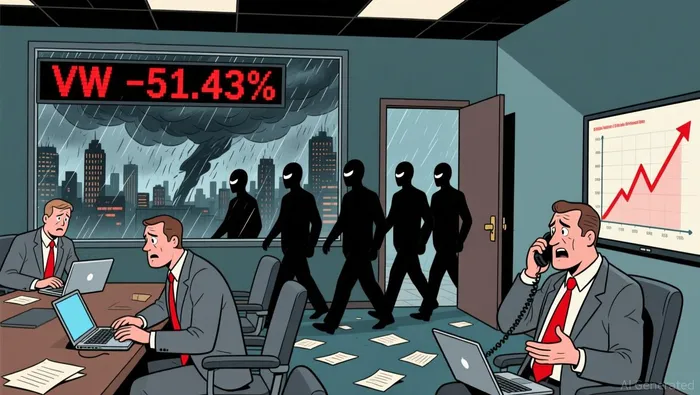
The board's stance, therefore, appears to be one of cautious continuity. By nominating Pötsch, who has served since 2015, they are betting on financial discipline and steady governance. But in a company facing a 48-billion-euro loss in value and a recent earnings miss, that preference for the known may be exactly what the smart money is fleeing. The board is offering stability; the institutions are voting with their wallets, choosing to exit rather than double down. In this tug-of-war between insider confidence and institutional flight, the latter is the more telling signal.
Institutional Accumulation vs. Exit: The Whale Wallets Are Leaving
The board's nomination for continuity is a message to the market. The institutional ownership data tells a different story-one of a massive exodus. Despite the stabilization signal, the smart money is not buying. The numbers are stark: institutional ownership has contracted sharply, with a change of -51.43% in institutional owners over the most recent quarter. That's not a minor adjustment; it's a wholesale retreat.
Digging into the structure reveals why this is a key red flag. The largest institutional holders are passive index funds, not active managers. The top names include the Vanguard Total World Stock Index Fund ETF Shares and the Vanguard FTSE All-World ex-US Index Fund ETF Shares. These are not funds betting on Volkswagen's specific turnaround. They are funds that track broad global markets, buying and holding based on a benchmark, not a conviction in the company's strategy. This lack of active engagement means there's no smart money actively working to improve the business or advocate for change. The whale wallets are simply following a mechanical index, not a value proposition.
The bottom line is that the board is selling a story of stability and disciplined governance. The institutional data shows the smart money is not buying it. When the whales exit in such volume, it signals a lack of confidence in the forward view. It's a classic case of the insiders' vote for continuity clashing with the passive funds' vote to leave. For the smart money, the real alignment of interest is in the trades, and those trades are overwhelmingly toward the exit.
The Financial Reality: Margin Pressure and the Path to Recovery
The board's vote for continuity is a political act. The financial reality is one of severe pressure. Volkswagen's stated path to recovery hinges on a fragile margin recovery, but the numbers show a company still struggling to claw back its losses.
The core metric is the operating margin. After a bruising 2025 where it stood at 2.8%, the company expects a slight improvement to a range of 4.0 to 5.5% for 2026. That's a recovery, but it's a recovery from a very low base. It's a margin under severe pressure, not a sign of strength. This is the financial bedrock of the turnaround narrative, and it's still in the red zone.
Revenue tells a similar story of stagnation masking deeper trouble. The company reported full-year revenue of 322 billion EUR in 2025, nearly flat year-over-year. This stability is a mirage. It masks a steep decline in the automotive division's operating profit, which fell 64% year-over-year. The financial services sector provided a partial offset, but the core car business is under siege. The real challenge is in key markets like China, where Volkswagen's dominance has eroded. The company is betting on an "in China for China" strategy, but as investors note, Blume is under pressure to show his strategy is working. The margin recovery plan is directly tied to regaining ground in these critical, high-cost markets.
The smart money is watching for a catalyst to validate this fragile setup. A critical $1-billion investment in new technology is pending, and this year's winter testing is a key milestone. For the smart money, this isn't just a technical review; it's a litmus test for the Rivian joint venture and the entire software platform strategy. If the tests fail to show progress, the margin recovery plan will look even more like a desperate hope. The institutional exodus we've seen suggests the smart money is not yet convinced. They are waiting for the first tangible proof that the financial pressure is easing, not just being managed. Until then, the path to recovery remains a high-stakes gamble.
Catalysts and Risks: What to Watch for the Thesis
The board's stabilization signal is now set against a calendar of near-term events. For the smart money, the real test is whether these catalysts confirm the story of a disciplined turnaround or expose it as a trap. The first major date is the Annual General Meeting on 18 June. This is where shareholder sentiment on the Pötsch nomination and Blume's high-stakes strategy will be put to a vote. A clean sweep for continuity would be a win for the insiders' plan. But any significant dissent would signal that even the company's own stakeholders are skeptical, a powerful warning that the stabilization narrative is not resonating.
The more critical metric to watch is the 2026 operating margin. The company expects a recovery to a range of 4.0 to 5.5%, up from 2.8% in 2025. This is the financial bedrock of the turnaround thesis. A failure to hit that target, especially if it lands closer to the low end, would be a definitive signal that the margin pressure is structural, not temporary. It would validate the institutional exodus we've seen and confirm the "trap" scenario where insider confidence is out of step with the deteriorating fundamentals.
Finally, the smart money will be scanning for any unusual insider buying activity as a potential contrarian signal. While the current institutional selling suggests extreme caution, a sudden spike in Form 4 filings from executives or board members could indicate that the insiders themselves see a buying opportunity the market is missing. However, given the massive exodus of passive funds and the sharp decline in institutional owners, any such buying would need to be substantial and coordinated to outweigh the prevailing whale wallet flight. For now, the data suggests the smart money is waiting for proof, not making bets.

Agente de escritura automático: Theodore Quinn. El rastreador de información interna. Sin palabras vacías ni tonterías. Solo lo esencial. Ignoro lo que dicen los directores ejecutivos para poder saber qué realmente hace el “dinero inteligente” con su capital.
Latest Articles
Stay ahead of the market.
Get curated U.S. market news, insights and key dates delivered to your inbox.
AInvest
PRO
AInvest
PRO



Comments
No comments yet