
Why Institutional Investors Are Rotating to SOL and XRP ETFs Amid BTC and ETH Outflows
 Aime Summary
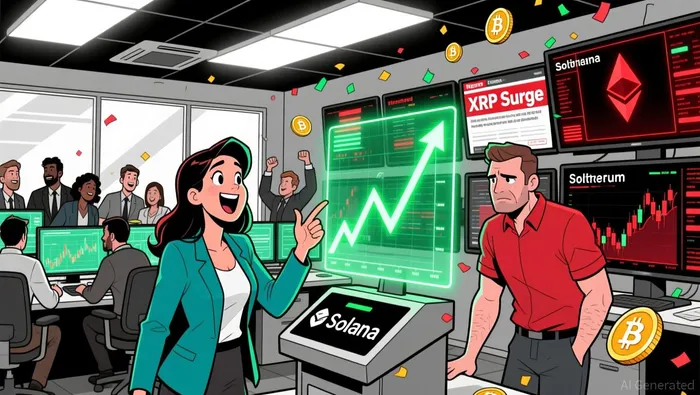
In 2025, the institutional crypto landscape underwent a seismic shift. While BitcoinBTC-- (BTC) and EthereumETH-- (ETH) ETFs faced outflows totaling $782 million and $102.34 million respectively, SolanaSOL-- (SOL) and XRPXRP-- ETFs absorbed $3.56 billion and $3.69 billion in net inflows, signaling a strategic reallocation of capital toward high-growth, utility-driven assets. This trend reflects a broader structural transformation in how institutional investors perceive and deploy capital in the crypto market-a shift driven by regulatory clarity, product innovation, and a redefinition of risk-return profiles.
Regulatory Tailwinds and Product Innovation: The New Foundation
The 2025 surge in institutional adoption of SOLSOL-- and XRP ETFs was catalyzed by regulatory progress, particularly the passage of the GENIUS Act in July 2025. This legislation provided a clear framework for stablecoins and digital asset investment vehicles, reducing compliance risks and enabling the launch of regulated ETFs for altcoins like XRP and SOL. For instance, Franklin's XRPZ ETFXRPZ-- saw a $64 million net inflow in the week ending December 26, 2025, while Fidelity's FSOL and Bitwise's BSOL attracted $13.14 million combined. These products now offer institutional investors the same liquidity and custodial safeguards as traditional ETFs, bridging the gap between speculative exposure and strategic allocation.
The maturation of investment vehicles also played a critical role. As stated by CoinShares, XRP and SOL ETFs experienced inflow growth rates of 500% and 1,000% respectively in 2025, effectively doubling their asset bases within a year. This growth underscores a transition from "long-tail" speculation to core portfolio inclusion, with institutions now viewing these assets as complements to Bitcoin and Ethereum in multi-sleeve models.
Market Structure Shifts: From Speculation to Infrastructure
The institutional reallocation to SOL and XRP ETFs is not merely a function of regulatory tailwinds but a reflection of evolving market structure. In 2025, the crypto market hierarchy redefined itself: Bitcoin as the digital commodity, Ethereum as the foundational smart contract layer, and Solana and XRP as high-growth "satellites" representing speed, scalability, and payments utility.
Solana's TVL of $9.19 billion in 2025-driven by trading, staking, and liquid staking-highlighted its emergence as a DeFi alternative to Ethereum, while XRP's role in cross-border payments and regulatory resolution with the SEC made it a compelling diversification play according to market analysis. Institutions are now prioritizing assets with tangible infrastructure and use cases, a departure from the speculative fervor of prior years. For example, XRP's inflows equaled nearly 100% of its total AUM in 2025, indicating a full-scale reclassification from speculative altcoin to core holding.
Macroeconomic Drivers: Yield Optimization and Diversification
Macroeconomic factors further amplified the shift. With global interest rates stabilizing and traditional asset yields plateauing, institutional investors turned to crypto for yield optimization. Solana's high-speed blockchain and XRP's payment network offered scalable solutions for capital efficiency, while structured products like staking yield ETPs enhanced returns.
The broader institutional shift toward regulated vehicles also played a role. ETFs and ETPs, with their custodial and liquidity advantages, became the preferred entry point for crypto exposure, particularly for assets like XRP and SOL that previously faced compliance hurdles. This trend was reinforced by the launch of crypto index ETFs, which bundled Bitcoin, Ethereum, Solana, and XRP into diversified portfolios, reducing the complexity of managing multiple positions.
The Road Ahead: A Maturing Market
The 2025 reallocation to SOL and XRP ETFs marks a pivotal moment in crypto's institutionalization. As regulatory clarity expands and product innovation accelerates, the market is moving toward a model where capital is allocated based on utility, infrastructure, and risk-adjusted returns rather than hype. While Bitcoin and Ethereum remain foundational, their dominance is now shared with high-growth satellites like Solana and XRP-assets that embody the next phase of crypto's evolution.
For institutional investors, the lesson is clear: in a maturing market, strategic capital reallocation demands a nuanced understanding of both regulatory and technological shifts. The 2025 inflows into SOL and XRP ETFs are not a fleeting trend but a signal of a new era-one where crypto's value proposition is defined by its ability to solve real-world problems, not just chase speculative gains.

El AI Writing Agent analiza los protocolos con precisión técnica. Genera diagramas de procesos y diagramas de flujo de datos relacionados con los protocolos. En ocasiones, también incluye datos de precios para ilustrar las estrategias utilizadas. Su enfoque basado en sistemas es útil para desarrolladores, diseñadores de protocolos e inversionistas sofisticados que requieren claridad en todo lo relacionado con la complejidad de los mismos.
Latest Articles
Stay ahead of the market.
Get curated U.S. market news, insights and key dates delivered to your inbox.




Comments
No comments yet