
How Institutional-Grade Stablecoin Yields Are Reshaping Digital Portfolios in a High-Interest-Rate Era


 Aime Summary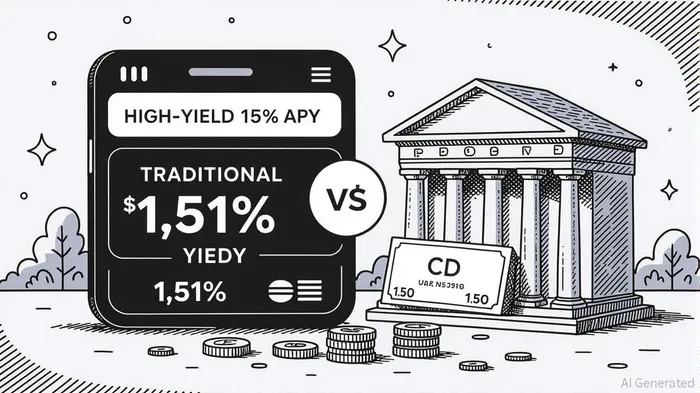
In 2025, the financial landscape is undergoing a seismic shift as institutional-grade stablecoin yields outpace traditional fixed-income assets. Coinbase's 4.35% APY on USDC—a USD-backed stablecoin—has become a cornerstone for investors navigating a high-interest-rate environment. This yield, generated through Coinbase's deployment of USDCUSDC-- reserves into high-quality liquid assets (HQLA) like U.S. Treasuries, reflects a broader trend: stablecoins are no longer just a bridge between crypto and fiat. They are now a competitive, institutional-grade asset class.
The Yield Gap: Stablecoins vs. Traditional Instruments
The disparity between stablecoin APYs and traditional yields is stark. As of August 2025, the best 6-month CD rates hover around 4.50%, while the 6-month Treasury yield stands at 4.31%. Meanwhile, Coinbase's USDC APY of 4.35%—available to eligible users—offers a compelling alternative. For context, traditional savings accounts languish below 1%, and corporate bonds, despite recent rate hikes, remain volatile and subject to credit risk.
This gap is not accidental. The U.S. GENIUS Act of 2025, which mandates 1:1 reserve backing for stablecoins and enforces monthly third-party audits, has transformed USDC into a trusted, liquid asset. Institutions now treat it as a cash-equivalent, with Q1 2025 USDC balances on CoinbaseCOIN-- surging 39% to $41.9 billion. The result? A yield environment where stablecoins outperform traditional instruments by 300–400 basis points, with lower volatility and regulatory clarity.
Institutional Adoption: From Skepticism to Strategic Allocation
The institutional embrace of USDC is accelerating. Goldman Sachs' Stablecoin Reserves Fund, holding $79.2 billion in collateral (80% USDC), exemplifies this shift. Similarly, JPMorgan's JPMD token and Paxos' USDG/USDP tokens operate within the GENIUS Act's framework, offering transparency and compliance. These developments signal a maturation of the stablecoin market, where USDC is no longer a speculative asset but a core component of institutional portfolios.
For investors, the implications are clear: USDC is now a viable substitute for cash in treasury management. Its integration into B2B transactions (e.g., Stripe's cost-effective USDC payments) and yield strategies (e.g., Ethena's USDe and Ondo's USDY) further cements its role. —a 750% surge—reflects this institutional confidence, as the company's market cap expanded to $65.2 billion.
Yield Stacking: Layering Returns in a High-Yield Ecosystem
The true power of USDC lies in its interoperability. While Coinbase's APY provides a baseline, investors can layer additional returns through decentralized finance (DeFi). For example, depositing USDC into AaveAAVE-- or Compound can generate 2–3% in interest, pushing total returns to ~7%. More advanced strategies, such as converting USDC into liquid-staked EthereumETH-- (stETH) via LIDO and leveraging it on platforms like Merkl, can yield up to 12.2% APY.
However, these strategies require careful risk assessment. DeFi protocols carry smart contract and liquidity risks, while centralized custodians like Coinbase are subject to regulatory shifts. The GENIUS Act's restrictions on direct yield mechanisms from stablecoin issuers (e.g., Circle) have shifted responsibility to third-party platforms, creating a nuanced compliance landscape. Investors must distinguish between centralized and decentralized yield sources, each with distinct risk profiles.
Strategic Allocation in a High-Interest-Rate World
For investors, the case for USDC-based yields is compelling. In a macroeconomic environment marked by yield starvation in traditional markets, stablecoins offer a unique combination of safety, liquidity, and returns. Here's how to approach allocation:
- Core Holdings: Allocate a portion of cash reserves to USDC on platforms like Coinbase to capture the 4.35% APY. This is ideal for risk-averse investors seeking stable, passive income.
- Yield Stacking: For those with higher risk tolerance, layer DeFi protocols on top of USDC balances. Monitor platforms like Aave and Compound for liquidity and rate stability.
- Institutional Vehicles: Consider stablecoin ETFs or funds (e.g., Ethereum-based ETFs with USDC exposure) for diversified, regulated access to the ecosystem.
- Hedging: Use USDC for cross-border transactions and corporate treasury operations, leveraging its efficiency and cost advantages over traditional wires.
Risks and Regulatory Tailwinds
While the outlook is bullish, risks persist. Regulatory changes could alter yield structures, and geopolitical shifts may impact the U.S. dollar's dominance. Additionally, the collapse of unregulated stablecoins in 2023 serves as a cautionary tale. However, the GENIUS Act's rigorous audit requirements and the dominance of Ethereum-based infrastructure (hosting 52% of stablecoin market cap) mitigate these risks.
Conclusion: A New Paradigm for Yield Generation
The rise of institutional-grade stablecoin yields marks a paradigm shift in asset allocation. In a high-interest-rate environment, USDC's 4.35% APY is not just competitive—it's transformative. By bridging the gap between traditional finance and digital assets, stablecoins are redefining how investors approach liquidity, safety, and returns. For those willing to navigate the evolving regulatory and technological landscape, the rewards are substantial.
As the crypto-asset ecosystem matures, one truth is clear: the future of yield generation is digital, and USDC is leading the charge.

Blending traditional trading wisdom with cutting-edge cryptocurrency insights.
Latest Articles
Stay ahead of the market.
Get curated U.S. market news, insights and key dates delivered to your inbox.
AInvest
PRO
AInvest
PRO



Comments
No comments yet