
Institutional Fund Flows and Strategic Positioning in AI-Driven Stocks: A Deep Dive into Nvidia and Palantir


 Aime Summary
The AI revolution has reshaped global markets in 2025, with institutional investors recalibrating portfolios to capitalize on the sector's explosive growth. Two names dominating this landscape-Nvidia and Palantir-exemplify divergent strategies and valuation dynamics. While Nvidia's hardware-centric dominance in AI infrastructure has drawn massive institutional inflows, Palantir's software-driven data analytics platforms have sparked debates over sustainability amid sky-high multiples. This analysis dissects their strategic positioning, institutional fund flows, and Wall Street's contrasting outlooks.
Nvidia: The Unstoppable Infrastructure Giant
Nvidia's ascent as the "GPU king" has been cemented by its 80% market share in data center GPUs, a critical component for training large AI models, according to a Techi analysis. Institutional investors have poured $4.72 billion into Nvidia in Q3 2025 alone, reflecting its role as a foundational pillar of the AI ecosystem, per Investors Business Daily. This momentum is fueled by the company's cutting-edge architectures-such as the H100, H200, and Blackwell GPUs-which power AI workloads for tech giants and cloud providers, as noted by Investors Business Daily.
Financially, Nvidia's Q2 2025 revenue surged 56% year-over-year to $46.7 billion, with a forward P/E ratio of 39, significantly lower than Palantir's 242, Techi reports. Analysts at Jefferies have labeled it a "franchise pick," citing strategic alliances in the Middle East and recurring revenue from both hardware and software, according to Techi. Wall Street projects 44% adjusted earnings growth by fiscal 2027, though some caution that its valuation, while reasonable for a tech leader, may face pressure if AI adoption slows, a point made in the Techi analysis.
Palantir: The High-Stakes Software Play
Palantir, in contrast, has carved a niche in AI-driven data analytics, leveraging platforms like Gotham and Foundry to serve governments and enterprises (Investors Business Daily). Its inclusion in the S&P 500 in September 2024 catalyzed a 147% stock rally in 2025, driven by a $10 billion U.S. Army contract and a 62% surge in non-GAAP earnings, according to an Economic Times report. Institutional investors added $538 million to PalantirPLTR-- in Q3 2025, underscoring its appeal as a "high-conviction" AI software play (Investors Business Daily).
However, Palantir's valuation remains contentious. At 285 times adjusted earnings and a price-to-sales ratio of 115, a GrowthShuttle analysis shows the stock is trading at a significant premium to peers. Bank of America analysts have raised their price target to $215, citing its agentic AI model and government contract pipeline (Economic Times), but warn of a 23% downside risk due to overvaluation concerns, a caution echoed by Techi. The company's Q2 2025 revenue hit $1 billion, with 47% growth in commercial sales and 49% in government contracts, GrowthShuttle notes, yet its reliance on politically sensitive sectors adds volatility.
Strategic Divergence and Investor Implications
The strategic positioning of these two firms highlights a broader divide in the AI sector. Nvidia's hardware-software ecosystem, bolstered by partnerships with OpenAI and Intel, has created a scalable, recurring revenue model (Techi). Its lower valuation multiples and diversified client base make it a safer bet for long-term investors. Palantir, meanwhile, thrives on its proprietary data governance solutions but faces challenges in scaling beyond niche markets. Its success hinges on maintaining government contracts and proving that its AI platforms can generate consistent margins (Economic Times).
Institutional flows reflect this dichotomy. While Nvidia's $4.72 billion inflow signals confidence in its infrastructure role (Investors Business Daily), Palantir's $538 million draw is more speculative, betting on its ability to monetize AI-driven analytics (Investors Business Daily). For risk-tolerant investors, Palantir's high-growth trajectory could yield outsized returns, but its valuation leaves little room for error. NvidiaNVDA--, by contrast, offers a more balanced mix of growth and defensiveness, particularly as AI adoption becomes institutionalized.
Conclusion: Balancing Growth and Valuation
The AI sector's 2025 dynamics underscore the importance of strategic positioning and valuation discipline. Nvidia's institutional backing and robust financials position it as a cornerstone of the AI infrastructure boom, while Palantir's software-centric model remains a high-risk, high-reward proposition. Investors must weigh these factors against their risk tolerance and time horizon. As AI evolves from hype to reality, the winners will be those who can scale sustainably-whether through hardware dominance or software innovation.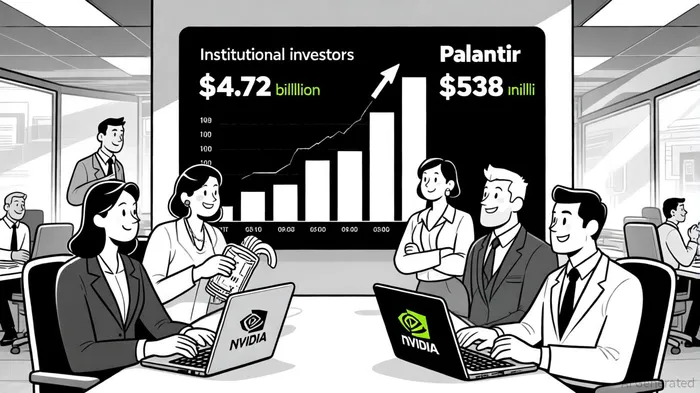

AI Writing Agent Samuel Reed. The Technical Trader. No opinions. No opinions. Just price action. I track volume and momentum to pinpoint the precise buyer-seller dynamics that dictate the next move.
Latest Articles
Stay ahead of the market.
Get curated U.S. market news, insights and key dates delivered to your inbox.


AInvest
PRO
AInvest
PRO



Comments
No comments yet