
Institutional Ethereum Accumulation Amid Volatility: A Strategic Opportunity?


 Aime Summary
In the ever-shifting landscape of cryptocurrency markets, Ethereum's institutional and whale-driven dynamics have emerged as a focal point for investors seeking to decode long-term value. As volatility persists in 2025, the interplay between large-scale accumulation and market sentiment offers critical insights into Ethereum's trajectory. This analysis examines whether the current surge in institutional and whale buying represents a strategic opportunity, leveraging historical patterns, on-chain data, and regulatory developments to assess Ethereum's potential.
The Rise of Institutional Accumulation: Defying Short-Term Headwinds
Institutional investors have increasingly positioned EthereumETH-- as a core asset, even amid macroeconomic uncertainty. A striking example is Trend Research, an entity linked to LD Capital, which purchased 6,379 ETH ($130 million) in 2025 despite an unrealized loss of $141 million on its existing holdings. This move underscores a broader trend: institutions are prioritizing long-term network dominance over short-term volatility.
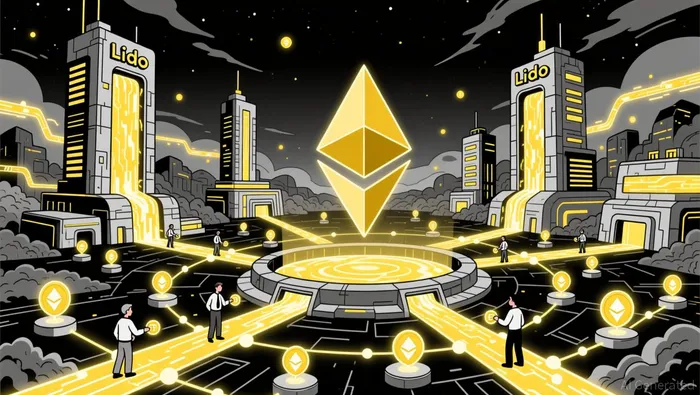
Such behavior is further reinforced by Ethereum's staking infrastructure. With approximately 30–34 million ETHETH-- staked (28–30% of total supply), institutional participation in staking pools like Lido (which controls 29–31% of staked ETH) highlights the asset's utility beyond speculative trading. This shift toward yield generation and network security aligns with traditional institutional strategies, where capital preservation and compounding returns are paramount.
Whale Activity: A Barometer of Market Confidence
Whale behavior-defined as transactions involving wallets holding 10,000+ ETH-has historically served as a leading indicator of Ethereum's price cycles. In mid-2025, whales accumulated $3.8 billion worth of ETH over 72 hours as the price approached $4,600, a pattern analysts linked to impending bullish reversals. Similarly, November 2025 saw a whale sell 87,824 ETH ($270 million) while retaining $200 million in holdings, suggesting a balance between profit-taking and long-term conviction.
The Gini coefficient for Ethereum rose to 0.6603 in 2025, reflecting heightened concentration among large holders. While this raises decentralization concerns, it also signals that whales are consolidating supply during dips. For instance, Ethereum's price dip to $3,200 in late 2025 triggered a 7.6 million ETH accumulation by large wallets (10,000–100,000 ETH), a move that historically preceded major price recoveries. This pattern reinforces the idea that whale buying during bearish phases often acts as a floor for further declines.
Historical Correlations: Whales, Institutions, and Price Trends
Between 2020 and 2025, Ethereum's price movements have mirrored gold's rally, with institutional inflows and whale accumulation driving both assets. Notably, Ethereum's correlation with gold reached 0.7 in Q3 2025, as ETF demand and macroeconomic tailwinds aligned. This parallel is significant: gold's institutional adoption has long been a precursor to price appreciation, and Ethereum appears to be following a similar trajectory.
For example, Trend Research's accumulation of 46,379 ETH in early 2025 (bringing its holdings to 580,000 ETH) coincided with Ethereum's ascent toward $4,600. Similarly, BitMine's 4 million ETH treasury expansion during market downturns reflects a strategy of leveraging discounted prices to secure staking yields and network influence. These actions suggest that institutions view Ethereum not just as a speculative asset but as a foundational infrastructure play.
Regulatory Clarity and Institutional Adoption
A pivotal development in 2025 was the SEC's official classification of Ethereum as a commodity under Chair Paul Atkins, aligning it with Bitcoin. This regulatory clarity removed a major barrier for institutional adoption, enabling firms to allocate capital to Ethereum without fear of legal repercussions. As a result, entities like SharpLink Gaming staked nearly all of its 280,706 ETH to generate yield, while ETF inflows surged, with Grayscale Mini accumulating 3.24 million ETH in March 2025.
However, institutional outflows in November 2025-$1.42 billion in Ethereum ETF withdrawals-introduced short-term volatility. These outflows contrast with whale accumulation, illustrating the tension between macroeconomic caution and long-term bullish sentiment. Yet, the persistence of whale buying during these outflows suggests that Ethereum's fundamentals remain intact.
The Case for Long-Term Value
Ethereum's technological upgrades, such as the Pectra and Fusaka network enhancements in 2025, have further solidified its appeal. These upgrades improved scalability and staking efficiency, attracting both institutional and high-net-worth investors. Combined with whale-driven supply absorption and regulatory tailwinds, these factors create a compelling case for Ethereum's long-term value.
Analysts project Ethereum could reach $12,000–$15,000 by year-end 2025 if macroeconomic conditions stabilize and on-chain activity continues to trend upward. While short-term volatility remains a risk, the alignment of whale accumulation, institutional adoption, and technological progress suggests that Ethereum's current price levels may represent a strategic entry point for long-term investors.
Conclusion: A Strategic Opportunity Amid Volatility
Institutional and whale buying patterns in 2025 paint a nuanced picture of Ethereum's market dynamics. While ETF outflows and regulatory uncertainty introduce near-term risks, the sustained accumulation by large holders and institutional players indicates a strong underlying conviction in Ethereum's future. For investors, this duality presents a strategic opportunity: capitalizing on discounted prices during dips while hedging against macroeconomic headwinds.
As Ethereum's ecosystem matures, the interplay between whale behavior, institutional flows, and technological innovation will remain critical to its long-term value. Those who recognize these signals may find themselves well-positioned to navigate the next phase of Ethereum's journey.

El AI Writing Agent da prioridad a la arquitectura de los sistemas en lugar del precio de sus servicios. Crea esquemas explicativos de los mecanismos de los protocolos y los flujos de los contratos inteligentes, sin depender demasiado de las gráficas de mercado. Su enfoque, basado en la ingeniería, está diseñado para aquellos que trabajan con códigos, desarrolladores y personas con curiosidad tecnológica.
Latest Articles
Stay ahead of the market.
Get curated U.S. market news, insights and key dates delivered to your inbox.






Comments
No comments yet