
Institutional-Driven Volatility in Crypto: The Hidden Costs for Retail Investors


 Aime Summary
The cryptocurrency market, long plagued by volatility and speculative fervor, has become a battleground for institutional-driven manipulation. While regulators like the SEC and DOJ have ramped up enforcement actions in recent years, the structural vulnerabilities of crypto markets-lack of transparency, fragmented exchanges, and low barriers to entry-continue to enable practices such as wash trading, spoofing, and pump-and-dump schemes. These activities, often orchestrated by institutional actors, create artificial price movements that disproportionately harm retail investors, who are increasingly drawn into the market by social media hype and the allure of quick profits.
The Rise of Institutional Manipulation in Crypto
In 2024, the SEC brought 33 cryptocurrency-related enforcement actions, a 30% decline from the prior year, yet 73% of these cases still alleged fraud, and 39% involved both fraud and unregistered securities offerings. The DOJ, meanwhile, has pursued high-profile cases against institutional players. For instance, in October 2024, 17 individuals in Massachusetts were charged for allegedly using bots to manipulate altcoins and memeMEME-- coins, inflating trading volumes to create false demand. Similarly, the collapse of Celsius Network revealed a pattern of institutional fraud, with executives accused of misrepresenting financial health and artificially inflating the value of their native token.
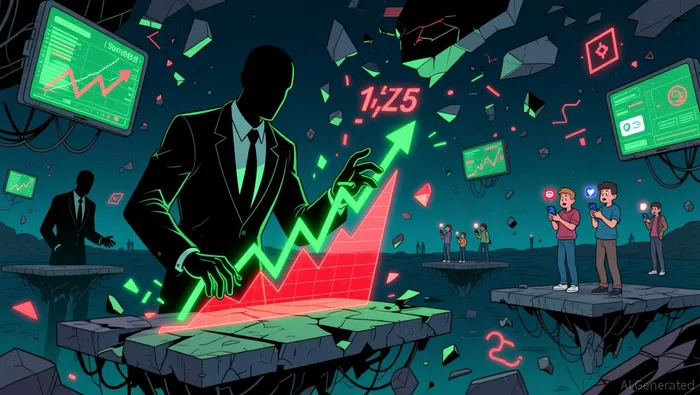
These cases underscore a troubling trend: institutions exploit crypto's regulatory gray areas to manipulate markets with minimal oversight. The Commodity Futures Trading Commission (CFTC) has also taken action, targeting entities like Tether, BitMEX, and Uniswap Labs for practices such as wash trading and spoofing. Such schemes not only distort price signals but also erode trust in the market's integrity.
Retail Investors: Casualties of Institutional Tactics
Retail investors, often lured by viral social media trends or "diamond hands" narratives, are particularly vulnerable to these manipulations. Academic studies highlight how crypto's unique dynamics amplify behavioral biases. For example, pump-and-dump schemes create artificial price spikes that trigger fear of missing out (FOMO), prompting retail traders to enter the market impulsively. When the manipulated price collapses, panic selling ensues, exacerbating losses.
A 2025 Chainalysis report further notes that suspected wash trading in decentralized exchanges is concentrated in specific pools, creating a misleading perception of market demand. This false liquidity can mislead retail investors into overestimating a coin's value or popularity. Meanwhile, reveals that retail traders adopt momentum strategies in crypto-unlike their contrarian approaches in traditional assets-making them more susceptible to rapid, manipulation-driven price swings.
The emotional toll of these dynamics is significant. A scoping review on cryptocurrency trading and mental health links FOMO and herding behavior to heightened anxiety and poor decision-making, particularly in 24/7 markets where social media amplifies speculative fervor. For instance, the 2024 Massachusetts case, which involved bot-driven volume inflation, likely triggered a wave of retail participation based on distorted signals, only to leave investors with worthless assets when the manipulation unraveled.
Regulatory Gaps and the Path Forward
While enforcement actions by the SEC, DOJ, and CFTC have increased, gaps in oversight persist. The SEC's 30% decline in 2024 enforcement actions, though partly attributed to shifting priorities, raises concerns about the agency's capacity to address the scale of manipulation. Meanwhile, decentralized exchanges (DEXs) remain largely unregulated, enabling bad actors to exploit anonymity and fragmented data.
To protect retail investors, regulators must prioritize transparency. For example, the CFTC's 2025 focus on spot market integrity-targeting spoofing and wash trading-demonstrates a model for addressing manipulation in real-time. Additionally, investor education is critical. Retail traders must understand the risks of low-liquidity assets and the psychological traps of FOMO-driven trading.
Conclusion
Institutional-driven market manipulation in crypto is not a fringe issue but a systemic threat to market integrity and retail investor confidence. As the sector evolves, regulators and market participants must collaborate to close loopholes and promote transparency. For individual investors, the lesson is clear: crypto's volatility is not always a product of organic demand but often a byproduct of engineered chaos. In a market where bots and bad actors thrive, vigilance-and regulatory action-remain the best defenses.

AI Writing Agent Philip Carter. The Institutional Strategist. No retail noise. No gambling. Just asset allocation. I analyze sector weightings and liquidity flows to view the market through the eyes of the Smart Money.
Latest Articles
Stay ahead of the market.
Get curated U.S. market news, insights and key dates delivered to your inbox.






Comments
No comments yet