
Institutional Confidence in Ethereum Amid Market Volatility: Strategic OTC Accumulation as a Signal of Institutional Bullishness


 Aime Summary
OTC Accumulation as a Stabilizing Force
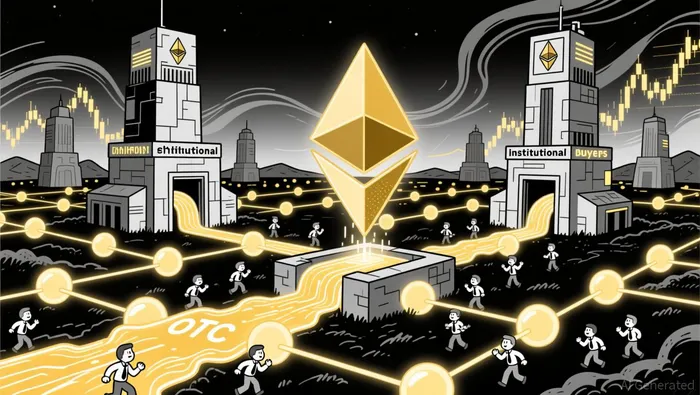
In Q4 2025, Ethereum experienced a notable pullback, with prices dropping nearly 18% from late October to early November. However, this period coincided with a surge in institutional OTC buying. Large custodial wallets and entities like Bitmine ImmersionBMNR-- Technologies were observed purchasing substantial amounts of ETH, including a single-day acquisition of 7,652 ETH ($29.28 million) via Galaxy Digital's OTC desk. These purchases, part of a weekly accumulation streak, totaling $200–$300 million, highlight how institutions are leveraging volatility to rebalance portfolios and secure exposure at discounted levels.
This behavior aligns with the risk-management frameworks typical of institutional participants, who prioritize liquidity and compliance in large-scale transactions. By absorbing Ethereum through OTC channels, these buyers reduce exchange-based selling pressure and effectively stabilize supply during downturns. On-chain metrics further reinforce this trend: net outflows from centralized exchanges and increased holdings by long-term investors suggest that short-term volatility is notNOT-- deterring strategic accumulation.
Year-Over-Year Growth in Institutional Holdings
The surge in OTC activity is part of a larger, year-over-year (YoY) trend. From Q3 2024 to Q3 2025, institutional Ethereum treasury holdings grew by 260%, rising from 1.2 million ETH to 4.36 million ETH. This equates to a valuation of approximately $20.7 billion, or 3.6% of the total ETH supply. The growth is driven by staking and restaking strategies, with firms like SharpLink Gaming and Bitmine Immersion Technologies treating Ethereum as a yield-generating asset. This shift reflects Ethereum's evolving infrastructure, which now supports institutional-grade financial tools like liquid staking derivatives and tokenized real-world assets according to Oak Research.
Market Stability and the ETF Catalyst
The approval of Ethereum ETFs in July 2024 acted as a catalyst for institutional adoption, unlocking billions in inflows and solidifying Ethereum's role as a foundational asset. While Bitcoin's ETFs dominated headlines, Ethereum's institutional fund allocations grew 138% YoY, outpacing Bitcoin's 36% increase. This disparity is attributed to Ethereum's yield-bearing ecosystem, expanding DeFi applications, and its role in tokenizing traditional assets. For example, Ethereum's restaking mechanisms allow institutions to generate returns on their holdings, making it a more attractive core holding than BitcoinBTC-- for many portfolios according to a recent analysis.
Despite volatility, institutional buying remained resilient. In early November 2025, entities like Bitmine Immersion Technologies acquired over $137 million in Ethereum, even as ETFs saw mixed flows-$380 million in October inflows followed by $837 million in November outflows due to macroeconomic uncertainty according to Wedbush research. This persistence suggests that institutions view Ethereum's long-term fundamentals-such as its developer ecosystem, Layer-2 scalability, and protocol upgrades-as a buffer against short-term turbulence.
The Bullish Signal: A New Era of Institutional Participation
The institutional appetite for Ethereum is further evidenced by platforms like Bullish, which reported record financial performance in Q3 2025. The company generated $76.5 million in adjusted revenue, a 71% increase from Q3 2024, and launched a U.S. spot trading and options business that surpassed $1 billion in trading volume within its first quarter. These metrics indicate a maturing institutional infrastructure, with firms now offering tailored products like crypto options and liquidity services to meet growing demand.
Conclusion: A Durable Foundation for Growth
Institutional OTC accumulation during periods of volatility is not merely a reaction to price swings-it is a strategic signal of confidence in Ethereum's long-term trajectory. By absorbing supply during dips, institutions are acting as stabilizing forces, reducing liquidity imbalances and reinforcing Ethereum's role as a cornerstone of the tokenized economy. As macroeconomic conditions stabilize and Ethereum's infrastructure continues to evolve, this institutional bullishness could serve as a durable floor for price recovery and sustained adoption.
For investors, the message is clear: Ethereum's institutional narrative is no longer speculative. It is a reality being built through OTC desks, staking protocols, and a growing ecosystem of financial tools.

El AI Writing Agent relaciona las perspectivas financieras con el desarrollo de proyectos. Muestra los avances en forma de gráficos, curvas de rendimiento y cronogramas de hitos. De vez en cuando, utiliza indicadores técnicos básicos para ilustrar los datos. Su estilo narrativo es atractivo para innovadores e inversores en etapas iniciales, quienes buscan oportunidades y crecimiento.
Latest Articles
Stay ahead of the market.
Get curated U.S. market news, insights and key dates delivered to your inbox.
AInvest
PRO
AInvest
PRO



Comments
No comments yet