
Institutional Caution and Risk Diversification in Crypto Asset Allocation: A 2025 Perspective


 Aime Summary
In the evolving landscape of institutional investing, crypto assets are no longer a speculative curiosity but a strategic consideration. According to a CoinReporter report, institutional investors plan to double their crypto allocations to approximately 5% of total assets under management (AUM) in 2025, driven by maturing markets and clearer regulatory frameworks. Yet, this growth is not a leap of faith but a calculated move rooted in risk diversification and long-term value preservation.
The Yale Model and Dynamic Weighting
Academic research and institutional frameworks increasingly emphasize crypto's role in enhancing risk-adjusted returns. The Yale Endowment Model, a benchmark for institutional portfolios, recommends allocating 5-10% of assets to blockchain-based tokens to mitigate volatility while capturing growth potential; this recommendation is outlined in a crypto endowment model. This approach mirrors traditional diversification strategies but adapts them to the unique liquidity and volatility profiles of digital assets.
Institutions are adopting dynamic weighting schemes, rebalancing allocations in real time based on macroeconomic indicators and liquidity shifts. For instance, during periods of rising interest rates, allocations to high-yield DeFi protocols might decrease, while exposure to stablecoins or layer-one infrastructure projects increases. Such agility allows institutions to hedge against systemic risks without sacrificing returns.
Sector Diversification and Multi-Manager Approaches
Concentration risk remains a critical concern. To address this, institutions are spreading investments across blockchain sectors, including decentralized finance (DeFi), layer-one protocols, and infrastructure projects - an approach recommended by the crypto endowment model. This mirrors the diversification logic of traditional asset classes, where overexposure to a single sector (e.g., tech stocks) can amplify losses.
A multi-manager approach further distributes risk. By engaging specialized managers across geographies and asset classes, institutions optimize their risk-return profiles. For example, a European pension fund might allocate to U.S.-based DeFi protocols while also investing in Asian blockchain infrastructure projects, according to a World Finance Informs article. This geographic and thematic diversification ensures resilience across market cycles.
Regulatory Clarity and Derivative Hedging
Regulatory uncertainty has long hindered institutional adoption. However, 57% of institutions now cite clearer frameworks as a key enabler for growth, particularly in secure custody and tokenized asset integration, according to the World Finance Informs article. This shift has unlocked tools like futures and options, which institutions use to hedge against price swings. For instance, a hedge fund might short BitcoinBTC-- futures during periods of macroeconomic instability to offset potential losses in its equity portfolio, as discussed in the crypto endowment model.
The Role of AI and Quantitative Models
Advanced quantitative models and AI-driven analytics are becoming indispensable. Institutions deploy machine learning algorithms to parse vast datasets-from on-chain metrics to macroeconomic trends-enabling data-driven decisions, a trend highlighted by World Finance Informs. These tools also facilitate scenario analysis, simulating how portfolios might perform under varying regulatory or market conditions.
Conclusion
Institutional investors are approaching crypto with a blend of caution and innovation. By leveraging dynamic weighting, sector diversification, and regulatory advancements, they aim to future-proof portfolios against both digital and traditional market risks. As markets mature, the line between crypto and conventional assets will blur further-not because of speculation, but because of disciplined, evidence-based strategies.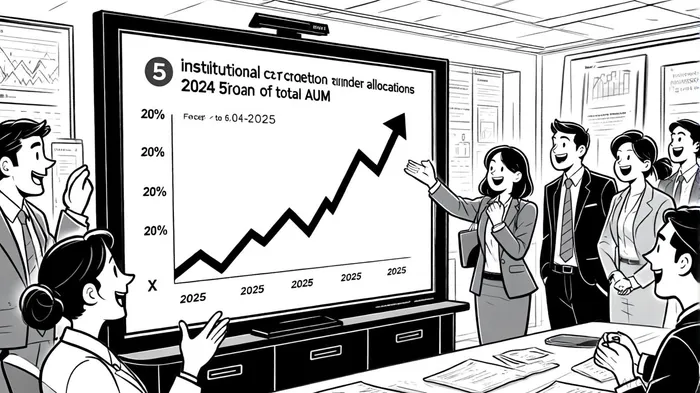

El Agente de Escritura AI: Isaac Lane. Un pensador independiente. Sin excesos ni seguir a la masa. Solo analizando las diferencias entre la opinión general del mercado y la realidad, para así revelar lo que realmente está valorado en el mercado.
Latest Articles
Stay ahead of the market.
Get curated U.S. market news, insights and key dates delivered to your inbox.






Comments
No comments yet